The Disappearance of Nagato Yuki-chan, Vol. 3

By Nagaru Tanigawa and Puyo. Released in Japan as “Nagato Yuki-chan no Shoushitsu” by Kadokawa Shoten, serialization ongoing in the magazine Young Ace. Released in North America by Yen Press.

A Quick Guide to writing manga AUs for the otaku fan, by Sean Gaffney.

I’m assisted today by Puyo, author of the Disappearance of Nagato Yuki-chan, a spinoff of the Disappearance movie filtered through the sensibilities of Puyo’s Haruhi-chan gag manga. With that in mind, let’s examine a volume of this series closely, keeping an eye out for handy tips.

yuki-chan3

The first thing to learn is that you have to know your audience. In this case, the audience are fans of the Haruhi franchise who read Kadokawa Shoten’s Young Ace magazine. They’re a built-in fanbase, and know the source material inside and out. This has its uses. You don’t have to delve so hard into character introductions, as everyone reading it knows who you’re writing about. And it means that your character interaction can be subtler. Take a look at page 27, which features Mikuru. Her dialogue, “I’m not very assertive, though, so I appreciate it when people can push me into doing things” is a redemptive reading for the original series’ Haruhi. This Mikuru is free to admit that she’s not simply being bullied and assaulted by a girl she can’t say no to, but is grateful for the assertiveness training.

In fact, this is another of the main bonuses to franchises like these, especially ones based on a light novel with a first-person narrator. Due to the viewpoint, the reader’s observations and biases are linked with the main character, as you rarely see scenes outside his purview. Even a straight manga adaptation, such as Haruhi’s, is forced by its source material into this narrow path. But in Nagato Yuki, the viewpoint is third person, which means we have the opportunity to see people in perspectives other than Kyon’s. This is particularly helpful in regards to Haruhi and Ryoko (or, as I like to call them, OTP), Both these characters change when they’re around each other. Ryoko, normally forced to be the perfect oneesama around Kyon and Yuki, lets out her childish immaturity near Haruhi. Likewise, the genki Haruhi is forced into the straight man role around Ryoko, and shows a genuine concern for her. Both characters benefit immensely from this.

The key in writing these sorts of AUs is to deviate from canon an acceptable amount, but not too much. In this case, the material is benefited by the movie itself, which gave us the shy, emotional Nagato used for this adaptation. Certain other AU adaptations, which I won’t name but rhyme with Bevamgelion, have taken their characters and made them 100% different from the original in almost every way, leading the reader to wonder why they simply didn’t create a new character? (The answer, as I’m sure you all know by now, is MONEY. Use your franchise well and use it wisely.) Nagato Yuki here is considerably different from the canon, to be sure, but the movie helped build a bridge, and there are enough signs of the original (Yuki’s explanations being incomprehensible, her reaching out for the stars) that it works.

Even Kyon, who has been poorly developed so far, gets a bit to do here, as his conversation with Ryoko shows that he seems more aware of Yuki’s affection than his canon counterpart, and is simply taking things slow. (As for Koizumi, well, he gets nothing. The others even acknowledge in the story how useless he is. We’ll be discussing this next month when we talk about the Kyon and Koizumi collection.)

In terms of things NOT to do – get back here, Puyo, and take your medicine – the artist’s art still needs work. His shading is too simplistic, especially in regards to hair. This means when you have Haruhi, Tsuruya, and Ryoko all standing near each other, they can be difficult to distinguish. I shouldn’t have to identify a person only by their hairband or eyebrows. There’s also quite a bit of fanservice here, but the artist wisely put it all in one eight-page chapter, along with the interstitials. And really, compared to some other Kadokawa titles I’ve seen, this is pretty tame. The readers of this book are the “D’aaaaawww, look at them being adorable!” crowd, they don’t need lots of nipples.

I apologize to the class for the cliffhanger ending, but Puyo assures us there’s a good reason for it, and reassures us that Yuki is not in fact killed by a car. That would make the rest of the series quite short. In the meantime, your homework is to compare and contrast this franchise to Evangelion – whoops, sorry, Bevamgelion – and Alice in the Country of Hearts, paying particular attention to which audience subset each separate spinoff title aims for. We’ll see you back here in May, and we’ll have a lot more to talk about with Yuki then. Dismissed!

The Disappearance of Nagato Yuki-Chan, Vol. 2

By Nagaru Tanigawa and Puyo. Released in Japan as “Nagato Yuki-chan no Shoushitsu” by Kadokawa Shoten, serialization ongoing in the magazine Young Ace. Released in North America by Yen Press.

In an earlier post regarding this book’s imminent debut, it was noted that the series is essentially a fanfic AU written by someone who wants to get Kyon and Yuki together, just like you see with the infinite Harry/Hermione or Zuko/Katara fanfics on FFNet. And there’s honestly no denying it; that is exactly what this is. It’s light and fluffy fun, but it is essentially Haruhi with all the spiky bits filed off it. Everyone’s more agreeable, everyone’s more adaptable, and everyone’s simply happier. Including Yuki Sue… um, Yuki Nagato.

Now, this isn’t saying that this manga is horrible. I like it a lot. It’s simply saying that this manga is not particularly gripping or filled with tension. In essence, it’s not really a spinoff of the Haruhi series itself as it is a spinoff of the SD-manga spinoff Haruhi-chan. Various ideas from that series (Ryoko as an onee-sama type, though a comedic one; Nagato’s gaming habits; Haruhi going after Santa) are used in this AU, mostly to show off the author’s own preferences. But whereas in Haruhi-chan everything ends up being a setup for a punchline, here everything is a setup for an adorable heartwarming moment. Even the dramatic moments.

This volume sees the introduction of Haruhi herself (as well as Koizumi, who is essentially a non-entity in this series). She’s not totally unrecognizable. She’s still trying to befriend aliens, time-travelers and espers, and will scream this out to anyone who asks. She’s still bulldozing through people to get her own way, and quickly takes up residence at the literature club even if she goes to a different school. and she’s not above using Kyon as her personal punching bag when a punching bag is needed. But she’s more mature than the Haruhi of the original series, and it’s striking that, even though we see her starting to fall for Kyon here, she’s not going to get all that jealous about it. Haruhi doesn’t have the power to change the world with a bad mood here, and it seems to have made her a better person.

As for Yuki and Kyon, they continue to grow closer, much to Ryoko’s encouragement and chagrin. Valentine’s Day is in this volume, and of course there is chocolate to be made. This leads to what’s probably the best sequence of the book, where we’re led to believe that we will see a cliched misunderstanding lead to heartbreak. It’s not entirely out of the question – this manga isn’t all that original. But this Yuki is more of a ditz than a doormat, and the misunderstanding turns out to have been… well, a misunderstanding. And Haruhi, who’s no dummy and can clearly see that Yuki is head over heels for Kyon, challenges her to step up and go after him. In a genre where high school girls are so often cruel and heartless, it’s fantastic to see love rivals be open and honest.

The flaws I mentioned in Volume 1 are still here. The art simply isn’t all that great, though it’s getting better. And Kyon needs more snark desperately. But of course no one is particularly reading this book for Kyon, but for the moe cuteness. And in that respect, few things deliver on that promise like Nagato Yuki-chan. That said, I’m not sure the series can coast on cute fluffiness forever. I hope that the author comes up with a more serious arc by, say, Volume 4. (Foreshadowing: your key to quality literature.)

(Also, is it wrong of me to ship Haruhi/Ryoko? Cause I totally am.)

The Disappearance of Nagato Yuki-chan, Vol. 1

By Nagaru Tanigawa and Puyo. Released in Japan as “Nagato Yuki-chan no Shoushitsu” by Kadokawa Shoten, serialization ongoing in the magazine Young Ace. Released in North America by Yen Press.

It is noted in the ads at the back of this volume shamelessly plugging the rest of the Haruhi franchise that in order to get maximum enjoyment from this work, you need to have read the original books, particularly the 4th novel, Disappearance (which was made into the Haruhi movie). I think this is quite accurate. Without the context of Haruhi, this seems a lot fluffier and pointless than it really is. Not that it isn’t already light as air – this is not a manga for those who seek the sci-fi adventures the original sometimes gives us. But knowing the original series as we do helps us to see what the artist is trying to achieve here by, in effect, changing Kyon’s decision in the 4th book. What if he’d stayed, and his memories were also rewritten? How would that universe have kept going?

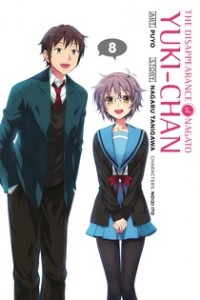
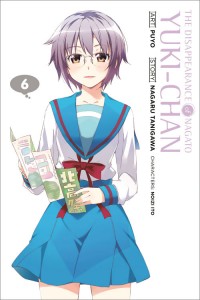
As you might guess by the cover, the focus here is on Yuki, who is back to being the meek and shy but far more human Yuki we saw in that novel. Luckily, she’s not a complete wallflower. One sensible thing this manga does is start ‘in media res’, as it were, showing us several chapters of Yuki, Kyon and the other interacting before going back at the end and giving us a flashback as to how they met. This allows us to see a Yuki more comfortable with Kyon (although she’s still awkward around him) and even lets her have the occasional snarky line, although that’s mostly directed at Ryouko, who fires right back.

Ah yes, Ryouko. Fans have a tendency to influence other people’s creations, as many writers will tell you. Especially when this is a spinoff once-removed sort of series. The artist, Puyo, is also writing the Haruhi-chan gag mangas for Shonen Ace, which feature his own conceit of Ryouko coming back as an adorable plushie-like creature and basically losing every trace of evil in her. Likewise, fandom in Japan read the first Haruhi books (and Disappearance) and theorized that Yuki and Ryouko would be eating meals together and such before Haruhi showed up and Ryouko went insane. Combining the two, here we see Ryouko as a pure onee-san figure. She has a quick temper, and gets easily frustrated, especially by Yuki’s indecision, but this is a Ryouko who is not going to be stabbing Kyon anytime soon – a genuinely good-hearted character who really is Yuki’s best friend. It’s quite sweet.

There are a few flaws here, of course. As with Haruhi-chan, Puyo’s art can be highly variable, especially when he draws faces. Unlike Haruhi-chan, he isn’t allowed the luxury of going super-deformed all the time. So sometimes we see some very awkward poses and art. In addition, our hero Kyon, deprived of Haruhi’s antics giving him a cynical and sarcastic inner monologue, comes off as being a bit dull, the standard romantic lead for the shy girl who wins her heart by… well, by actually interacting with her. His sharpest moments are actually with Ryouko, who is trying to nudge the two leads together, much to Kyon’s clueless bafflement.

Even with the universe having been rewritten, and Kyon and Haruhi not meeting each other, she’s still not very far away. This time around, an older Haruhi gets Yuki to draw figures on the ground – this time sending out a message for Santa. It’s another example of what this series is trying to do. It’s taking the characters of the Haruhi franchise (including Haruhi, who will get more to do in the next volume) and putting them in situations that make you go ‘Awwwww’ and smile. If you enjoy the sharp, caustic comedy of the original franchise, it would be best to stick to that. As an AU alternative, though, this is simply cute as a button.