Excel Saga Volume 2

By Rikdo Koshi. Released in Japan by Shonen Gahosha, serialization ongoing in the magazine Young King OURS. Released in North America by Viz.

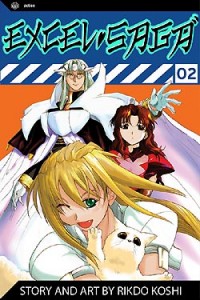
Volume 2 of Excel Saga starts to spin a bit more of its actual plot, though things are still in the beginning stages. (By the way, Viz and Rikdo Koshi have done original cover art for the first 4 volumes of the manga, ostensibly to help them sell. When presumably they didn’t sell, Viz reverted to simply using the original Japanese covers, starting with Volume 5.)
es2

The good news is we meet two more of our main cast in this volume. Dr. Kabapu makes an immediate impression. He looks odd, and he is odd. But he’s also immediately shown to be morally bankrupt, and willing to be an utter jerk for his own ends. If you ask me, he’s more of a villain throughout the series than Il Palazzo is, even though he is ostensibly ‘protecting the city’. (Of course, once Miwa Rengaya shows up, you get the feeling she’ll soon overtake both of them).

And then there’s Misaki Matsuya, who plays the resident ‘sensible’ woman throughout the manga. Rikdo Koshi is not generally above letting anyone, at any time, play the boke or tsukkomi as events warrant, and indeed the liner notes for Volume 2 note that Excel and Hyatt alternate boke and tsukkomi depending on the situation. Likewise, while Watanabe (at first) and Sumiyoshi CAN be sensible and level-headed, it’s Misaki who carries the brunt of whacking idiots and pointing out stupid things. In a manga with as many weirdos and idiots as this one, it’s welcome.

A couple of other things to note about her introduction: we see her briefly with a cute keychain plushie. Misaki’s addiction to cute plushies, besides being a nice break in her otherwise ‘perfect independent and strong woman’ persona, will continue in future volumes. It’s generally a way for Rikdo to make references to other series that are running alongside Excel Saga in Young King OURS. The other thing is that it’s revealed that she and Iwata were classmates in college. He’s far too informal with her, and she beats him constantly for calling her Misaki, with no honorific. Stay tuned for a lot more on these two…

Meanwhile, our heroines are doing what they do best. Working odd jobs, hailing Il Palazzo, making pathetic attempts to take over the city for the glory of ACROSS, and occasionally sniping at each other. That last is somewhat of a surprise, and won’t last; in a volume or two, Hyatt and Excel will have warmed up to each other, and Hyatt will end up being utterly deferential. (Excel’s true sniping partner will arrive in Volume 8.) Amusing gags here include Hyatt’s inability to not steal medicine, couples with Excel’s inability to resist the word ‘conquer’; yet another insane appearance by the Black Jack-esque doctor and his nurse; and Hyatt’s mysterious ability to avoid setting off any mines while walking through a minefield.

This leads us to the two major plot points that will become important over the whole series. The first is Excel’s superhuman endurance and abilities. At first, you think that it might be merely manga exaggeration – this is a comedy, after all. But gradually, as Excel gets blown into the air by mines, drowned in the middle of oceans, and forced to lift unconscious robots, that she’s simply more than a mere insane human.

The other thing that is introduced here is Il Palazzo suffering from what appears to be multiple personalities. There’s voices talking to him in his head yelling at him about enemies, and he sends Excel and Hyatt on missions and then seems to be completely ignorant of what he’s done. This too will be important later on, and was in fact also used in the anime version (though it was taken in a different direction). This is probably a good thing, as Il Palazzo on his own tends to be fairly drab, spouting rhetoric and pulling ropes on trapdoors. An air of mystery adds to his character.

And of course there are endnotes by Carl Horn. I know fans who buy manga sight unseen just for Carl’s notes.

This is a fun, funny manga, with weird wacky situations, and you get the sense that a big confrontation is set up. To be continued!

License Request: Tokyo Crazy Paradise

So, you’ve been reading the Shojo Beat line. In particular, you’re a fan of Skip Beat! You like the characterization, the strong female leads, and the dramatic posing. You want more! Has this author done any other shojo?

Why yes, yes, she has! In fact, if you turn over your Skip Beat volume to the back, Viz will tell you! Skip Beat is from the author of Tokyo Crazy Paradise! Fantastic, you think! When did Viz release that one? Well, ahem, they haven’t. Tokyo Crazy Paradise remains unlicensed.

Is it too long? Not really. At 19 volumes, it’s shorter than Skip Beat. Does it have a naive and romantically dense yet strong and spunky heroine? Why yes, yes, it does. Does it feature lots of hot bishonen guys, including a brooding male lead who teases the heroine out of love and is too serious for its own good? Yep, it’s got that too. Does it have chain whip fights? Oh, you bet it does! Sometimes the heroine gets spattered in gore! All this and the usual humor and drama mix we’ve come to exp—

…wait, back up a second. Chain whip fights?

OK, perhaps I should explain what Tokyo Crazy Paradise is about.

Yoshiki Nakamura had been writing for Hakusensha since 1993, and just had a small 7-volume success with MVP Wa Yuzurenai! In 1996, she started this new manga, but the tone was decidedly darker – at least the background was. This was not unusual for mid-1990s Hana to Yume, which still featured Descendants of Darkness and was a lot less fluffy than it is today (though it still had its share of fluff).

The series takes place in a dystopian Tokyo in the year 2020. Despite advances in technology, the main problem is that men greatly outnumber women. This means that most women who venture outside end up getting sexually assaulted – in fact, that’s how the series begins, with Tsukasa, son of a cop family, rescuing a woman from some rapists. Notably, everyone else on the street had been blithely ignoring the scene.

Unfortunately, Tsukasa’s parents were just killed, leaving he and his three brothers homeless. Desperate, they turn to his school classmate Ryuji… who also just lost his father, and is now the head of one of the largest yakuza families in the city. Needless to say, he does not take kindly to favors from the offspring of the police. Eventually, however, they work to catch the killer, and Tsukasa ends up as Ryuji’s bodyguard.

This is probably a good thing, as Ryuji is one of the very few to know Tsukasa’s secret: he’s actually a she, having dressed as a boy her whole life in order to avoid being assaulted in this Crazy Paradise. (For those worried about spoilers, we find this out on Page 20 of Chapter 1, so…)

The story then moves in the usual shojo pattern: guy likes girl and is jerkish to her to show it, girl gets angry with guy and completely misses that he’s fallen for her, rival for guy shows up, rival for girl shows up, etc. Balanced against this is the far more serious plot of rival yakuza gangs fighting for power, and how various pasts end up being connected. Tsukasa, being Ryuji’s bodyguard, also gets most of the big fight scenes in this manga as well. She is no delicate flower. And being the daughter of cops, she is not very fond of yakuza either.

There are a few drawbacks to licensing this, of course. At 19 volumes, it’s still long (for shoujo). It’s much darker than Skip Beat (major, likeable characters die), and thus hard to sell to teen girls with a ‘from the creator of!’ blurb, as Viz does the reverse for now. On the other hand, Viz has been known to release dark and violent shoujo (Descendants of Darkness, also from Hana to Yume – see above), so this isn’t too alien to them. And the overall tone is a dark background and plot interspersed with fun comedy and romance. Lastly, it’s also completely scanlated online, which is a big drawback these days. (On the bright side, the scans of the latter chapters can be utterly crappy – fans would appreciate a decent volume.)

But overall, come on. It’s a fighting young crossdressing girl being bodyguard for a brooding blond hunk. From the author of Skip Beat. This is marketable.

One Piece Volume 32

By Eiichiro Oda. Released in Japan by Shueisha, serialization ongoing in the magazine Weekly Shonen Jump. Released in North America by Viz.

And so we wrap up Skypeia, with the final battle between Luffy and Eneru. Luffy wins, of course, using the huge lump of gold Eneru fastened on his right fist against him, and finally ringing the Golden Bell that had been waiting centuries to be heard. One of Oda’s better montages has everyone’s reaction to hearing the bell, ending with Luffy and Nami peacefully relaxing on a cloud after all the furor.

So in the end, Eneru is defeated! And so he’s captured and imp… no, wait, he’s not. So he’s killed? Nope. No death here. His dreams are crushed, then? Well, to a degree, but really, Eneru’s Skypeia story ends with him relaunching his ark and headed to Endless Varse… which turns out to be the Moon! Wow, what an awesome dream! In Japan, Eneru is consistently the most popular main villain in character polls, and Oda must love him too, as he really gets very little retribution for all of this.

So everyone lives happily ever after. Even Conis’s dad turned out to be Not So Dead. And there’s a giant party, which is drawn in loving detail. One Piece may have angst and shonen fights, but it’s also well known for people just having fun, and the joy expressed in this art is simply magical.

We also get a notable first (and so far, only) here: Luffy & co. actually stealing treasure for themselves! My god, you’d think they were pirates or something! Admittedly, the Skypeians turned out to be perfectly happy with them taking it, and in fact were prepared to give even more, but hey.

And there’s a nice mention of Robin’s plot here, as she finds another poneglyph that turns out to be the secret location of a Weapon of Mass Destruction (not what she’s after), but also has a scribbled note from Gold Roger on the side of the stone, noting that he is ‘guiding the document to its end’. Of course, this gives Robin an additional reason to travel with Luffy and friends to the end of the Grand Line, beyond simply “Because I’m mysterious like that.”

And so they leave Skypeia and head back down to actual sea, courtesy an Octopus Drop that must rival most amusement park rides. They have little time to relax, though, as they run into a pirate ship with the crew lying around and listless. They soon find out why: all the important crew members, including the captain, were taken by Foxy the Silver Fox in a Davy Back Fight!

…all right, I will admit, it’s hard to get all happy and bouncy about the Davy Back Fight arc. Foxy is clearly meant to be a minor comedic change of pace villain after the volumes of Eneru. Still, on we go to Volume 33. As always, recommended.