Negima! Magister Negi Magi Volume 25

By Ken Akamatsu. Released in Japan as “Mahou Sensei Negima!” by Kodansha, serialization ongoing in the magazine Weekly Shonen Magazine. Released in North America by Del Rey.

This was a pretty great volume of Negima for those who like shonen manga. There’s a huge fight that takes up 2/3 of the volume, with lots of attacks and counterattacks and evil psycho lesbians and things going boom. We also start to finally get some background on Negi’s father, courtesy Jack Rakan, and meet a new character, Princess Arika.

Generally I find it hard to describe fights, so I’ll just note that all of our heroes and heroines get a brief chance to show off their skills – and Nodoka really looks impressive, showing how far she’s come since getting to this world and how much she learned from her “treasure hunting” friends. While still remaining, of course, Shinobu from Love Hina with a slightly different look.

Negi and Setsuna have a much tougher time. Negi proves to be tougher than Fate expected, but Fate still pretty much manages to wipe the floor with him. Meanwhile, Tsukuyomi takes Setsuna apart, having apparently now gone from “I have an obsessive crush on you” to “making you bleed causes me to orgasm”. This volume shows how completely over the edge she’s gone (she even licks her blade, in the time-honored cliche), and she accuses Setsuna of being too close to her friends and too human to ever defeat her. Something we’ve heard Setsuna accused of before, by Evangeline. Of course, this is Setsuna, Mistress of Angst, so…

In the end, though, it seems like only a minor defeat, as all our heroes are alive and they get some useful intel on the enemy. I say seems, of course, as it turns out this was a DISASTROUS defeat for our heroes, but it’s only suggested here – we won’t really know why till Volume 26.

And of course there’s humor and fanservice, the other things Negima is known for. The service is much lower than it used to be in the early days of this manga, but it’s still there, mostly in the scenes where Jack Rakan defeats two of Fate’s minions by flipping their skirts, stealing their panties, and sexually harassing them till they surrender. Negi and Yue briefly meet, and she has a flicker of recognition, causing her to let him get away and sacrifice herself. (Emily’s ‘we will avenge your death!’ when people are not dead seems to be a running gag.) Jack Rakan’s film of the backstory is hysterical, especially when he notes Konoka’s dad’s similarities to Setsuna. And Nagi and Arika’s initial meeting – and subsequent dislike of each other – reminds me of the stereotypical Takahashi couple. Hrm, foreshadowing? (Yes – and obvious foreshadowing at that, but hey.)

Oh, and the copious notes regarding the spells being used here are really above and beyond – great details on the part of Akamatsu (and Del Rey’s translators, the Nibley twins).

If you can’t stand nudity and ‘boobies!’ type fanservice, this is not the title for you. But if you can get over that (and the protagonist’s age), this has become one of the most exciting shonen manga being released over here.

Terrorism: Bad! Definitely!

One Piece Volume 33

By Eiichiro Oda. Released in Japan by Shueisha, serialization ongoing in the magazine Weekly Shonen Jump. Released in North America by Viz.

When we last left our heroes, they were back on the Grand Line being challenged to a Davy Back Fight. The fight comes in 3 parts, and they choose teams ahead of time. So we have Robin, Nami, and Usopp; Zoro, Sanji, and Chopper; and Luffy by himself. What’s more, the team that wins gets to choose a crewmember of the team that loses for their own crew. This is why the fights are so bad – crews end up decimated if they lose.

This volume is really just an excuse to show that our crew are very strong and talented at what they do. Usopp comes up with science on the fly, Nami navigates through treacherous waters, and Robin uses her body part powers to keep things going. Unfortunately, the Foxy crew cheat openly (they even note cheating is perfectly fine in the rules), and due to his own Devil Fruit Powers, the Foxy team wins the first race.

Unfortunately for team 2, they decide to take Chopper for their crew, as he’s cute and a doctor and basically a talking reindeer. Chopper is horrified, and Zoro and Sanji now have to work on their own against Foxy’s team, three huge guys who outweigh them and outsize them by several orders of magnitude. However, the fun of these few chapters comes from watching the glorious bitching and sniping that Zoro and Sanji fling at each other. They may be fellow crew members, but they make a big deal of being unable to stand each other, and the result is comedy gold.

We also get my favorite moment of the whole volume in this battle, which is set up to be a soccer hybrid. Just like soccer, there are fouls and red cards, and the referee is blatantly favoring Fozy’s team. So much so that Sanji pummels him to the ground. Near unconsciousness, he reaches for his red card to remove Sanji from the game, when he finds his cards and whistle gone! Cut to Nami, tongue sticking out, flashing the cards and whistle. “It’s an old habit.” A nice reminder of Nami’s thieving ways.

Sanji and Zoro win, of course, and Chopper is rescued. This leads to the final game, which is Foxy vs. Luffy. But not just any Luffy… AFRO LUFFY! I have to admit, I was waiting for this volume just so I could see how Viz would handle the awkward dialogue. They did an excellent job of it, playing up the ‘champion’ part of the boxing being why Luffy needs the afro (the original had Luffy getting the mysterious strength of a black person, in case you’re curious). Needless to say, Afro Luffy is hysterically funny, especially when all the other characters start crediting the Afro with making him stronger (except Nami, our voice of reason as always).

However, Foxy turns out to be less of a pushover than we thought, and due to a combination of his devil fruit and dirty tricks, manages to beat Luffy to near-death? Is this the end for Straw-Hat Luffy? (Well, no, it’s not. Come on, Foxy is a jobber. But you’ll have to wait for Vol. 34 to see what happens.)

Despite the extra expense, I’m glad Viz is catching up with One Piece. Especially as starting with 34 we head into Water 7 and Enies Lobby, my favorite arc of the series to date.

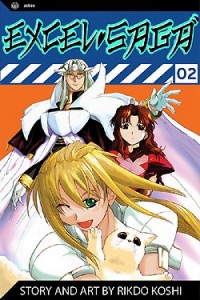
Excel Saga Volume 2

By Rikdo Koshi. Released in Japan by Shonen Gahosha, serialization ongoing in the magazine Young King OURS. Released in North America by Viz.

Volume 2 of Excel Saga starts to spin a bit more of its actual plot, though things are still in the beginning stages. (By the way, Viz and Rikdo Koshi have done original cover art for the first 4 volumes of the manga, ostensibly to help them sell. When presumably they didn’t sell, Viz reverted to simply using the original Japanese covers, starting with Volume 5.)

es2

The good news is we meet two more of our main cast in this volume. Dr. Kabapu makes an immediate impression. He looks odd, and he is odd. But he’s also immediately shown to be morally bankrupt, and willing to be an utter jerk for his own ends. If you ask me, he’s more of a villain throughout the series than Il Palazzo is, even though he is ostensibly ‘protecting the city’. (Of course, once Miwa Rengaya shows up, you get the feeling she’ll soon overtake both of them).

And then there’s Misaki Matsuya, who plays the resident ‘sensible’ woman throughout the manga. Rikdo Koshi is not generally above letting anyone, at any time, play the boke or tsukkomi as events warrant, and indeed the liner notes for Volume 2 note that Excel and Hyatt alternate boke and tsukkomi depending on the situation. Likewise, while Watanabe (at first) and Sumiyoshi CAN be sensible and level-headed, it’s Misaki who carries the brunt of whacking idiots and pointing out stupid things. In a manga with as many weirdos and idiots as this one, it’s welcome.

A couple of other things to note about her introduction: we see her briefly with a cute keychain plushie. Misaki’s addiction to cute plushies, besides being a nice break in her otherwise ‘perfect independent and strong woman’ persona, will continue in future volumes. It’s generally a way for Rikdo to make references to other series that are running alongside Excel Saga in Young King OURS. The other thing is that it’s revealed that she and Iwata were classmates in college. He’s far too informal with her, and she beats him constantly for calling her Misaki, with no honorific. Stay tuned for a lot more on these two…

Meanwhile, our heroines are doing what they do best. Working odd jobs, hailing Il Palazzo, making pathetic attempts to take over the city for the glory of ACROSS, and occasionally sniping at each other. That last is somewhat of a surprise, and won’t last; in a volume or two, Hyatt and Excel will have warmed up to each other, and Hyatt will end up being utterly deferential. (Excel’s true sniping partner will arrive in Volume 8.) Amusing gags here include Hyatt’s inability to not steal medicine, couples with Excel’s inability to resist the word ‘conquer’; yet another insane appearance by the Black Jack-esque doctor and his nurse; and Hyatt’s mysterious ability to avoid setting off any mines while walking through a minefield.

This leads us to the two major plot points that will become important over the whole series. The first is Excel’s superhuman endurance and abilities. At first, you think that it might be merely manga exaggeration – this is a comedy, after all. But gradually, as Excel gets blown into the air by mines, drowned in the middle of oceans, and forced to lift unconscious robots, that she’s simply more than a mere insane human.

The other thing that is introduced here is Il Palazzo suffering from what appears to be multiple personalities. There’s voices talking to him in his head yelling at him about enemies, and he sends Excel and Hyatt on missions and then seems to be completely ignorant of what he’s done. This too will be important later on, and was in fact also used in the anime version (though it was taken in a different direction). This is probably a good thing, as Il Palazzo on his own tends to be fairly drab, spouting rhetoric and pulling ropes on trapdoors. An air of mystery adds to his character.

And of course there are endnotes by Carl Horn. I know fans who buy manga sight unseen just for Carl’s notes.

This is a fun, funny manga, with weird wacky situations, and you get the sense that a big confrontation is set up. To be continued!