Monthly Archives: May 2012

Fallen Words

By Yoshihiro Tatsumi. Released in North America by Drawn and Quarterly.

Sometimes you don’t need deep, significant plots. You don’t need characters that go on an incredibly journey that lets them grow up and learn about life. And you may not need 65 volumes to tell your story. Sometimes all you need to do is be interesting, to have an anecdote to tell and to enthrall the listener with that anecdote. And if it ends on a funny note, well, so much the better. The art of rakugo is beloved in Japan. It’s basically storytelling, but has an element of stand up comedy to it (while, of course, being nothing like stand up at all). The stories usually involve dialogues, all conveyed through changes in tone and pitch. And now we have legendary mangaka Yoshihiro Tatsumi giving us some rakugo in manga form.

There are eight stories here, all about 30-50 pages in length, and almost all being fairly comedic and lighthearted. Even the darkest of the bunch, which involves a down-on-his-luck man who befriends The Grim Reaper (seen on the cover here) is still fairly humorous until its dark conclusion. Since Tatsumi cannot aurally convey what the world of the Rakugo is like, he simply has to do it by drawing us into the stories. And it works beautifully, as I found it very hard to pull myself away, even when I was reading about yet another get-rich-quick scheme (a common theme of these stories is the lack of money).

While I said the stories weren’t stand-up, they are of course devoted to telling a funny story. I was reminded a bit of the longer and less humor-oriented parts of Henry Rollins’ old spoken word albums, where he described photo shoots in Australia and crappy jobs euthanizing animals. The other thing these stories reminded me of, especially since some of them *do* end with a punchline that makes you groan rather than laugh, is the shaggy dog story. Not in as much as you feel that you just wasted 15-20 minutes of your life (which is what the best shaggy dog stories offer to the listener), but that feeling that the journey was more important than the destination. In a story about a courtesan and her clients, all of whom sit alone and rail at the poor beleaguered assistant, the final joke is sort of a quick “the end’ gag. What’s fun is the entire story itself, watching these puffed-up and self-deluded middle-aged men ranting and raving because they aren’t getting any.

My favorite story, in terms of combining all the elements I mentioned above, was the third in the book, Escape of the Sparrows. Featuring a prologue that is seemingly irrelevant to the rest of the tale, this them spins off into another ‘deadbeat guest’ story, but becomes far more fantastical. As the pace quickens and the stakes increase, the story also takes on a fantasy element, and even manages to have some beauty. And then… there’s the last page, which features a horrible, horrible joke that wraps up everything the entire story did in a neat bow. You will groan, but feel like applauding.

Such is the nature of the craft of rakugo. Tatsumi says in his afterword that the performers would retire if they didn’t feel they could convey the different moods anymore. I don’t think Tatsumi has anything to worry about here, though. This is not only a great collection of humorous short stories, but a storybook, the kind that you feel like reading aloud to people after you’ve finished it. Perhaps someone will read these and become a rakugo (or its Western equivalent) of his own!

Manga the Week of 5/9

After a very busy week this week, next week is looking eerily quiet. Too quiet. (Except for me. Due to shipping issues with Diamond and UPS you may have heard of, 2/3 of my order this week never showed. Some is coming next week… some still later. In case you wonder where my Oresama Techer review is…)

In fact, Midtown is so quiet I’m going to throw in some stuff not on their list. One came in via Diamond today, the other next week, and both are from Drawn & Quarterly. Yoshihiro Tatsumi’s Fallen Words is a new short story collection from the author of A Drifting Life, each story told in the oral tradition of rakugo. I got that one today, and it looks fantastic.

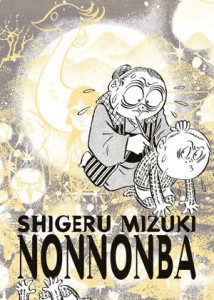
And next week we get a new Shigeru Mizuki title, NonNonBa, a memoir about his lifelong interest in yokai. Given we are apparently not getting Gegege no Kitaro over here anytime soon, this is the next best thing, and everyone who reads this blog should get a copy. (For those wondering, Midtown apparently gets their ‘indie publisher’ stuff from a non-Diamond source, meaning some D&Q titles take forever to get there.)

Dark Horse has two manga ouit, one new and one a re-release. The new is the 2nd volume of Yasuhiro Nightow’s Blood Blockade Battlefront, which brings a Jump Square mentality to his traditional Western-style gunplay heroics. Let’s hope Shieisha’s editors were better than Shonen Gahosha’s at making his art more coherent, especially in fight scenes.

Speaking of incoherence, Dark Horse is also releasing the FLCL series as one big omnibus. Originally an anime, it was adapted in Kodansha’s Magazine Z, which tended to be devoted to media properties. Tokyopop released it back in the day, but this should have a fresh new translation and color pages and other cool things. I wasn’t too impressed first time round, I seem to recall, but then I found the anime overrated as well. If you liked the anime, though, this should be right up your street.

Another ‘not from Midtown but from Diamond’ title, the fourth in Seven Seas’s A Certain New York Times Bestselling Railgun is coming out, and should be electrifying as usual. So to speak.

Lastly, a Viz title that for some reason didn’t come in with the pile this week. The Story of Saiunkoku is up to Vol. 7, and now that Shurei actually is a civil servant, she should finally be able to achieve her dream… once she stops being bullied damn near to death, of course. The series recently ended in Asuka at 9 volumes (though the light novels go on forever), so we’re in the home stretch. Court intrigue ahoy!

So what are you getting this week? (And yes, Sailor Moon will be out in bookstores a week before comic stores, as usual. I’ll plug it next week, no doubt.)

GTO: The Early Years, Vol. 12

By Toru Fujisawa. Released in Japan as “Shonan Jun’ai Gumi” by Kodansha, serialized in the magazine Weekly Shonen Magazine. Released in North America by Vertical.

Volume 11 of this manga was fortuitously focused on Onizuka. I say fortuitously because when you’re reintroducing a series via a different publisher that didn’t sell well in the first place, it’s always best to drum up sales by featuring the one character people absolutely love. This next volume, however, reminds you that GTO: The Early Years didn’t just star Onizuka, but his best friend Ryuji Danma, and he gets most of the focus here.

This is not to say there isn’t also plenty of Onizuka. He gets most of the first half, actually, as we resolve the Joey storyline from the previous volume. As you might guess form a delinquent story set in Shonen Magazine, this is not done through graphic violence and killings, but via a motorcycle race. Joey is on one of the best bikes around, Onizuka is on a legendary old bike whose best days are behind it. Guess who wins. It’s notable that, while we all know Onizuka as a cool character who is constantly allowed to be a giant comedic goof, he also works well in the opposite direction: Onizuka is a goofy, horndog teen who can nevertheless back up his boasts with feats of utter badassery. And of course teaching valuable lessons, which he does with Joey here.

Meanwhile, Onizuka gets to cool moments, but Ryuji gets the emotional turmoil. (Not a surprise: Ryuji has always been vaguely more mature than his best friend. Note I said vaguely.) First of all, he’s dealing with his former teacher and first love appearing back in his life again, right when he’s trying to settle down with Nagisa. Secondly, there’s the ongoing issues with Joey, and his girlfriend being used as “bait” to draw out the two leaders. But both of these pale next to the end of his “castle” and idyllic trailer park life, as the cops arrive to destroy everything, and Nagisa’s parents arrive to take their runaway daughter back home. Ryuji, of course, is forbidden to see her.

There’s a lot of teen angst here, which I can’t help but see from a slightly older perspective. For all that Ryuji and Nagisa were living in their happy fantasy, a bus in the middle of a field, with no real prospects for the future is not something to cling to. I think Nagisa gets that more than the others. While Onizuka and Shinomi are wondering why they can’t be left alone, Nagisa’s the one noting that no matter where they run, adults (and by extension reality) will still exist. They can’t face life as a loving couple on teenage terms. Growing up has to be done. And for the moment, that means dealing with her being under house arrest and having to communicate via written messages.

There is still, lest this all sound like a bummer, plenty of humor – this is an Onizuka manga, after all. The catfight between Shinomi and Saya over Onizuka is ridiculous and hilarious, as is the chapter where Nagisa reveals she might be pregnant, and everyone goes completely out of control. (Spoiler: she isn’t.) Best of all, though, is Onizuka accidentally ending up in the middle of a yakuza job, and finding the horrifying things you would expect – all played for comedy, of course. All in all, the series continues to give us what Fujiwara does best: lots of fighting, lots of goofy faces, a few heartwarming/heartbreaking moments, and lots of a future Great Teacher.