Monthly Archives: December 2012

Kaoru Mori: Anything and Something

By Kaoru Mori. Released in Japan by Enterbrain, serialized in various magazines. Released in North America by Yen Press.

Well this is a bit of an odd duck, isn’t it? Half story collection, half sketchbook, it’s no surprise that this is being released in more expensive hardcover, as I doubt it would recoup any costs whatsoever otherwise. But then that’s also true of A Bride’s Story as well (and note Emma and Shirley were “blogger favorites” with crappy sales). Kaoru Mori is not the author of a Bleach or Naruto, and has a very enthusiastic but minimal audience. As such, this may almost be review proof – anyone buying this is getting it because it’s something new by the author, and the content is mostly irrelevant. That said, there is a lot to like here, even as there’s also a lot that left me scratching my head or feeling vaguely unsatisfied. Which is about what you’d expect from a collection like this.
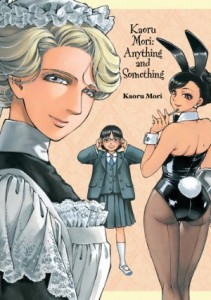
anythingandsomething

One thing that pleased me greatly was the sense of humor of many of these stories. Indeed, they’re not simply funny but eccentric – always one of my favorites. The first story in the collection shows a butler and maid desperate for a master so that they can continue to live as they are accustomed – and it’s clear who’s going to be in charge. Then there’s the very early story involving a perverted loon of an inventor and his implacable battle maid. It was impossible for me not to think of the inventor as being played by Michael Bentine (google it). And the cute yet slight story of a girl who takes forever to grow into her school uniform just brings a smile to the face. Some girls are born to attract attention no matter how they look.

There’s also quite a bit of cheesecake here, as if the cover art didn’t clue you in. A Bride’s Story and Emma don’t exactly give a lot of opportunities to draw the female form (except covered in gorgeous clothing). Also, Mori writes mainly for Fellows!, an Enterbrain seinen magazine whose content is geared towards older men who like to see something sexy. This explains the almost static chapters with the Host Club bunny and the wife trying on her swimsuit, which are almost there for art alone. Indeed, one very short story about a girl who is bird-watching essentially stars her posterior.

There were one or two stories that reminded me of my frustration with Mori’s implacable females, particularly one involving a young master wanting to no longer be treated like a child and his maid who smiles politely no matter what. I admit it’s what she does best, but I was hoping for a bit more wackiness. Ironically, the longest story of the collection (and one of my favorites) wasn’t written by Mori, but by fellow Fellows! writer Satoshi Fukushima (who writes Kidou Ryodan Hachifukujin, which would be an awesome if unsellable license). This also features a seemingly implacable girl, but mostly focuses on the ‘normal’ girl who becomes her friend. There were a lot of subtleties here regarding art and life, and I worried that the story was going to end far more tragically, so was pleased at its more ambiguous climax.

After that, there’s the 2nd half of the book. I have far less to say about it – it’s a sketchbook, basically – and if you like Emma or A Bride’s Story, or simply reading about things like fireplaces, then you should find it satisfying. I do wish it had been interspersed with the short stories – having it all come in the 2nd half ends up making the whole book feel like a bit of a curate’s egg (google that too). There’s some good stuff here, but as a collection it’s more ‘odd’ than ‘satisfying’. Which is appropriate, as that’s how I’ve come to view Mori’s work as a whole.

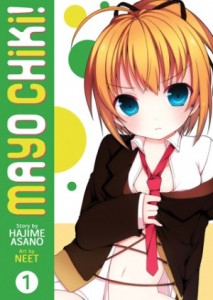
Mayo Chiki!, Vol. 1

By Hajime Asano and NEET. Released in Japan as “Mayoeru Shitsuji to Chikin na Ore to!” by Media Factory, serialization ongoing in the magazine Comic Alive. Released in North America by Seven Seas.

Possibly the most frustrating thing about Mayo Chiki! is that there is a manga with some interest in it struggling to get out here. The story is not remotely going to be original, but it could at least be interesting, with some likeable characters and a healthy dose of humor. The humor, at least, is present, and one of the manga’s saving graces. But none of that really seems to matter, as the manga’s art and general mood seems to revolve around presenting young girls (in the classic moe ‘they’re 17 but look about 9’ style) looking humiliated in half-naked (and sometimes 3/4 naked) poses. And it kills any chance the story may have had of doing something with its cliches.

mayochiki

The basic premise of Mayo Chiki! reads like any number of the moe light novels that have come out in Japan recently, and been made into anime/manga/games/etc. Indeed, some of you may have read my reviews of I Don’t Like You At All, Big Brother!! and Haganai, both of which run in the same magazine and are cut from the same cloth. The premise is that Jiro, who is terrified of women (but extremely tough) due to his mother (a wrestler) and sister (just a sadist) beating the shit out of him every day, such that he gets a nosebleed whenever he sees a woman as a defense mechanism (his family stopped when they saw blood). School is his only refuge, but one day, in the bathroom, he accidentally walks in on the handsome yet cold Subaru, and notes he is wearing panties. In fact, it’s worse than that – Subaru is a girl. And no one is supposed to find this out on pain of death. Luckily, Subaru is more than just a handsome bishie trap – she’s also butler for the school’s rich princess, who turns out to be sympathetic – and sadistic. She blackmails Jiro into keeping their secret, and gradually Jiro and Subaru grow closer, despite everyone else now thinking the two of them are gay.

Yes, there was no way this would be fantastic or original given that premise. But it didn’t have to be all that bad. And as I said, the manga has some very funny moments in it, my favorite being the ‘secret memory manipulation technique’ which consists of hitting someone till they lose their memory. And there are some possible plot points of interest, especially given the hero and heroine have both lost a parent. But then you get the little sister turning out to have incestual feelings for her brother, I think simply because you can’t write a moe light novel without incest subtext anymore. And Subaru being tied up in bed with a ball gag in her mouth, supposedly to stop her from killing Jiro but more accurately to show the reader she is tied up and with a ball gag in her mouth. And the extras, which have a ‘I am holding a microphone with my mouth open’ shot, a ‘I am licking ice cream’ shot, and a 2-page spread of the cover, only with Subaru wearing only an unbuttoned men’s shirt.

I like some moe stuff – Haruhi Suzumiya, K-On!, Toradora. But I think my general feeling about moe manga with so many suggestive poses like Mayo Chiki! is that it makes me feel like a criminal when I read it. Certainly I don’t recommend taking this book anywhere near Canadian Customs. That said, I am me, and I’m sure that if readers can get past the art style and sleazy sexual poses, there’s a more interesting story in here crying to get out. And of course there’s the anime adaptation, which Sentai has released, so it has a built-in fanbase. I think I’m just tired of anything from Comic Alive, maybe.

Neon Genesis Evangelion Omnibus, Vol. 1-3

By Yoshiyuki Sadamoto and GAINAX. Released in Japan by Kadokawa Shoten, serialized in the magazine Shonen Ace. Released in North America by Viz Media.

In a not-entirely-coincidental move, Viz has released the first of their omnibus releases for Evangelion at the same time as Vol. 13, giving the reader a chance to catch up and remind themselves of what they may have forgotten. And it’s definitely possible that they forgot, as the manga began in 1995, and Viz started releasing it in 1998 or so, in 32-page comic book format (remember when they did that?) and flipped (remember when they did that?). But now it’s decades later, and it’s time to get the band back together again with this new oversize omnibus with color pages and snazzy packaging. (Which is well worth it, by the way, it looks great.) But what about the content?

evangelion

Given I only reviewed Vol. 13 of Evangelion last week, there may be some repetition involved. But the main reason I tend to prefer the manga adaptation of Evangelion to the anime is that it takes the basic plot and makes everything just slightly more tolerable. And indeed, in these early volumes, it is pretty slight – there are no major changes from what we watched in the first 6 episodes or so of the anime. For those living in a cave, Evangelion starts off as a post-apocalyptic giant robot sort of story where a young teenager estranged from his father is called to a super secret base to find out that he’s one of the few people who can pilot said giant robot and defeat the enemy creatures that keep attacking the Earth. Only the creatures are Angels, and that’s not merely Japan’s love for using religion where it’s not appropriate – Evangelion is drenched in religion, with each enemy angel having an appropriate name – Sachiel, Shamshel, Ramiel, etc.

Shinji in particular benefits from the adaptation to manga. He still complains quite a bit, and still runs off halfway through the volume, but his general demeanor is more argumentative and sullen rather than weak and whiny, and it simply makes the reader identify with him better. Indeed, his reasoning for running off is given better depth in the manga – he’s desperately searching for a family/parental figure, and finding that the closest one he now has, Misato, has been writing a journal for NERV analyzing him is a crushing blow. His response to Touji is also excellent – some may object that it shows Shinji being too ‘cool’, but I like to think that it shows Shinji as being slightly less broken.

There’s also Shinji’s relationship with Gendo, and his observation of Rei’s relationship with Gendo. I’ll admit I’m not all that fond of Gendo, and the manga doesn’t help – he’s the one character who’s actually less appealing than in the anime. But seeing his interactions with Rei must deal Shinji’s fragile psyche a crushing blow, wondering what in God’s name is wrong with him if he can’t get any sort of affection from his father but she can. Of course, this isn’t Rei’s fault, and it’s to his credit that he’s able to bond with her as well. The three volumes are roughly divided into Shinji’s relationship with another person – Gendo in Vol. 1, Misato in 2, and Rei in 3. The climax to 3, where Shinji manages to coax a genuine smile out of Rei,l is wonderfully heartwarming, and a great place to end this omnibus.

If you haven’t read the manga yet, this is absolutely a worthy release to get, showing why it’s become one of the most important stories from the last thirty years.

Also, Page 234 has to be read to be disbelieved. Sometimes an Angel is not just a cigar, I guess. And Misato’s dialogue is just icing on the cake.