Monthly Archives: February 2013

The Wallflower, Vol. 30

By Tomoko Hayakawa. Released in Japan as “Yamato Nadeshiko Shichihenge” by Kodansha, serialization ongoing in the magazine Bessatsu Friend (“Betsufure”). Released in North America by Kodansha Comics.

Recently, Vol. 30 came out of two separate successful shoujo series. Yet while the reaction of most online fans to Skip Beat! 30 is “Yay! I’m so happy that it’s still running!”, the reaction the The Wallflower 30 tends to be more “EEEENNNNDD!!! EEEEEEEEEEEENNNNNNDDDDD!” Partly this is due to The Wallflower’s writer having little to no idea on how to resolve her romance without destroying her comedy, as I’ve noted before. But another reason is that The Wallflower is so episodic. If you jump from Vol. 6 of Skip Beat! to Vol. 25, you’re going to be somewhat lost. This is much less of a problem with this series, where even in this volume, where three of the stories interweave a small amount, each can be read on its own if you just happen to pick up that month’s Betsufure after a 4-year-hiatus.
wallflower30

There is also, every chapter, the illusion that progress is being made and characters are growing. I’m not sure how much of it is deliberate, actually. But every chapter in this volume has that one moment where a character (either Sunako, Kyohei, or both) has that moment of realization where they understand what someone else is thinking and what needs to be done. Their empathy with Sunako’s aunt when she’s once again taken advantage of; Sunako noting that “I’ll just pretend we’re not friends” is a horrible strategy when trying to avoid having your friend get bullied; Kyohei realizing that there is a difference between ‘watching Sunako get embarrassed’ and real emotional and physical pain; and Sunako finding that regarding Kyohei as a ‘bright, shiny object’ as she always does is only what everyone else in the world has done to him forever, and he HATES it. You sense that everyone is gradually growing up… yet you aren’t surprised when they backslide next month.

Because everyone still serves the comedy. Which is how Ranmaru can be the most awesome fiance ever in one chapter and then (literally five minutes later in story terms) announce he’s going to go out and pick up more women. (By the way, props to Takenaga for calling him out on it – Noi wasn’t even there to impress!) Meanwhile, Tamao gets a bit more development here, but I’m not sure it’s to her benefit. She’s always been the nice, perfect princess who loves Ranmaru no matter what and doesn’t get angry, but now we see her life at school involves another, less perfect princess bullying her every day, and she simply takes it with a niceness that borders on surreal. Thank God Sunako shows up (looking gorgeous, by the way, one of the best ‘Sunako pinup’ shots in ages). Oh well, it could be worse – she could be Yuki, who the author has totally forgotten about.

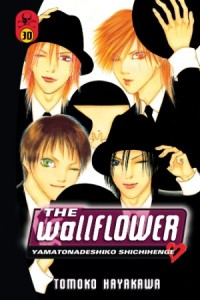
This series continues to have all the weaknesses that it’s well-known for, and is not getting rid of any of them soon. (My favorite being the author’s complete inability to draw backgrounds half the time – the story could take place in a white void for all we know.) But it also continues to have all of the same strengths, and Kyohei and Sunako are both perfect for each other, even if they don’t see it. Best of all, the series is still funny, as everyone in this manga, except maybe Yuki and Tamao, are completely insane. Which is why we get shots of the leads dressed as PIRATES! in the first chapter here. Looking forward to the next 30 volumes!

Emerald and Other Stories

By Hiroaki Samura. Released in Japan as “Sister Generator” by Kodansha, serialized in various magazines. Released in North America by Dark Horse Comics.

Well, first off, there’s not a samurai in this thing. It’s an anthology similar to the one we saw recently from Kaoru Mori, aka “I need to do something different occasionally and show off my chops”. As with most anthologies, the quality is highly variable, but the author is good enough that even the stories I didn’t really get into here had something to offer. It’s a good short story collection, all told.

emerald

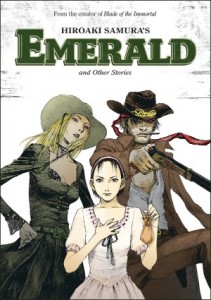
The collection itself was published by Kodansha, and it’s likely no coincidence that the three strongest stories in it ran in that company’s seinen magazine Monthly Afternoon, also home to Blade of the Immortal, the work that Samura is most famous for. This North American version uses Emerald as the title story (Sister Generator is an amusing title, but I think would convey the wrong image over here), and it’s a straight-up Western, with gunslingers, saloons, and an orphan playing a tortured game in order to save her family’s good name (and her chastity). As with the best Westerns, the morality is incredibly ambiguous, but there’s a heartwarming center to it despite it all.

The stories are interspersed with some short gag comics that ran in Ohta Shuppan’s QuickJapan for a while, all based around Japanese schoolgirls snarking around whatever fashionable trend they’re dealing with at the moment. It reminded me quite a bit of Furuya’s Short Cuts series, and while these aren’t quite ko-gals, there’s the same surreal quality to a lot of their conversations (probably my favorite is where two of the girls compare their fan fiction, and we find that one of them basically writes straight-up bad porn). I like these sorts of stories, but I can see how they might be a weak link for any other readers. Another weak link might be Shizuru Cinema, a short story from Media Factory’s Comic Flapper, which I think ended up being a little TOO weird and diffuse for me. (The same could be said about Brigitte’s Dinner, but that won me over with its stark imagery.)

The real winner, though, is “The Kusein Family’s Grandest Show”, a dark and twisted story about a family where all is not as it seems. I don’t want to give away too much about the plot – the way you can tell I really love a story is I either spend 5000 words or 6 describing it – but it shows a very dark take on daughters taking after their mothers, what we leave behind, and exactly what it means to fulfill a man’s dying wishes. The mood, dialogue, and sinister plot all combine to create something almost poetic – although it’s a subdued, erotic poetry. The whole volume is worth it for this story.

As with a lot of short story collections, you want to come out of them saying “I’ve got to get more of this author’s work!” As such, I’m really interested in both Blade of the Immortal and his other NA short story collection, Ohikkoshi. The man can certainly spin a tale. And if all else fails, you can take pride in his amazing mahjong hand, as seen in perhaps the most obscure manga in this collection.

Umineko: When They Cry, Vol. 2

Story by Ryukishi07; Art by Kei Natsumi. Released in Japan in two separate volumes as “Umineko no Naku Koro ni: Legend of the Golden Witch” by Square Enix, serialized in the magazine Gangan Powered. Released in North America by Yen Press.

And so the first arc of Umineko: When They Cry is finished, and even more than the first Higurashi arc, it shows us that what we’ve been reading for the last 1100 pages is simply a prologue for everything that is to come. It shows us the main players, allows us to see the family drama at the heart of everything, and of course has a number of gloriously gruesome murders, but you keep expecting the last page to be, with apologies to The Goon Show, Wallace Greenslade announcing “And this is where the story REALLY starts.”

umineko2

There’s a lot more emphasis on the mystery itself than there was in the Abducted by Demons arc, with each new killing propelling the remaining cast to desperately try to figure out how in God’s name they’re happening. This is made possible by the deliberate closed-in locked-room style of the series, which does not allow much in the way of escaping or trying to forget about everything. Thus Umineko is a more oppressive series than Higurashi, but it’s also more focused. Character allegiances shift rapidly, as Eva, one of the more sensible character in the first volume, proves to be incredibly nasty at trying to pin the crime on Natsuhi; Maria’s split personality is genuinely looked into as possibly being a product of her mother’s resentment; and Natsuhi herself finally takes control of the family at the expense of… well, a whole lot.

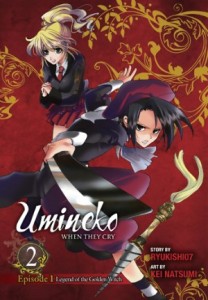
Jessica and Kanon are on the cover, but they really don’t get much of a look in beyond the fact that Jessica clearly has a crush on Kanon. (I understand the second arc focuses more on Jessica and George’s relationships.) But the inside cover tells the real story of this book, showing a frustrated and enraged Battler and a smug, grinning Beatrice wielding chess pieces at each other.

Then there’s the tea party. I’ve been reading through a couple of the Higurashi Visual Novels (available legally from Mangagamer, by the way – one of the few non-porn things they’ve done), and each of them ends with a short ‘tea party’ set in the cafe where the cast, out of character, go over what happened in the book and whether it was due to demon or human elements. That said, it’s totally independent of the VNs themselves, and was dropped from the manga adaptation as being irrelevant. Is was therefore a big surprise to me to see the tea party actually adapted for the manga… and it proved to be the biggest plot twist as well. It’s all very well and good to deny the existence of a witch who appears as shafts of light or butterflies, but her physical presence really throws Battler for a loop. And when he continues to deny her involvement… let’s just say things don’t end well for our heroes.

And so we seem to have a plot and a meta-plot, as Battler and Beatrice are now in competition to find the best explanation for the events at Rokkenjima (note that actually trying to stop the murders doesn’t seem to be an option anyone brings up this time). And then at the very end there’s a meta-meta plot, as Beatrice has her own tea party with another witch named Bernkastel… who we’ve seen in the Massacre arc breaking down the Higurashi plot with Rika. Indeed, Bernkastel looks exactly like Rika… and while Ryukishi07 has apparently said that the two are not the same, there’s clearly enough similarities that they’re connected in some way.

The balance between mystery and horror is what drives this series, as the author himself notes at the end. And while events may be more dramatic, gestures more declamatory, and events far more hopeless than Higurashi, the key is whether a reader wants to read on and find out more. I certainly do, especially since I want to find out more about Beatrice, who insists she’s behind everything, but hasn’t really given a reason why beyond “cause I’m evil like that”. I’m going to guess that’s not the real reason.