Monthly Archives: March 2013

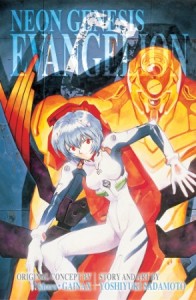
Neon Genesis Evangelion Omnibus, Vols. 4-6

By Yoshiyuki Sadamoto and GAINAX. Released in Japan by Kadokawa Shoten, serialized in the magazine Shonen Ace. Released in North America by Viz Media.

These volumes of Evangelion were coming out just as the TV series was finishing, so by now readers had a general idea where things were going to go. And so that allows Sadamoto to start to mix things up and change what we expect to see. There’s no radical alterations here, but some introductions are different, and one character’s fate is changed – for the worse.
evangelion2

Rei features on the cover, but really has very little to do in these three volumes. That said, her one major scene is quite good. Shinji is still angsting about his father, and how he hates him but knows he’d like that to change. Rei points out that being silent isn’t changing anything, and he should talk to his father. So he does! And he gets shut down cold, as it becomes clear that Gendo is never going to bond with Shinji in any parental way, or stop using him as a tool. (Ironically, telling Shinji to stop trying to get closer to him might be the nicest thing Gendo does for him.) Rei also realizes that for all that Gendo is supposedly closer to her, it’s merely a facade, and I think that bothers her, in her own Rei sort of way.

Of course, the majority of this omnibus is focused on the arrival of Asuka. As noted above, she gets a different and far cooler introduction to the story, taking out an Angel by herself and then beating up a group of street punks to save Shinji’s butt. That said, she’s as harsh and abrasive as ever – except around Kaji, of course. (Kaji shutting Asuka down towards the end of this volume is handled quite well – he clearly knows what is going on and has been ignoring the hell out of it, but Asuka stripping in front of him lets him know he can’t do that anymore. Actually, Kaji in general is handled really well in the manga.) Shinji’s scenes with Asuka are usually the funniest parts of the books, and they also get some sweet bonding moments, showing them starting to open up to each other a little bit.

Then there’s the last third of this omnibus. I wonder if Sadamoto had heard people talking about how the manga was a lighter, more optimistic take on the anime and said “Oh yeah? Well take this!” All of Vol. 6 is devoted to Toji being selected as the 4th pilot, and all that stems from that. And it’s horrible, in the best possible way. In particular, Hikari’s tsundere antics (genuine tsundere, as opposed to Asuka’s “I am at heart emotionally broken” tsundere) are simply impossible to read as anything but tragic, and the last scene of the volume is a perfect “OK, gonna go sob in the corner now” capper. I hated reading it, but it was handled in a fantastic way.

So with that cliffhanger, we’ve been shown that the happy fun times of Evangelion are over. How Shinji reacts to his role in all this – as well as what his father did – will no doubt take up part of the next book. In the meantime, if you never read this series, this oversize omnibus with color pages and detailed notes explaining the confusing backstory is a perfect introduction.

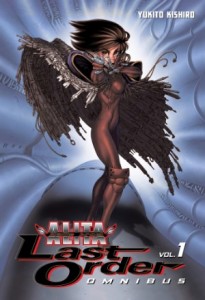
Battle Angel Alita: Last Order, Omnibus 1

By Yukito Kishiro. Released originally in Japan as “Gunnm: Last Order” by Shueisha, serialized in the magazine Ultra Jump; currently owned by Kodansha and serialized in the magazine Evening. Released in North America by Kodansha Comics.

In the beginning, there was Gunnm, which ran in Shueisha’s Business Jump from 1990-1995, and told the story of Gally, a cyborg creation who was revived and had lots of awesome Rollerball-type adventures, killed bad guys, and battled the evil Desty Nova. Then in 1995 the series was wrapped up fast as the author was ill. Like “get your affairs in order” ill. Luckily, he got better, and 5 years later revived the series for new magazine Ultra Jump, retconning most of the last volume and restarting with Gally’s adventures in the sky. Viz Media licensed both series, renamed Gally to Alita, and released the first series as Battle Angela Alita and the second with the Last Order tag.

Then a few years ago, Shueisha was going to re-release the original Alita manga, but decided to remove the word “crazy” from the manga as it might upset the mentally ill. Kishiro was quite upset, and after a long, protracted battle, pulled his manga and moved to Kodansha, where it is currently running in Evening. Over here, the manga likewise leaped from Viz to Kodansha, who have started to put it out from where Viz left off (Vol. 16), but are also going back and re-releasing Last Order as large omnibuses, based off Kodansha’s bunko releases. The fate of the original series remains up in the air, but I suspect a re-release is unlikely.

lastorder1

Which is a shame, as I think the omnibus would read much better if people could refresh their memories of the original. Kodansha Comics puts a 2-page “what has gone before” at the start, but despite trying to make Last Order as newbie-friendly as possible, every time Alita starts wondering about Figure Four, or obsessing over Lou, the reader is left thinking that they missed the first 20 minutes of this movie. Admittedly, if they did re-release the original people might be reminded that some characters who originally got happy endings now are suffering much more gruesome fates. Speaking of Lou.

With all that said, this is a really entertaining read once you get past starting in the middle. Alita’s a cute, sullen heroine who the author makes sure not to take seriously at times. Desty Nova reappears as a crazy awesome mad scientist, still amoral but no longer bwa-ha-ha evil, and now apparently mentoring her. We meet a few of her cyborg duplicates, like Sechs, who is obsessed with “defeating the original”, and Elf and Swolf, who I think are just there to be cute and snarky. And there are new characters, all of whom are dealing with a world that really, really seems to hate everyone. It’s a good thing that there’s elements of humor sprinkled throughout, as otherwise this would be the most depressing thing ever written.

There are also a lot of action sequences, which are equally excellent. James Cameron wants to turn this into a movie, and it’s not hard to see why. Not only does the artist draw a lot of fights, but you can actually tell how the characters are moving in those fights – a rarity with manga writers. Alita is amazing, of course, but still manages to get her ass kicked several times – which, given she’s a cyborg, usually involves her getting ripped in half. Indeed, she spends a good chunk of this book as only a top half. In amongst this action, there’s a whole lot of worldbuilding (I admit I skipped the textual diagrams, and don’t think I missed much), and hammering home the basic theme of the entire series, which is “what does it mean to be human” and “what makes humans different from others?” Having dreams, having goals, believing in yourself – there’s shiny shonen manga ideals buried under all this dystopia.

The omnibus is huge – 670 pages – and padded out even more by two early short stories Kishiro wrote about a year before starting Gunnm. The first is the better of the two, about a man trying to build his own plane meeting an Angel-like creature who has wings but hasn’t really had the gumption to use them. The other story, about a giant tank the size of a mountain that destroys towns and tends to mind control those who try to stop it, is less good. That said, both do continue the basic themes here – strive to survive, maintain your humanity, even if you’re a cyborg, an Angel, or a demon, and don’t let others dictate your goals.

There’s a lot going on in this volume. I didn’t even mention the Martian Queen (who appears to be Orihime Inoue’s descendant), or the obviously evil Venusian guy offering everyone roast babies just to be a dick; or my desire to see this cross over with A Certain Magical Index. But the basics of the series are laid out here, and there are a number of directions the series could go. Lots of politics, lots of action. Unless the author somehow gets distracted by writing 100+ chapters of a fighting tournament or something, I think he can’t possibly lose here.

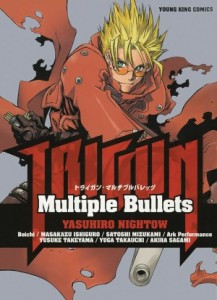
Trigun: Multiple Bullets

By Various Artists, series created by Yasuhiro Nightow. Released in Japan by Shonen Gahosha direct to tankobon. Released in North America by Dark Horse.

I am generally a manga person, though I have a lot of anime that I love. But if you were to ask me which I preferred, the manga or the anime, 90% of the time I would pick the former. Trigun is one of those exceptions, however. I saw the anime first, and was entertained and riveted by its over the top action and comedy slowly wending its way towards inevitable tragedy. It, like many other Shonen Gahosha series (including Hellsing and Excel Saga) was licensed for an anime very early on in its run, so had an ending that had many of the same beats the author wanted but was distinctly different. Unfortunately, Nightow’s action scenes tend to leave me hopelessly confused, as I simply can’t follow what he’s drawing half the time. His storytelling is also very oblique (typical to a Western). As such, I never really got into Trigun Maximum.

trigunmultiple

But I picked up this anthology anyway, as I was curious to see what other writers would do with Nightow’s vision. Of course, what most people might pick this up for is Nightow himself – it contains the 80-page story he wrote up to go with the release of the Trigun movie. The story, Badlands Rumble, is pretty much an encapsulation of the manga. Meryl and Milly are there but don’t do anything, Vash is really silly and then not so much, Wolfwood gets irritated but clearly is siding with Vash, and there are innocents and villains who are out of Bob’s Big Book of Western Cliches. If you liked Trigun, you’ll get a kick out of it.

Of the remaining stories, there were two that didn’t really work for me. Boichi’s story about a woman giving birth to an atomic bomb – sort of – and plays on Vash’s pledge to avoid killing. It is, however, filled with Boichi’s fanservice (he writes Sun-Ken Rock), something Trigun is usually blissfully free of. And the 4-koma with Meryl and Milly is really, really slight and not all that funny.

But there’s also some excellent storytelling here. The folks who worked on this anthology love to play around in Nightow’s world, rather than just writing character-based stories about Vash. Satoshi Mizukami, who does my pet favorite The Lucifer and Biscuit Hammer, has a story about whether the various warring races (humans, plants, worms) can really come together, but it’s actually cuter than I make it sound. Yusuke Takeyama’s is dark and depressing, with another typical Western cliche: the bit of hope that is then brutally cut down. That said, it’s tense, gripping stuff. And Sagami Akira’s Vash/Meryl story about the impossibility that is Vash’s hair is really shippy in exactly the same way that the Trigun manga never is. (The anime was a bit better at it.)

And easily the gold standard in this collection is the storybook tale that retells Trigun as a fairy tale, written by Ark Performance (better known for their Gundam stuff). The art is fantastic, the style is gorgeous, and the reveal of who’s telling the story is the perfect sweet (and bittersweet) capper. The entire volume is worth getting just for this 16-page story.

I generally prefer character-driven works to world-building stories, and Trigun definitely falls into the latter category. That said, many writers love walking around in someone else’s world, and Nightow’s is probably one of the best to wade into. This anthology had more hits than misses, and is a good epilogue to the Trigun series.