Monthly Archives: April 2013

Angel Sanctuary, Vol. 1

By Kaori Yuki. Released in Japan as “Tenshi Kinryouku” by Hakusensha, serialized in the magazine Hana to Yume. Released in North America by Viz Media.

It’s worth noting that this came out in the mid-to-late 90s in Hana to Yume, which these days is better known as the home of series like Oresama Teacher and Skip Beat!. It evolved rapidly in the early years of the 21st century, because back in the late 80s-early 90s there was a lot more darkness and a lot more androgyny in the magazine. And one of the best examples of this is Kaori Yuki’s Angel Sanctuary, a 20-volume series about angels, demons, impossible relationships, and above all strange things happening so fast the cast cannot get proper time to angst (but they manage to work it in anyway).
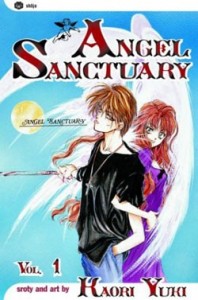
angelsanctuary1

First of all, yes, as my Manga Bookshelf colleagues have noted, this first volume is a bit tedious at times. There’s a lot of setup, a lot of putting pieces in place, and a lot of backstory that really doesn’t make much sense. We also don’t get enough time to like Sara’s friend as herself before she’s immediately possessed/killed/whatever. That said, I think that the volume manages to succeed anyway, almost entirely on mood. Everything is tense here as we wait for horrible things to happen to our lead, Setsuna, who is a typical troubled teenager with an atypical love for his sister, Sara. He’s having enough trouble trying to shut out his own lustful desires, he really does not need folks coming down and saying he’s the reincarnation of an angel. In fact, his hotheaded and impulsive personality is very reminiscent of a shonen protagonist. But boy, is he in the wrong series.

I mentioned the incest elements, and it’s worth noting how they’re handled. Given that here in 2013 there is an overabundance of incest in almost every manga or anime designed for the otaku, you’d think it would lose its thrill. But this is not here to titillate. Setsuna’s feelings are powerful and deep, and they horrify him. I loved that the first thing he did was check the family register to make sure that one of them wasn’t secretly adopted – he’s read other shoujo manga, I see! But no, he doesn’t get an out that way. And of course Sara feels the same way, though I don’t think either of them is quite aware of the depths of their love just yet. It helps that, familial relationship aside, they make the cutest couple in the book – which, to be fair, is not about romance. Well, not shoujo schoolgirl romance anyway.

The art is another strong point here – at times, it’s the only humor in the series, and I love some of Setsuna’s facial expressions and asides. Given that the series is about angels and demons, there’s also a lot of androgyny on display here, and I guessed wrong about the gender of two of the characters TWICE before nailing it down. (Kurai and Arachne also provide much needed humor here, I should note.) But overall, if I was to use a word to describe this series, it would be overdramatic. And I don’t necessarily mean that just in a bad way. It’s a great series for teenagers – particularly, I think teenage girls would eat this up – as everyone is pretty and your forbidden love is, literally, the end of the world.

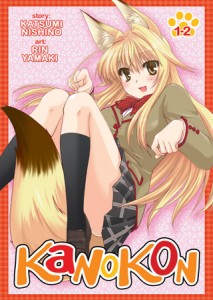
Kanokon, Vols. 1-2

By Katsumi Nishino and Rin Yamaki. Released in Japan as by Media Factory, serialized in the magazine Comic Alive. Released in North America by Seven Seas.

As I’ve noted before, in general these days I try to give every new Vol. 1 a chance and a review. Sometimes, though, I suspect on seeing the advance solicit that I know I’m just hurting myself. Kanokon was that sort of title. Moe foxgirl on the cover. Runs in Comic Alive. Harem title. Lots of overt fanservice and sexuality with little actual sex. Male lead whose sole good quality is his endearing niceness. That said, I was hoping at least for a chance to write a scathing review with lots of amusing vitriol, a la Sasameke or Qwazer of Stigmata. But the manga doesn’t even hit those levels of bad. It’s simply a mediocre-to-fair yokai harem manga.

kanokon_vol1-2_full

The title is another of those abbreviations that are becoming increasingly needed in a world where every book coming out has a title like “My Light Novel Can’t Possibly Be This Awkwardly Phrased” (AwkPhr for short). In this case, Kanokon stands for “Kanojo wa Kon to, Kowaiku Seki wo Shite”, or “She Coughed With a Cute Little “Yip”. (eeeeurgh…) Seven Seas does helpfully have a couple notes at the back explaining this, as well as a few other culture notes. As for the plot, if you were asked to write a harem manga for comic alive and given the premise of yokai, this is probably what you’d come up with. New transfer student Kouta is from the country, and thus attracts the attention of the popular girl Chizuru. She turns out to be a fox yokai, and has not only fallen for Kouta but can also merge and take over his body to a degree, though it depends on their feelings for each other. Cue angry brother, angry classmate, angry fellow yokai, and teachers, all of whom would like to see Chizuru be a bit more reticent and a lot less horny.

From what I understand, the anime got a lot more blatant, or perhaps this just feels worse when you see it as moving images. In any case, I was not nearly as horrified as my friends who saw the anime said I would be. Instead, it was more of a malaise. There does appear to be an ongoing plot that has potential to get interesting (and thank God this was in omnibus format, as if it had just been the first half it might have been unbearable). That said, the story has some very dumb stuff in it in order to allow the plot to function, particularly how, in creating a juvenile delinquent school for troubled yokai, they then allow totally normal humans to attend, for reasons I cannot fathom. (Yes, yes, learn how to blend in, etc. Still, highly dangerous.)

With all that said, I went into this knowing it was not a series for me. It does, however, have a fanbase of people who love this sort of thing. Cute fox girls, titillation, some fights, and a lead non-entity they can project themselves on who has a girl falling all over herself to sleep with him (and I’ve no doubt there will be more girls added later on). It does its job well for those readers, and thus is not actively radioactive. It’s simply not my thing.

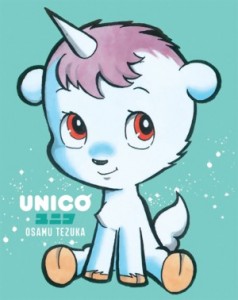
Unico

By Osamu Tezuka. Released in Japan by Sanrio, serialized in the magazine Lyrica. Released in North America by Digital Manga Publishing.

Here’s an unusual one: a Tezuka title that read left-to-right originally. Unico was apparently written for a magazine that was going to come out in the West, so was drawn in the Western way. It’s also full-color, and (given it’s Sanrio) features an adorable, thoroughly marketable creature on the cover and throughout the story. But it’s also Tezuka, so you know there’s going to be some darkness in there, even if it’s for kids. The question is, how does the story hold up?

unico

The main plot is basically a MacGuffin to let Tezuka tell whatever story he wants, as the goddess Venus, pissed off as usual that she isn’t the fairest in the land, banishes Unico for basically being too adorable and awesome. He’s whisked all over space and time, and whenever he shows signs of being happy or achieving something, the West Wind whisks him away again. He’s also mindwiped so he never remembers anything. It’s really pretty horrible if you swell on it. Luckily, Unico is nothing if not earnest, and knows enough about himself to help others with his unicorn magic… though occasionally that help goes sour.

The stories themselves are basic children’s fairy tales, with talking animals and mythical beasts, a place where Unico will not have much trouble at all fitting in. The saddest is the first one, a tale of a forbidden love between a young Native American boy and a white settler girl, who become older via Unico’s magic so they can experience adult passion. The concepts behind that are staggeringly fascinating (and creepy), and it’s no surprise that everything goes wrong. Honestly, I was pleased that the rest of the volume didn’t get quite that morally ambiguous… or political.

The rest of the stories are slightly less ambiguous. The longest one is about a cat who yearns to belong to a witch, and I believe it was adapted into a movie. It features a man who is so over the top evil that I had to laugh. All he lacked was a mustache to twirl. That said, the shots of him massacring the animals of the forest are quite dramatic, and small children might find them quite scary. Other highlights include a young girl being kidnapped by a sentient factory that has fallen in love with her (didn’t Demon Seed come out around the time Tezuka wrote this?) and a young Russian thief who secretly wants to be a shy princess, but can’t quite pull it off as she’s simply too awesome.

As you’d expect, the translation is quite good, being simple without sounding childish. There are footnotes for the few culture references in here, most of which have to do with the band Pink Lady, who were becoming superstars at the time Tezuka was writing this. And a few of Tezuka’s ‘star system’ characters can be glimpsed in here, in different roles. But even if you aren’t a Tezuka fan, Unico is worth checking out. it’s family friendly, straightforward, and cute. It doesn’t have much of an ending, but that’s what you get when your lead character drives the plot but isn’t really the plot himself.