Monthly Archives: April 2013

Crimson Empire: Circumstances to Serve a Noble, Vol. 1

By Quin Rose and Hazuki Futaba, based on the game by Quin Rose. Released in Japan by Ichijinsha, serialized in the magazine Zero-Sum Ward. Released in North America by Seven Seas.

Seven Seas has very helpfully noted this is from the creator of the Alice in the Country of series on the cover, and indeed fans of that series will find a lot to like here. There’s a greater depth to the heroines, lots of hot guys with major personality defects, and a feeling that the entire world is just slightly broken. That said, it sure was helpful having Lewis Carroll’s template for the Alice books, because without that, things in Crimson Empire get awfully muddled awfully fast.
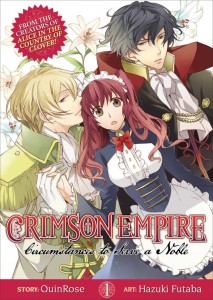
crimsonempire

That said, the volume opens awfully well. Our heroine is a street rat somewhere in Anime Arabia, who sells her soul to a demon (who notes she has quite a future ahead of her – though good or bad, he can’t say)and becomes an assassin-cum-bodyguard, defending Prince Edvard from the many and varied people trying to kill him – including Justin, his own half-brother. Oh, and of COURSE, she has to dress up as Head Maid. After all, this is the aristocracy, and we can’t just have women walking around in suits.

I made this sound a bit more fetishy than it actually is, to be honest. The fanservice is nil, and this is definitely a josei title. Sheila is quite similar to Alice, though a bit stronger and more broken (she’s been through a bit more), and as with Alice, the various men around her are Otome Game types, where the player can choose to interact with their favorite. In terms of manga plot (vs. game plot), the first volume is quite simple. Sheila prevents people from murdering Edvard, Edvard snarks and acts nice on the outside but evil on the inside, Justin is the opposite, etc.

The difficulty here is, even with a ‘Cast of Characters’ page at the start, there’s simply too many people introduced too fast. Things aren’t helped by the fact that this is a semi-sequel to another Otome Game, Arabians Lost, which introduces a few characters from that series and mentions the Queen, who was the player character. Moreover, Sheila seems to have past relationships with several of them, which don’t come off as “Well, the manga will catch me up on their shared history” as much as “I feel I missed something, I should go buy the previous game this is clearly meant to be pimping out.”

From a manga perspective, the plot simply meanders. Given there’s less of a desire to see who Sheila will end up with (she’s sold her soul, so it’s sort of irrelevant, as she’ll end up with the demon one way or another), the need to read this likely hinges on how much you enjoy seeing Sheila interact with the characters around her. This isn’t helped by Sheila being, so far, the most interesting character. I also can’t help but compare the guys to the Alice series – Meissen, for one, is clearly Ace with the serial numbers filed off.

This is only three volumes, so I do recommend it if you like the Alice series in general and are a fan of this sort of josei “girl surrounded by pretty boys” series. But plotwise, it really needs to sort itself out. More scenes like the bleak opening, which was excellent.


Blood Lad, Vol. 2

By Yuuki Kodama. Released in Japan by Kadokawa Shoten, serialization ongoing in the magazine Young Ace. Released in North America by Yen Press.

The second volume of Blood Lad improves on the first, and this has become a nice, solid series. The lead is different in an interesting way, the otaku humor is fit in better, we meet several new possibilities for antagonist, and the fighting and humor are top notch. There are still issues with the heroine, but I can’t have everything – and besides, this runs in Young Ace to begin with.

bloodlad2

Let’s start with Fuyumi, actually, as we do get a bit of a hint that there’s more to her than previously thought. Her mother has passed away, and Braz indicates in his usual vague yet evil way that she has a connection with Bell. It would not particularly surprise me if she turned out to have some demon blood in her (related to Bell?), which could possibly lead to new plot possibilities and a cure for her current condition. That said, I doubt it will lead to a cure of being Miss Fanservice. The scenes where she is sucking on the phallic water bottle made my eyes roll back so far into my head I worried I’d have to see a doctor.

That said, I’ve seen much worse fanservice than this, and the rest of the title more than makes up for it, particularly our reluctant hero. Staz’s limiter is removed in this volume, making him even more powerful than before – dangerously powerful, everyone notes. And yet he’s not all that hot-blooded of a shonen hero. Oh sure, during a fight he’ll get fired up, but there’s a passivity and caginess to Staz that really makes him appeal to me. He’s not going to go charging headlong at an enemy – well, not unless there’s a good reason to. Or they have a DVD set.

We also see more development of Staz’s two siblings. Braz is handled better, and walks a nice fine line between being an evil mastermind and being a supportive brother. He’s likely both, so that shouldn’t be too much of an issue. As for Liz, every fear I had about what she’d be like after finishing the first volume turned out to be absolutely correct. That said, she’s cute and harmless, so I’ll just roll with it. The scenes of her bonding with Staz and Fuyumi over watching Laputa: Castle in the Sky is sweet and adorable.

Lastly, here’s a rarity for a shonen manga (yes, it runs in Young Ace, but there’s absolutely nothing in this that shouldn’t be in Shonen Ace too); it’s very well-paced. No subplot outwears its welcome, and even the fights seem to be exactly the right length. This could be simply as everyone is very clever here. Staz shows it the most, but there’s a genre awareness here that permeates into all the characters, allowing it to get away with things that a reader wouldn’t otherwise accept. Combine that with a great sense of humor, as well as a worldscape filled with vampires, werewolves and demons, and you have something that should be a can’t miss it over here.

Love Hina Omnibus, Vol. 5

By Ken Akamatsu. Released in Japan by Kodansha, serialized in the magazine Weekly Shonen Magazine. Released in North America by Kodansha Comics.

When I reviewed the first omnibus of Love Hina, I noted that one of its major faults was that, compared to the pacing of the end of the series, it seemed glacially slow. Now we’ve gotten to the final volume, and I’m starting to see the opposite problem. Akamatsu has discovered he can do fast chases well, so after an entire volume spent chasing Naru to the north of Japan, we get another one devoted to chasing Keitaro around the MolMol Kingdom, with all the wacky hijinks that entails. Indeed, reality, which always had a tenuous hold on this series anyway, seems to mostly go out the window here.

lovehina5

As you can see, Kodansha spoils the entire volume on its cover (I have this image of Angry Naru haters replacing her head on the cover with Motoko or Kitsune or whoever and giggling). Yes indeed, the series does end with a wedding. But before that, we have to run through the pick of the best of some of Love Hina’s Greatest Hits, Vol. 2. Which means archaeological ruins, chase scenes, the girls all trying to stop Keitaro and Naru simply because the plot requires it – indeed, Su basically admits she’s only doing this for fun. Speaking of Su, turns out she’s MolMol’s princess, which probably gives some justification as to why she acts the way she does. Motoko gets a lot of stuff to do at the start of this omnibus, even if most of it is a repeat of a previous volume (notice a pattern?). Shinobu less so, but at least she gets out a confession. And Seta and Haruka get married, in one of the fastest weddings you’ll ever see, barely giving Haruka a chance to turn red.

As for Keitaro and Naru, well, life continues to conspire against them. A popular fan theory is that the universe LITERALLY does not want to see them together, and constantly sends disasters their way just to prevent it, and you see a glimpse of this sort of thing here. Things aren’t helped by Naru, who clearly loves Keitaro, wants to become more intimate with him (she takes him to a love hotel here)… but still has issues that lead to disaster and Keitaro getting whacked. (I’m a huge foe of the “Naru is insane and needs therapy” fandom block, mostly as it rarely comes from sympathy, but I will admit I do wonder if something in her childhood happened that led her to be this twitchy.) As for Keitaro, by now he’s accepted his lot in life, freely admitting his supposed immortality and going with the flow provided the flow takes him back to Naru.

The title ends with an epilogue showing the Hinata Inn four years later, with the arrival of a new girl who’s heard it’s legendary for helping hopeless students get into Todai. She’s essentially a female Keitaro, so it’s no surprise that she runs into the residents of the inn (now older) naked, accidentally screws something up, and ends up in a giant chase scene. And if she’s Keitaro, then who does Keitaro get to be? I think most of the “Keitaro turns into Seta Mk. 2!” fan displeasure came from this epilogue, where admittedly he pretty much does act like Seta. But then again, a relaxed Keitaro who’s resolved his Todai and love life issues may very well go in that direction… we’ve seen how Seta and Haruka parallel Keitaro and Naru to begin with. More likely, he was Seta’d up to make the situation funnier, because this is still a manga.

And so in the end I think I have finished unleashing all my inner fandom demons at Love Hina, and can appreciate it for what it is; an intermediate work of Ken Akamatsu’s, filled with memorable characters, sweet moments and a lot of humor, but also poorly paced, about 5 volumes too long, and over-relying on physical comedy. His next series, Negima, gets better at all of these, but still has the same essential weaknesses. Luckily, his strengths also get even stronger there. So let’s leave Keitaro and Naru, married now, living at the Hinata Inn and no doubt spawning a new generation of comedic misunderstandings that could be worked out if only anyone would stop for two seconds.