Monthly Archives: May 2014

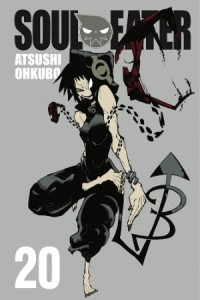
Soul Eater, Vol. 20

By Atsushi Ohkubo. Released in Japan by Square Enix, serialized in the magazine Shonen Gangan. Released in North America by Yen Press.

So much of what has gotten me addicted to Soul Eater comes to a climax in this volume. The discussion of madness and knowledge, and how the two sometimes interact. The artstyle, which lends an air of disturbing surrealism to any actual depiction of madness on the page, from Crona’s twisted grins of despair to a ball of black poisonous concentrated insanity. And of course we have the culmination of Medusa and Crona’s relationship, which has always been shown to be awful, abusive and toxic, but in the final chapter is given even more nightmarish proportions, to a point where there seems to be only one solution to the whole thing. Killing.
souleater20

Speaking of madness, though, I liked the battle between Justin and Tezca, particularly with Justin pounding on about faith in the Kishin, and Tezca wondering how strong a faith can be when it simply switches over to the next big powerful thing to fear/worship. There are a lot of terrifying things going on in the Soul Eater universe, so it’s understandable that one would want to ally oneself with the strongest even if it means sacrificing ideals. I’m not really sure Justin had any ideals to begin with, though – the confrontation loses something as it’s sort of obvious that Justin is never going to go back to the side of the heroes.

There is a scene with Sbhinigami and Kid where they argue about whether they should have gone into Baghdad to find the Kishin just because they knew there were anti-DWMA groups there, with Kid noting that they didn’t find anything, and Shinigami saying he was sure they’d find the Kishin there. I’ll just leave that here. Sometimes something is so blatant that even analyzing it would be overdone.

Maka and Soul get some nice stuff as well, with Soul managing to control the madness with in himself, but I want to talk more about Crona. Crona spends the first half of the book using black blood to destroy and drive insane anything that barrels into Crona’s path. Now in Russia, we see an entire city in the Ukraine where the populace are driven into madness and turn into a huge ball of madness. It’s especially chilling as it’s implied that those people can’t be brought back – that they are, essentially, dead. Like Justin, Crona’s last attempts at redemption seem to have come and gone. Unlike Justin, we still have some sympathy for Crona.

Let’s talk about the final chapter, ‘Just A Simple Story About Killing A Person’. It’s a two-hander between Crona and Medusa, who is at her most monstrous here. Crona’s backstory and childhood is every bit as bad as we feared, if not worse – from the stick-figure styled book about different ways to kill, to being starved to death unless Crona kills adorable baby bunnies, it’s all been designed to drive Crona to the very brink of madness, with Maka’s friendship being the only thing that ever held Crona back. And now Medusa needs to complete the descent, and does it in such a clever way, I almost have to admire her loathsome craftiness. She’s died in the series before, but I’m fairly certain that this time she’s died for good. But she got what she wanted – Crona is primed, ready to go, and completely insane.

As I said earlier, the art plays a major role in making this chapter as effective as it is – stick figures have never been so terrifying. And what’s more, it makes for a truly chilling cliffhanger. And next time, we start the final arc. An absolutely essential volume of Soul Eater. Even those who don’t read it should get it for the final chapter of the book.
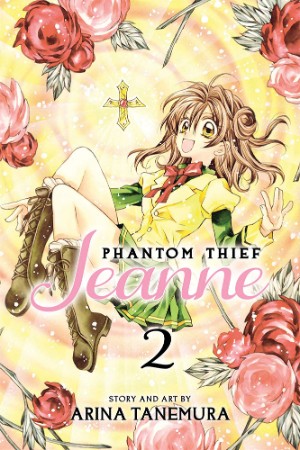
Phantom Thief Jeanne, Vol. 2

By Arina Tanemura. Released in Japan as “Kamikaze Kaitou Jeanne” by Shueisha, serialized in the magazine Ribon. Released in North America by Viz.

When I reviewed the first volume of this Tanemura magical girl title, I noted that her parents splitting up and suddenly moving out of the country looked ‘suspicious’. Well, it turned out to be more prosaic, as in this volume Maron gets notice from her mother that they are indeed getting a divorce, something that sends her running away from everything for a while. I will admit, despite one of those “didn’t you see that they built this amusement part because they love you’ moments, these are still two parents who are not going to be winning awards anytime soon. They’re lucky that Maron has survived with only minor ‘screwed up’ tendencies. The rest of the volume continues to show off Jeanne’s skills as a phantom thief, as well as the author’s skill for giving a touch of darkness to the standard magical girl genre.

jeanne2

Speaking of families, this volume seems to focus on them quite a bit. First Chiaki’s father is possessed by one of the paintings, causing him to kidnap young women and store them in glass cages in his basement (something that really gives maximum creep factor, particularly as his father is such a weirdo to begin with). Then Miyako comes to Jeanne for help, despite their rivalry, and asks her to steal a painting that has corrupted her scientist brother, who is now turning to mad science (complete with “they laughed at me at the academy” overtones). This is all done with maximum threats of peril and also allows Jeanne to show off her skills at being clever, particularly in the first part where she uses the realistic android-like ‘dolls’ to her advantage to pull a switch.

Miyako also gets a side chapter going further into her motivation for chasing Jeanne. I have to say that she’s probably my favorite character in the series, and most of the time she seems to understands how Maron thinks better than she does. There is the small matter of her being unable to connect Maron to Jeanne, but that’s a standard trope of this genre, so I’m inclined to let it slide. (Honestly, given how things are playing out, I would not be surprised if Miyako had figured it out at some point and is just going along with it by now. Particularly when Jeanne is being far too knowledgeable about her brother.)

There is a lot less of the heaven vs. hell aspect in this particular book, with the exception of the final chapter, where Jeanne finds herself in a deathtrap without her transformation abilities or her familiar and has to power up through sheer force of will. This is referred to as “Holy Power”, and seems to delight Finn (who we see far less of this time around, which pleases me as she’s annoying). There is one line that really struck me, however, and I suspect it will be followed up on in the next volume. She’s thanking Chiaki for helping her as Sinbad, and notes “I didn’t know followers of the demon lord used a cross as well.” As she toddles off, Chiaki stares and goes “what is she talking about?” To me this suggests that we’re not looking at a simple battle between heaven and hell. I can’t wait to see more with the next volume.

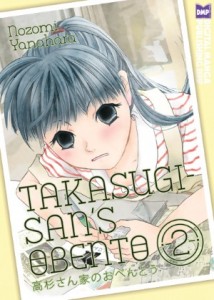
Takasugi-san’s Obento, Vol. 2

By Nozomi Yanahara. Released in Japan by Media Factory, serialization ongoing in the magazine Comic Flapper. Released in North America by Digital Manga Publishing.

In general, one of the more disliked traits in manga among Western fandom is the oblivious harem hero who cannot see the obvious crushes that all the girls have on him, and wonders why it is he’s so unpopular. I agree 100% that this can be aggravating, but I have to admit that I am so very happy that Harumi, the start of Takasugi-san’s Obento, is exactly like this. Because the longer he keeps trying to act like a father and close family member to Kururi and doesn’t notice her blushes and googly eyes whenever he’s around, the happier I am. Mostly as despite the threat of this happening, this is a very good manga, with Vol. 2 having lots of great moments.

obento2

I’d mentioned in Vol. 1’s review that Natsuki, the snarky girl who was introduced to be the class bully but actually formed a close friendship with Kururi, reminded me strongly in both looks and attitude of Shinobu from Hakusensha shoujo series Teru Teru x Shonen. That opinion is reinforced by my favorite chapter in the book, where they start a new year only to find that Kururi and Mitsuru, the two that she’d bonded with, are in another class, leaving her alone with all of her former friends and cronies, who are very bitter about Natsuki changing her affections to the quiet weird girl. And so the bully becomes the bullied. That’s not what I liked about the chapter. What I liked was the way Natsuki handled it, being totally aware of what was going on, and then taking the earliest opportunity to gain the upper hand and reassert her position. We do see a teacher talk about stepping in, which is good, but I enjoyed seeing Natsuki being empowered again all by herself.

It also helped that she used a bento to do so. This still is not quite a foodie manga, but food certainly plays a major role in it, with Harumi and Kururi constantly trying new things and enjoying seasonal treats – even if their cooking skills don’t necessarily match up with their intentions. This is true of Harumi in general, who continues to be very awkward with most social interaction, and has a tendency to not think about what others around him might be feeling before he decides on a course of action. This is, of course, part of why he’s still an oblivious harem protagonist. The author’s notes said she has fun with him beign a passive, sad guy. Kururi, on the other hand, is a full-blown introvert, and this is also shown very deftly in several chapters.

Finally, let’s go back to Kururi’s crush. It’s still there, and everyone but Harumi seems to be aware of it. I was very grateful for the expansion of Mitsuru’s role, as he’s not only an age and family-appropriate rival, but his bluntness about liking Kururi and reminding her of it – a lot – is refreshing. That said, that sort of guy often ends up on the losing side in these sorts of mangas. His older brother, who’s in Harumi’s workplace, is more a fan of passive-aggressive poking – his queries at Kosaka are clearly meant to force her to admit that she has a crush on Harumi, and since she doesn’t admit it he wants to go for it as well, but is not as self-confident as his younger sibling. Normally all these harem antics would be annoying, but here they are giving a hint that maybe the manga won’t end like we fear.

Despite that fear, I still greatly enjoy Takasugi-san’s Obento, which hits a lot of my buttons, and reminds me of the old CMX shoujo days, despite being a DMP seinen title. Recommended for heartwarming comedy with lots of food.