Monthly Archives: May 2014

Dorohedoro, Vol. 12

By Q Hayashida. Released in Japan by Shogakukan, serialization ongoing in the magazine Ikki. Released in North America by Viz.

This volume of Dorohedoro is particularly good at showing off all the myriad reasons why it’s become one of the more addicting seinen manga out there. There are some amazingly violent fight scenes, some hysterical humor, a dose of complete insane weirdness, and some truly visceral horror – and not body horror this time around. I had wondered at first how long the series could keep its premise up, now I worry that with the series ending in Japan soon it won’t have time to tell me everything that I need to know.
dorohedoro12

Let’s start with the violence, which spirals out after En’s death. And En definitely appears to be dead this time, though there’s a suggestion they can reverse it if they find Judas’ Ear, who is missing. En’s people are somewhat gutted by this – even Noi, who notes that she hated En for forcing her into all of this, but still feels at a loss. As for Fujita, he’s absolutely devastated, having flashbacks and trauma from finding the body. Luckily, Shin knows that everything will be solved by finding the parties responsible and killing them. Finding the cross-eyes is the next step, and killing them mostly goes well, at least until the climax. Hayashida knows just how to choreograph fights, and also that her audience does not mind seeing splattered limbs.

Her audience also wants a healthy does of humor and weirdness, both of which dovetail nicely with the creation of a living En doll to try to lead them to the location of the real En, assuming he is alive. This involves baking a giant pizza, out of which the doll En them rises. If you can’t quite understand what I’m talking about, that’s because it makes no sense unless you see it. Any time Turkey appears things are odd, but this one takes the biscuit. We then get a very amusing chase scene, as the Doll En has a mind of its own and is not interested in letting Shin and Noi keep up with it. If you combine this with the ongoing humiliation of Natsuki (involving nudity this time, natch), we’ve got a lot of laughs in here.

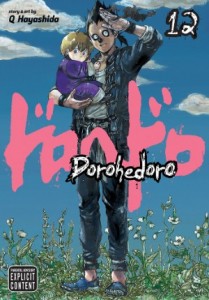
But what I suspect folks will take away from this volume is the flashback that explains Nikaido’s past, who she’s so reluctant to do magic, and the horrors of time travel. Some lessons, particularly when you’re a child, need to be learned firsthand, and this is a particularly horrifying and bitter one for Nikaido, whose friend is lost forever thanks to her own folly about time magic. It contrasts with the cover art with Asu and a child Nikaido, with a blue sky and blooming flowers belie the serious contents within.

And so, in the end, we have something for everyone, a little bit of plot advancement, a lot of weird humor, and some terrifying existential terror. In other words, all the reasons to read Dorohedoro, encapsulated in one book. At least until the next volume, when I assume we’ll find more. We even see the gyoza fairy again!

Bunny Drop, Vol. 10

By Yumi Unita. Released in Japan as “Usagi Drop” by Shodensha, serialized in the magazine Feel Young. Released in North America by Yen Press.

Yen Press very helpfully published an interview with Yumi Unita at the end of this final volume of Bunny Drop. In it she states that she had planned what happened in Bunny Drop from the start, and that she wanted to contrast it with the manga she was writing for rival publisher Takeshobo, Yoningurashi. A quick Google search led me to learn that Yoningurashi, aka The Four of Us, was a series about a couple raising two young children. And suddenly a lot of what happened in Bunny Drop makes more sense. Or more accurately, what didn’t happen.

bunnydrop10

See, I had expectations when I started reading Bunny Drop, before *those* spoilers came out. I expected what we got for the first four volumes, aka Daikichi’s learning how to be a parent and raising Rin in adorably heartwarming ways. But I also expected that he’d end up hooking up with Kouki’s mother, and that they’d raise Rin and Kouski as a family. Sure, I expected Rin and Kouki to hook up later in life, but honestly, I’ve been reading about ‘but we’re not really siblings’ love since the days of Marmalade Boy, so it didn’t really bother me.

Of course, we did not get that. Instead, Unita contrasted Bunny Drop with her other series by subverting every expectation we had. And I’ve got to hand it to her, it certainly worked, though in the end I’m still left with a feeling of massive frustration. This is not helped by the stories in this last volume, which go back and fill in some blanks from earlier in Rin’s life. We see heartwarming and amusing parenting as Daikichi tries to explain ‘why we don’t always kill bugs’ to young Rin. We get a tortuous ship teasing scene between Daikichi and Kouki’s mother after Kouki gets in an accident and Daikichi has to take care of things, where by the end you are screaming at the two of them to just kiss already. (Spoilers: they don’t.) We get some backstory explaining how Rin’s mother ended up with her manga assistant/lover, and how Kouki fell into delinquency (and then out of it) in middle school. Honestly, they’re all well-written and pretty fun.

And then we get a final story showing Rin and Daikichi, who have now been a couple for several months. And really, seriously, nothing has changed. I approve of Unita not showing us their sex life, but honestly without that you’re left wondering why any of this happened at all. (Things are not helped by adding a girl who not only Kouki but also the reader had forgotten, and seeing about hooking him up with her at the VERY last minute.) Unita noted that she tried to avoid Rin’s inner monologue in the ‘pre-timeskip’ period, and avoid Daikichi’s afterwards, but honestly all this has done is made us wonder about how any of this came about, particularly with Daikichi, whose love for Rin and desire to let her do this seems to come down to ‘well, OK, I guess.’

So in the end I liked individual parts of this story, but am very dissatisfied with how it came together as a whole. Particularly as there was a story that was being made really obvious and heartwarming that wasn’t told here. Now, part of that may be me as a reader projecting out on what wasn’t really intended, but given the general negative reception Bunny Drop has had post-timeskip, I don’t really think it’s just me. I’d suggest someone write some fixfics, but I’m not sure the series has enough of a fandom. In the end, Bunny Drop was an interesting, fascinating, and uniquely annoying series that amazingly I still think is worth reading anyway, provided your dentist doesn’t mind the loss of enamel you’ll have from grinding your teeth.