Monthly Archives: December 2014

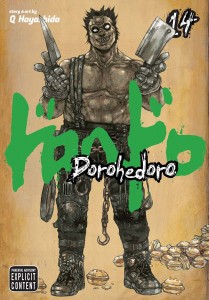
Dorohedoro, Vol. 14

By Q Hayashida. Released in Japan by Shogakukan, serialization ongoing in a Shogakukan magazine to be named later. Released in North America by Viz.

I pretty much had my jaw on the floor through this entire volume, though halfway through it changed from boggling at Nikaido to boggling at Kai and company. As always with Dorohedoro, there’s a lot going on and it’s pretty unforgiving to those who don’t remember previous volumes, but that doesn’t stop it from being a stunning read every time. In addition, we get another reminder that behind all these masks, many of the main characters are female. Gender reveals of Nikaido and Noi occupied Volume 1, but Hayashida still enjoys doing it, so we get two more here (though I think we already knew them and I had forgotten).
doro14

A couple of vlumes ago I had discussed Nikaido dealing wht her past and childhood, and how the misuse of her magic led to her best friend being erased from existence. This in turn led to her suppressing her own powers. So now that her power is needed, we have to have some shock therapy to speed things along. I could have done without the attempted rape dream sequence, to be honest, but it is a dream sequence, and ends up being more about Nikaido confronting her own fears and demons. Once that happens, not only is she gaining the abilities (and looks!) of a devil, but her power is now kind of scary. We see this as she returns to her own past, and this time manages to save her childhood friend and set time right (sort of). Nikaido’s abuse of time powers was a powerful message in the earlier books, but it’s now come full circle, and I was stunned.

Meanwhile, most of the second half of the volume deals with Kai’s rampage against sorcerers, who he and his gang have been slowly killing off. Dokuga and company are feeling a bit uncomfortable with this, but “the boss” is still “the boss”. Natsumi has disappeared, though, and just isn’t answering her calls. There’s an air of something about to snap here, and it all comes to a head in Tanba’s restaurant (also providing a good excuse to put him on the cover), with a huge fight that ends with Kai getting his face literally cut off by Kirion… not that this stops him, as several more heads (apparently devil tumors?) arise from the wreckage, and now Kai seems to be Aikawa. The whole Kai/Ai/Caiman/Aikawa thing the series has been playing with is about as close to getting confirmed as possible here.

The remains of En’s merry band don’t get as much to do here, though they do send Fujita off on a reconnaissance mission to find En’s devil tumor. No one is more surprised at this than Fujita himself, but Sho informs him that he is “the one who loves En’s family the most’, which is really sweet. Oh, and in case you were wondering about Ebisu, she provides the best moments of humor, with her puppet conversations, and also a brief moment of heartwarming, as she wishes Fujita good luck after he’s left (because God forbid he should hear her or something).

When Dorohedoro finishes, it’s going to be one of those series that’s amazing to marathon in one whole sitting. Till then, we are grateful for getting these volumes at four-month intervals, and the next one can’t come fast enough.

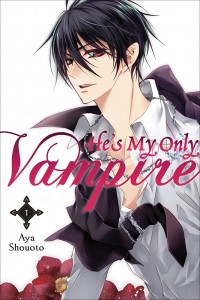
He’s My Only Vampire, Vol. 1

By Aya Shouoto. Released in Japan as “Junketsu + Kareshi” by Kodansha, serialized in the magazine Aria. Released in North America by Yen Press.

In general, when I’m reading a manga I am looking for an entertaining story that draws me in and makes me want to read more. The originality of that story, however, is way down on my list of necessities. I don’t need a title to be different from all those other titles, I just want it to be well-told. So don’t take it the wrong way when I say that there really isn’t much that is original in this series at all. The author is quite familiar to these shores, as Kiss of the Rose Princess, which runs in Asuka, came out a month or so ago. This is a more serious story so far, though there are light-hearted moments. But for the most part, as I went through I was quite happy with what I was reading, even if I kept thinking “This reminds me of Vampire Knight” or “This is just like Millennium Snow”.

onlyvamp1

Kana is a tomboy-ish heroine, popular at school, who seems to be good at everything, to the point where she joins three clubs a day to help out, then just as swiftly leaves. Of course, this is actually the result of not one but TWO tragic pasts – as a child, she was in a fire that took the life of two twins she was best friends with, and later, while running track, a delinquent’s misfired prank (also involving fire) results in a broken leg AND ligament tear, ending her career. So she’s at a loss in regards to life. The delinquent is still around, trying to make amends as he clearly is starting to fall for her, but that doesn’t seem to be where this story is going. No, instead she runs into one of the twins, now alive – and a vampire!

I frequently joke about titles being licensed only because there are vampires in it, but they’re a popular fictional genre, allowing readers to indulge in forbidden sexuality and darkness. The scenes of Aki (said vampire) biting Kana are drawn sensuously, and you can tell that there’s more pleasure than pain at work here. There’s a certain amount of subservience here – Aki declares Kana is his thrall, and describes her as his “food”. But the narrative starts pushing back against that fairly quickly – he’s clearly acting distant to cover up his feelings, and when he gets into a fight with Jin (the delinquent I mentioned earlier), Kana shows that she will not be content to simply stand there. Actually, the way she stops the fight is really clever, and my favorite part of the book.

There’s a lot of plot hints dropped here that I’m sure will play out in future volumes. Jin transformed into a wolf-man hybrid towards the end (see why I mentioned Millennium Snow?), Aki’s twin Eriya seems to be alive but in some sort of stasis (or perhaps evil?), and we see someone who seems to be either Aki’s boss or enemy clearly dislike what he’s doing (because of course vampires have rules that cannot be broken.) That said, the series (just ended in Japan) is 10 volumes long, so I imagine we’ll get our answers soon. There’s a lot of stuff you’ve seen before in this series, but it’s told well, and for me that’s what matters. Recommended, particularly if you like supernatural romance.

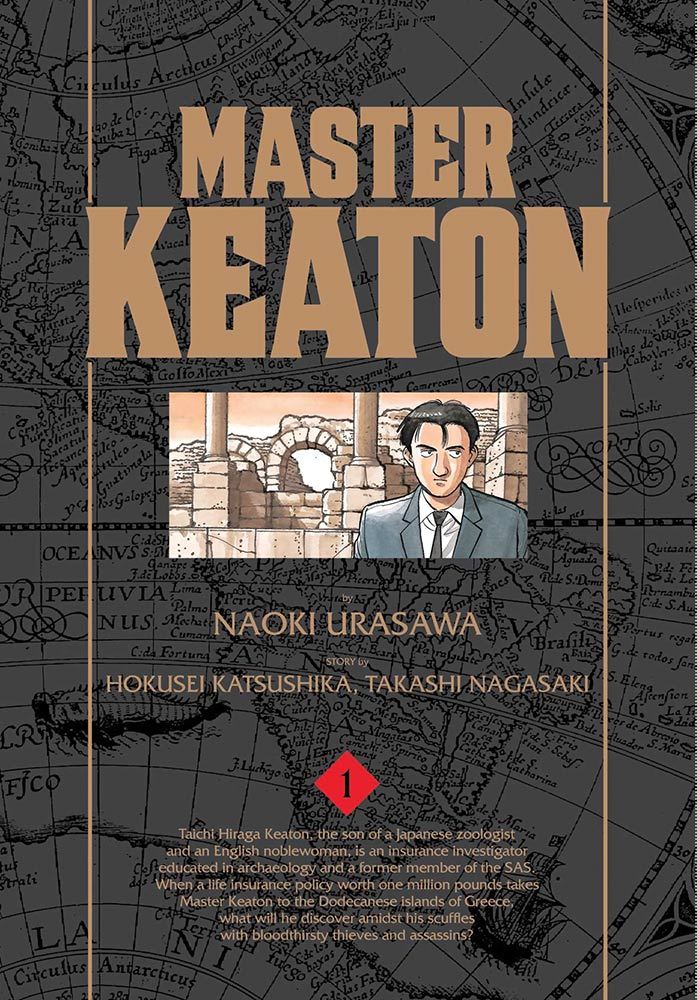
Master Keaton, Vol. 1

By Naoki Urasawa, Hokusei Katsushika, and Takashi Nagasaki. Released in Japan by Shogakukan, serialized in the magazine Big Comic Original. Released in North America by Viz Media.

A long awaited release on these shores, this is the sort of title that you’d have expected to be licensed back in the old Viz days of the early to mid 90s, filled with Crying Freeman and Mai the Psychic Girl. The series had an anime in the 1990s, but by then the fashion for seinen had passed, and it’s taken a resurgence, helped by the cult popularity of 20th Century Boys and Monster, to see the series out here at last as a deluxe Signature edition. There’s also some question over the actual creation. When it came out in the late 80s, it was credited to Katsushika as the writer and Urasawa as the artist. After Katsushika’s death, Urasawa claimed that they’d fought early in the series, and from that point Urasawa did the story himself, a viewpoint which has led to some criticism. Also, the third author on the cover is the writer for the CURRENT Master Keaton revival, which started in 2012, and which… isn’t this. (As with many Signature releases of older works, this is a release of the Japanese re-release, which may have updated art/storylines.)

keaton1

What is this, then? It’s been called “Indiana Jones manga”, but I’d compare it to another 80s icon, MacGyver. Taichi Keaton is a former SAS soldier turned freelance insurance investigator for Lloyd’s of London. He looks into wrongful death claims, art forgeries, and archaeological digs, all the while finding trouble and managing to maneuver his way out of it by virtue of his amazing survival skills. Sadly, he’s not nearly so competent in his personal live, being divorced and having a teenage daughter, Yuriko, who seems to find her father admirable and aggravating in equal measures.

I understand her frustration. Keaton is a man who it’s easy to admire but hard to like. His lax personality was highly popular at the time, and makes a nice change from, say, Golgo 13 (a series Katsushika also wrote for) or Crying Freeman. These days I think a reader might find it trying, especially his obsession with his ex-wife getting together with someone else (we never see the wife, and actually it occurs to me that Yuriko may have made the whole thing up to attempt to spur him into action). Later in the volume we see Keaton’s father, whose name he disavows (he takes his mother’s last name), and he’s also an eccentric, frustrating individual, who Keaton probably takes after more than he’d like. Keaton as a man seems mostly half-baked and half-hearted.

The series is on firmer ground with the mystery stories, which much of the time turn into spy stories. Master Keaton began in 1988, at the tail end of the Cold War, but feels more like an early 80s tale, with the Communists still exerting their hold behind the Iron Curtain. I wonder if we’ll see that change as the series went on – it lasted till 1994. The first few chapters are not fleshed out enough – Keaton is the sort of story that requires a bit of room to breathe, particularly with all the exposition, and it’s no surprise that it’s the multi-chapter works that are the best in the volume.

Master Keaton, in the end, is classic seinen. If I said this was a mystery series in Big Comic Original in the late 80s, the well-read manga fan would likely be able to predict precisely the types of stories you’d see here. But it’s very well-told, as expected from Urasawa, and when he’s not getting involved in personal business, Keaton makes an excellent investigator. I’ll definitely be picking up more.