Monthly Archives: December 2014

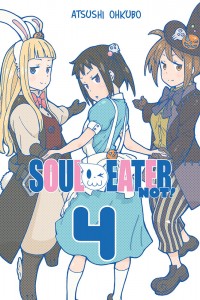
Soul Eater Not!, Vol. 4

By Atsushi Ohkubo. Released in Japan by Square Enix, serialized in the magazine Shonen Gangan. Released in North America by Yen Press.

I had thought that this was the final volume of the series, but apparently not, as there’s an unscheduled Vol. 5 that is likely waiting for a sufficient distance from the Japanese release. It’s unclear whether the plot of the manga will follow the anime, which had already finished (with Ohkubo’s advice) before this ended. That said, we have here a manga that still has the same problems which the first volume possessed, but is also adding some new ones, such as whether a typical ‘yuri’ fan is supposed to enjoy the series or be really pissed off about it, and how much serious plot you can have in a moe slice-of-life type manga before it really starts to feel out of place.
souleaternot4

Please note that by yuri fans I mean MALE yuri fans, the sort who would be quite happy to see the pairings end in a threesome, and who aren’t put off by the chapter of Meme running around naked that we see here. That said, fanservice isn’t everything, and I think most modern yuri fans are finding that the traditional tease just isn’t enough. Kim and Jackie are another good example – there’s lots of suggestion here that Jackie is in love with Kim, and some hints that Kim might one day return it… but this takes place before Soul Eater, where Kim and Ox become a couple. There’s no there there, it’s done solely to be ‘cutesy’ in a harmless way. Likewise, anyone who thinks that the ‘who will Tsugumi choose?’ plotline might actually involve genuine love and emotion has to be appalled at the aforementioned scene with the girls trying to sleep on a very hot night, which, fanservice aside, seems to show off the ‘immaturity’ of the girls for those who want a safe out.

That said, the other suggested romance in the series, that of Tsugumi and Akane, also seems to have vanished, and the manga is happily settling into focusing solely on our three heroines. There is also, among the jokes and 4-koma, a suggestion of the deeper ongoing plot. Eternal Feather is still recovering from her brainwashing two volumes ago. More importantly Meme’s memory issues, which have been used for comedy to this point, are getting to be a bigger and bigger issue, one that causes genuine concern. The final scene of the book is heartbreaking, as Tsugumi tears into Meme for what she sees as an annoying quirk (Tsugumi dealing with grief over a dead pet right now), but then stops seeing Meme expressing real sadness that she forgot something important again. It’s been vaguely implied she’s a mole for the villain, and I wonder if this is connected to that.

Soul Eater Not! is doing its best to try to appeal to a broader otaku market here, but it feels too pandering, to be honest, and could use more seriousness and heart. It still has some strengths – Anya has developed into the most sensible character of the bunch, and is a far cry from the tsundere princess she started as – but really, Soul Eater fans are better off with Soul Eater, and moe/yuri fans can find material that will give them better jokes and a better payoff than I expect this to have.

Yukarism, Vol. 1

By Chika Shiomi. Released in Japan by Hakusensha, serialized in the magazine Bessatsu Hana to Yume. Released in North America by Viz.

I wasn’t really sure what to expect of this new shoujo series going in. I was pleased to see it ran in Betsuhana, as Hakusensha licenses have been very slim ever since Tokyopop collapsed. I hadn’t read either Yurara or Rasetsu when Viz put them out, though, and mostly what I knew was ‘does supernatural romances’. And I suspect that’s what this is as well, but at least for the first volume, the romance is very much on the back burner. No, this is a manga that draws you in very simply: the premise is terrific, and you want to see more of the characters. In the end, that’s what makes for an exciting title.

yukarism1

Our hero is Yukari, a teenaged author who’s already famous for the astounding realism of his Edo-era works. He meets a girl who’s infatuated with his books, but she’s shocked to find that her impression of him is almost 100% wrong. Writing for Yukari isn’t so much writing to please an audience or even himself, but merely being able to conjure up the Edo period. At first we think that this series is going to start the girl, Mahoro, and deal with her goofy attempts to get the quiet, reserved guy to like her. But then Yukari collapses, and when he wakes up he finds himself in his past life – as an Oiran in the Edo period.

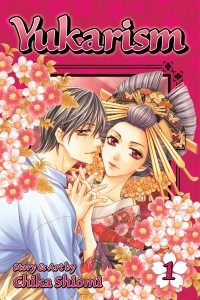
Yes, that’s Yukari on the cover, both as his present-day writer self and his past life. He’s not particularly good at imitating his past self’s attitude and mannerisms – or even getting the walk right – but seems to be picking it up as he goes along. Moreover, many of the people he sees in the past also seem to be reincarnated in the present, though they may not realize it – including the Oiran’s beleaguered bodyguard, who reminds him of the girl he’s just met. Why is he time-skipping? Well, we don’t find out in Volume 1, but given this series is only four volumes long, we should know very soon.

This is very likeable. Yukari is a bit standoffish, but he’s not a jerk like many shoujo heroes start off as. Mahoro’s a bit eccentric, and a bit quick to jealousy, but also comes across as very likeable. It will be interesting seeing whether Yukari can jump-start the past life memories in others – towards the end of the book we see Mahoro immediately despising a new arrival, but having no idea why – the reader has already guessed it’s actually her unconscious recall. The art, as you can imagine given it’s an old pro and this is Betsuhana, is also gorgeous, with just the right amount of superdeformed silliness to add spice.

So I’d actually call this series a mystery more than a shoujo romance. What’s going on with Yukari? Is he doing this in order to solve how “he” died in the past? Will memories of their past lives screw up any relationships in the present? I’m not certain, but I definitely want to know more. A very strong debut here.

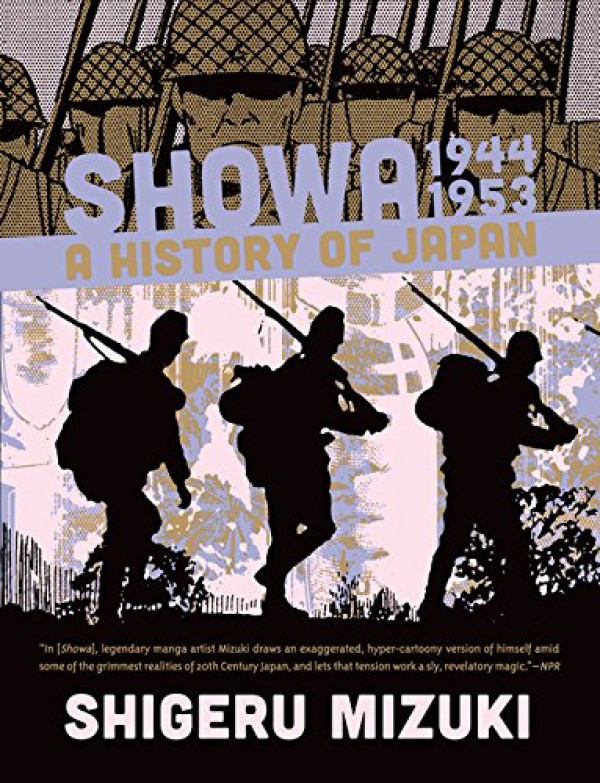
Showa 1944-1953: A History of Japan

By Shigeru Mizuki. Released in Japan as “Comic Shouwashi” by Kodansha. Released in North America by Drawn & Quarterly.

I was somewhat deceived by the cliffhanger in the last volume, where I felt that I’d gotten to the incident that caused Mizuki to lose his arm. In fact, it’s yet another breathtaking escape from the jaws of death, and the arm is lost much later in the narrative, when he lies delirious from malaria in the camp hospital. It’s fascinating how often he was nearly killed – indeed, it’s especially amazing given how often his squad was sent on suicide marches. He was the only survivor from his original squad, and this is looked upon as extremely shameful by the officers – why didn’t he die nobly? As ever, though, Mizuki seems not to think too hard about all of this, and is mostly concerned with food. At least, the Mizuki we read about here. The author knows very much what he’s saying in this volume, condemning the Japanese higher-ups for needless sacrifice.

showa3

The story continues to shift back and forth between Mizuki’s account of his own experiences during and after the war and the historical narrative being presented by Nezumi Otoko (who is briefly joined by two other yokai from the Kitaro series, possibly as Mizuki wanted to distract from some especially dry history). In the earlier volumes, I was more riveted by the history than I was my Mizuki’s biography, but here my interest began to shift, and I found myself wanting to learn more about this man and his determined survival traits, which again are consistently portrayed as being due to happenstance rather than any cunning or intelligence. Mizuki drifts through life during and after the war, and his creation of Kitaro – then known as Graveyard Kitaro – doesn’t even merit a panel, instead being framed as part of the larger narrative of his inability to succeed – Kamishibai, the style he’s trying, is on its way out, and manga is the brand new thing that may actually work out.

This is not to discount the history, of course, which remains excellent. Mizuki is very good at showing multiple sides of each situation, being sure to mention the heroic moments in the Pacific War along with the atrocities, and pointing out how the occupation post-War did help the economy recover (mostly due to the Korean War) while noting how hypocritical and unrelenting MacArthur and the GHQ could be in their promotion of democracy and search for communists. There’s a scene where the students are reading a book talking about the freedoms of Western capitalism which is heavily censored with black magic marker to remove references to Japanese patriotism. It helps to raise a generation of cynics.

As this volume ends, things are looking a little better for both Shigeru Mizuki and the people of Japan. The last volume, due out in the spring, will take us to 1989, the final year of Showa. I look forward to it greatly, but hope it will be a bit less harrowing than this one, which does not flinch in its portrayal of Japanese commanders sending their troops towards “noble deaths”, and one man’s ability to drift through life allowing him to survive that conflict – though not without sacrifice.