Monthly Archives: May 2016

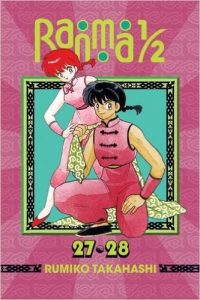
Ranma 1/2, Vols. 27-28

By Rumiko Takahashi. Released in Japan by Shogakukan, serialized in the magazine Shonen Sunday. Released in North America by Viz.

The difficulty with these omnibuses is that they can feel very unbalanced. This volume contains one of the strongest emotional and physical battles in the series… in its second half. To get there, you have to wade through Vol. 27 first, which features far more Mousse than is really recommended, Principal Kuno returning when no one wants him to, more possessed inanimate objects, and Hinako falling for Soun Tendo, a storyline that was a bit creepy when it was first released in the 1990s, but now reads as SUPER CREEPY today. Hinako may really be in her 20s, and have the body of a statuesque woman when she sucks out ki, but she looks (and acts) like an 8-year-old most of the time, and that fact makes the entire sequence a bit beyond the pale. Fortunately, Soun is totally oblivious to her, still being very much in love with his late wife.
ranma27-28

However, the 2nd half of this omnibus is top-notch. Ryu Kumon’s backstory, once revealed, may be played up a bit for comedy purposes, but it does feature his only parent killing himself by accident, leaving him alone. As a result, even though he is trying to trick her, Ryu is drawn to Ranma’s mother, who mistakes him for her own son, and he realizes that he can bond with her in ways that Ranma, who is cursed to always be female around her, can’t. This leads Ranma to be more emotional than ever, as his desire to be a good son for his mother, fear of the promise to kill an “unmanly” child that she made, and rage at this upstart taking over his life all coalesce, leading him to be a bit more serious than usual in the ensuing fight.

It helps that Ryu is a top-notch martial artist. As ever, Ranma gets the floor wiped with him till he can figure out how Ryu is fighting and the way to counterattack. It helps that the actual “Martial arts _______” fight this time is one of Takahashi’s all-time cleverest, revolving around entering and leaving a house, and you’d be amazed at how much that can translate into fighting techniques. Of course, the trick is that it’s not a tool for fighting at all – which is why Ryu’s father, who thought it was, inadvertently killed himself trying to use it. As always, Genma and Soun are there to provide running backstory, and Genma seems to be at fault, but for once it’s only accidentally his fault. And the action sequences are really good, Takahashi has found her groove here.

Oh yes, I almost forgot to mention the “Cursed Tunnel of Love” storyline. The anime softened this considerably in terms of Ukyou and Ryouga, the manga doesn’t bother. Ranma and Akane mistakenly think the two are a couple, but the idea is meant to be hilarious – the fights between them are nothing like the fights between Ranma and Akane, they’re just simply Ukyou’s frustration at Ryouga being Ryouga. That said, we’re coming near to wrapping up the series, and it would be nice if at least one of the harem candidates (on either side) got paired off. Oh Ryouga, if only there was a girl out there for you…

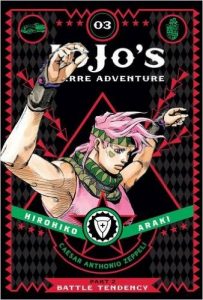
JoJo’s Bizarre Adventure: Battle Tendency, Vol. 3

By Hirohiko Araki. Released in Japan as “Jojo no Kimyou na Bouken” by Shueisha, serialized in the magazine Weekly Shonen Jump. Released in North America by Viz Media.

In modern days, it has become a somewhat amusing joke to say that “no one dies in (insert Jump title here)”, be it Bleach, One Piece (until recently), or other such series. There are lots of apparent deaths, but it is a very popular cliche to have the supposedly dead person reappear to much rejoicing, and Jump in particular loves to do it. That said, this is a good 25 years earlier, and so JoJo’s is not afraid to brutally murder major cast members in order to advance the plot and provide much character development and tears of rage from our titular hero. Indeed, the villains are so arrogant that being killed by one of them personally is deemed to be a blessing given to a worthy opponent – attention has been paid.

jojobattle3

Last arc it was Speedwagon who survived, with Jonathan being killed off right at the very end. Joseph is a different, less tragic sort of hero, and so it falls to Caesar to be the one who loses his life so that the others may pursue their goal of defeating the evil whositses – honestly, a lot of the plot details of JoJo still tend to whiz by me as people scream battle poses at each other. Not that this is a bad thing – that is why we read this series, as Araki is very good at keeping a reader’s interest with reaction shots and amazed exclamations. Take, for example, the return of Stroheim, who has returned as something of a cyborg, and manages for a while to go toe to toe with Kars (named after the band, or the Gary Numan song? Or both). This despite the fact that the entire “he’s a Nazi, but I don’t hate him as a person” plotline is deeply uncomfortable, and I won’t cry when we leave World War II behind.

As for Joseph himself, he is, as ever, more of a trickster than his grandfather was, which allows him more success in battle against enemies who are prone to being faked out. Of course, this comes with cocksure arrogance and sometimes a petulant anger as well. He’s at his best here dealing with Suzie Q, who he flirts with for about two pages before she’s possessed by another one of the bad guys. This is why seeing him and Lisa Lisa devastated at the climax of this volume is so heartbreaking. We don’t like seeing Joseph like this. I have no doubt that he will get an epic revenge in the fourth and final volume of this arc, but will he be able to bounce back and show us some cocksurity? Who knows.

By now anyone reading this series knows what they’re getting into. I wish there was less “Nazis may be evil but they sure are cool” here, to be frank, but other than that this is wall to wall excellent shonen at 100% volume.

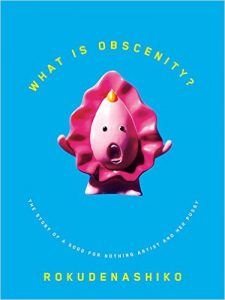
What Is Obscenity? The Story of a Good-For-Nothing Artist and Her Pussy

By Rokudenashiko. Released in Japan by Kinyobi, Inc., partially serialized in the magazine Shuukan Kinyobi. Released in North America by Koyama Press.

Like many people, I first heard about Rokudenashiko via news reports retweeted and reblogged around the internet. In fact, it may have been watching The Daily Show, which covered her arrest (she makes reference to it here). But when I saw that she had a panel at TCAF and was promoting a manga discussing what happened, I decided to seek it out. and I’m delighted that I did, as this manga is fascinating, managing to make the reader angry and outraged at her mistreatment while at the same time laughing hysterically. It actually comes in two parts. The first, written for the weekly magazine, is a light-hearted (but the events are serious) look at her arrest and imprisonment for distributing 3D copies of her vagina via crowdsourcing. The second half retells some of the same events, but as part of her life story, and it’s more serious and personal.

obscenity

The amazing double-standards of Japanese culture, which has no issues with the word ‘chinko’ (which means dick), but can’t abide the word ‘manko’ (which means pussy) is on display throughout, from the initial sneering and TV-cop stereotype of her arrest to the hilarious points where the officers try to take her statement and she humiliates them by insisting on saying ‘manko’ as many times as possible. We get a lovely tour of Japanese women’s prison, which is as unpleasant as you’d imagine, and she has a variety of cellmates, ranging from the normal to the intensely strange. Interspersed through the manga are various textual articles discussing the nature of obscenity, Japanese law (yes, it really is far more like Phoenix Wright than you’d expect), and the campaign on the outside to petition for her freedom (which we barely see as we’re following her POV).

As I said earlier, the second part of the manga is a short biography of her life, and how she ended up becoming an artist who used her ‘manko’ as an inspiration for various art projects and showcases. The most amusing part for me was that her initial reasoning was seeing that you can have “vaginal surgery” and thinking “whoah, cool!”. She was later told by her editors to change it and make her more ashamed of her body in order to sell to readers better. I am reminded of many other editorially demanding manga series. That said, we also see that using ‘manko’ in her art also led to her divorce, to her friends abandoning her, and to suicidal thoughts. None of that was in the more commercial first part of the book, but it adds a sense of depth and realism that touches the heart.

So rest assured, this is a highly entertaining and moving memoir. But it’s also a wonderful look at the standards that go into defining what is obscene, and the struggles that an artist has to go through in order to be able to express themselves properly. The behavior of the police and courts in this book is jaw-dropping, and if nothing else, I’m hoping that more awareness of the these issues might lead to international pressure for change. In the meantime, the story of Rokudenashiko and her artistic triumphs and struggles is a must-read for anyone who loves freedom of expression.