Monthly Archives: May 2016

The Birth of Kitaro

By Shigeru Mizuki. Released in Japan as “Gegege no Kitaro” by (among others) Kodansha, serialized in various magazines. Released in North America by Drawn & Quarterly.

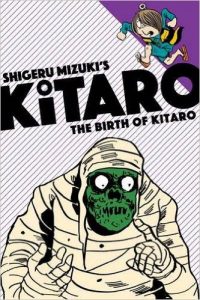
There was already a sampler of Kitaro a few years back, also by Drawn & Quarterly, but this new collection appears to be the equivalent of a multi-volume best-of, apparently signed off on by Mizuki himself, who gave the editor a test to see if he could choose the stories that Mizuki himself would have chosen (he got all but one). And so we see some earlier Kitaro manga from the late 60s, including a lengthy chapter from the magazine Garo that shows off how Kitaro came to be, and helps you understand that the otherwise generic zombie on the cover really is one of the main characters. It’s a grim little tale, more serious than the rest of the stories in this volume, possibly as it lacks the series’ main drawing point.
birthofkitaro

See, Kitaro is a nice kid, mostly (his ethics can be rather questionable from a human perspective), but he is essentially Mickey Mouse. He’s the title character and appears in every story, but what the readers really want is someone a bit more fallible and funny. And you can’t get much funnier or more fallible than Nezumi Otoko, which translates to Rat Man. He is the Donald Duck of this series, only Donald was never quite so evil. Nezumi Otoko will do absolutely anything for money, including tricking old rich men out of their life savings, luring respectable young manga editors to their yokai-influenced deaths, and take advantage of the dead – multiple times. Even when he’s not being an ass, he’s usually a coward, always the first to run away. This, of course, makes him a marvelous character, the best reason to read this series. He’s beloved in Japan (for a certain definition of beloved), and was used as narrator for Mizuki’s Showa history.

The other big reason to read the series is the yokai, who veer from the silly to the terrifying, but they’re all dangerous. Neko Musume shows up here, and those who recall her cute moe appearance in some of the more recent Kitaro animes will be startled by this bowl-cut girl who tries to literally eat Nezumi Otoko when she first sees him (to be fair, he deserved it – he always does). The Gyuki and Hideri Gami are more typical straight-up monsters, in the former case even managing to possess Kitaro, who gets to enjoy a rare turn attacking people. Kuckily, Kitaro is made of stern stuff, able to survive even being dropped in a volcano. Also luckily, this is very much not a serialized story. Tales need to end in a certain number of pages, so the yokai rarely get to do much before Kitaro has won and they’re off on their next adventure. (The anime was airing as these manga chapters were running, and you can see references to the insanely catchy theme song in these final ‘the adventure continues’ panels.)

Even if you aren’t a fan of manga history or yokai stories, this is still a must purchase. It’s also fairly child-friendly, despite a few scares. I am eagerly awaiting more.

One Piece, Vol. 78

By Eiichiro Oda. Released in Japan by Shueisha, serialization ongoing in the magazine Weekly Shonen Jump. Released in North America by Viz.

My last review of One Piece was, for me, quite negative, as I was getting very weary of Dressrosa. That hasn’t changed one bit with this new volume, unfortunately, and we’re still here. I am going to make a concerted effort not to bring up Rebecca, despite my teeth grinding so much during the “you are a pretty princess who must not fight” scenes I may need to see the dentist. Instead, let’s be positive and focus on the fun things going on in this arc. And there are fun things, because even when Oda is getting more sexist by the volume and rehashing things we’ve seen before, he can still introduce crazy stuff that makes you grin, or even show us a kid wearing a Bartholomew Kuma T-shirt.

onepiece78

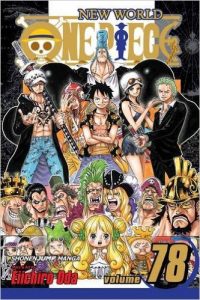
The cover, showing off the Straw Hats (+ Law), reminds us that the main cast may have gotten a bit too unwieldy, given that Oda now has to write out half the Straw Hats in order to not overburden an already overburdened arc. That said, it does allow those who are remaining to have moments to shine. Zoro has done “beyond the impossible” so many times that you’d think it would be old hat by now, but no, it’s always fun, mostly as every time you’re reminded what a complete lunatic he can be when he’s in battle mode. If the enemy needs to be stopped but is much too far away, just have yourself hurled at the enemy. If he shapeshifts too fast to kill his real body, just cut everything so fast he doesn’t have time to get away. And oh yes, use haki to make sure your swords won’t even get scratched. When Zoro isn’t sleeping or getting lost, he’s there to be super cool, and he achieves that here.

Then there’s Luffy, who gets to battle the real Doflamingo at long last, in what is hopefully the climax of this arc. The timeskip has helped to mature Luffy, even if (like the rest of the cast) he can backslide at any time for comedy reasons. True, his reasoning for going all out against Doflamingo is still somewhat simplistic – you made my friends cry, you made my friends mad. But honestly, that’s a good enough reason to begin with, and if anyone deserves to be punched into next week, it’s Doflamingo, who sets up one last deathtrap to kill everyone on the island for the lulz. Flashbacks show that if you tell a young boy filled with rage and fury that he is better than everyone else and give him whatever he wants, bad things will ensue. Luffy is the opposite of this, even though he is also filled with rage and fury here. Abuse of power is the main enemy in One Piece, be it pirates, marines, World Government, or what have you. If you do it, Luffy is here to kick your ass.

So there are many things to like here, but again, I will be very, very glad to see the back of this arc. I believe that in the next volume I finally achieve this.

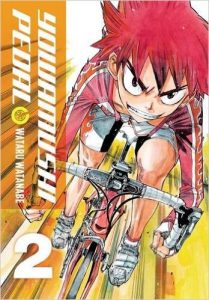
Yowamushi Pedal, Vol. 2

By Wataru Watanabe. Released in Japan in two separate volumes by Akita Shoten, serialization ongoing in the magazine Weekly Shonen Champion. Released in North America by Yen Press.

The last volume promised we’d see a race, but I don’t know if readers were prepared for the race to take up the entire omnibus, which is to say two volumes of the original Japanese release. Given that it’s meant to be an endurance test to weed out those who aren’t ready for the big time, it makes sense. And, of course, it ends up showing off the character development of our three leads – Onoda discovers the joy of competition, particularly when he gets a real bike; Naruko realizes that he is not in fact top dog here; and Imaizumi finds a desire to win that had been absent in him for some time. In other words, this still manages to embody all the archetypes of sports manga in one handy volume.

yowamushi2

Onoda is still the star, and we see him coming to terms with the fact that he can’t make it on pure guts alone – though god knows he tries, particularly when he gets his racing bike. There’s a lovely bit where he sees the car of team captains behind him (they’re there to pick up those too far behind and say they’ve lost) and despairs, but no, they’re here to give him his racing bike, which got stuck in traffic before the event. The team captains (and Kanzaki, who continues to boggle at Onoda’s raw potential, though this being a sports title, and an Akita Shoten one at that, I expect boggling is all she will do) also get to play Greek chorus along the way, explaining why *this* is the exact point that Onoda will finally run out of steam, only to be proven wrong time and time again.

Of course, he eventually does collapse – your male sports lead does not end up winning against the veterans in the early volumes. The course is designed to kill anyone who doesn’t plan on being a “cycling uber alles” sort, which means most of it is a giant hill. Onoda wins the race to the top of the hill, but that’s all he has in him. As for Imaizumi, there’s some lovely characterization here as he unconsciously finds himself riding as he did when he was a child (something noticed by Kanzaki, who was a childhood friend of his), and also overexerting himself despite knowing it’s not the right thing to do in order to efficiently win the race. Stoic types in manga are always at their most interesting when they go up against something that threatens their facade. It doesn’t necessarily have to make them emotional, but it’s good to see.

So now that Onoda has made a name for himself, to the point where even Kanzaki’s non-cycling BFF says that he seems to have more presence than before, what’s next? My guess is more cycling, and probably an intense training regimen. Are we too early for an inter-high meet? What does the author plan to do with the eccentric yet clearly intelligent and wily coach we’re introduced to? I definitely plan on finding out next time.