Monthly Archives: June 2016

Masamune-kun’s Revenge, Vol. 1

By Hazuki Takeoka and Tiv. Released in Japan by Ichijinsha, serialization ongoing in the magazine Comic Rex. Released in North America by Seven Seas.

The arrogant, haughty girl who owns the campus and can destroy your entire life with just a well-placed word. It’s a common sight in fiction for young adults, both here and in Japan, and it’s no surprise that Masamune-kun’s Revenge uses it as a starting point. Makabe Masamune was deeply wounded in elementary school by his crush, Adagaki Aki. Now starting high school, he’s lost the weight she mocked him for, cultivated a ‘handsome male lead’ personality, and is ready to win her heart only to crush it once and for all. Then he will finally have his… well, revenge, as the title implies. This premise sounds almost like one of the fanfics you read by 19-year-old men writing when they dislike the tsundere harem girl, but if handled well could be interesting. In the first volume, the authors handle it pretty well.

masamune

First of all, the narrative seems to be fairly self-aware at how ridiculous and petty Masamune is for carrying his grudge on an 8-year-old for so long. Every smooth move he makes is balanced out by his inner stress about how he looked and how he handled it, just to make it clear that no, he’s really just like you, the reader, honest. Secondly, as the second half of the book shows, he’s hardly the only one who’s devoted his life to messing with Aki. Yoshino is probably the best character in the book, a supposedly meek and put upon followers of Aki’s who in reality is happily manipulating her behind the scenes (and may come from a family of said manipulators). And, of course, he’s beginning to genuinely fall for Aki – if this were JUST about the revenge, there would be no point in reading it. It’s a romance.

As for Aki, I like her. More than I expect I’m supposed to. It’s fairly clear as the volume goes on that much of her arrogance is just as much of an affectation as Masamune’s cool persona. The annoying nicknames are completely lame, but I have to admit, the scavenger hunt she led him on to reject him made me laugh out loud at the payoff. That was well-played. Really, most of the things people hate about her seem to be simple social ineptitude, as she’s shown to have no idea how real life works, being very much a coddled rich girl. I expect in the next few volumes Masamune is going to want to dial back his revenge, and likely external forces will try to stop him. Because honestly, these two would make a pretty good couple if they both stopped putting on an act.

I’m not certain if this is a plain old revenge fantasy or a subversion of same yet, but I hope it’s the latter, as I would find a simple ‘break the haughty’ plot to be far too tedious. But based on the first volume, I think that the authors could pull off something nice. There was also less fanservice than I’d expect from a title like this, that foot fetish cover aside. Fans of guy-oriented romantic comedy might give this a try.

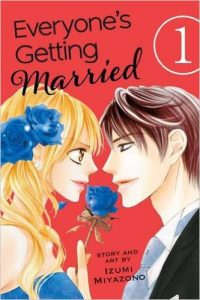
Everyone’s Getting Married, Vol. 1

By Izumi Miyazono. Released in Japan as “Totsuzen Desu Ga, Ashita Kekkon Shimasu” by Shogakukan, serialization ongoing in the magazine Petit Comic. Released in North America by Viz.

The ruke of thumb, be it in a shoujo comic set in school or a josei comic set in the workplace or really in any other piece of fiction ever, is that happy people are boring. Conflict is what drives a story, and anybody who insists that they know exactly what they’re going to get out of life is likely due for cruel disappointment. Of course, the goal after this is to make sure that the main characters read like real people and that you aren’t constantly slapping your forehead. We’ve seen quite a few Petit Comic titles over in North America over the last few years, and while I’ve enjoyed them to a greater or lesser degree, there has been quite a bit of forehead slapping. Everyone’s Getting Married, though, seems to be made of sterner stuff.

married1

Our heroine, Asuka, is a highly successful businesswoman, but what she really longs to do is settle down, get married, and be a housewife. The narrative points out several times that this is because of her own home upbringing and a definite choice she wants to make, rather than anything like “women shouldn’t be working” or other tropes you’d expect to see at this point. The guy who breaks up with her at the start of the book says she’s looking for “anyone who’d put a ring on her finger”, but we see over the course of the volume that’s not true – she has standards, and most guys fail to live up to them. The trouble is, this is modern Japan, and most guys she meets aren’t looking for a wife to stay at home and keep house.

Enter our hero, Ryu. He’s a highly successful newscaster with a reputation as a playboy, but he’s actually just the sort of man that Asuka is looking for. There’s just one problem, of course – he is absolutely not looking for marriage, for both professional reasons (as a handsome face who gets female viewers, ratings would drop if he was “unavailable”) and personal reasons (a hinted bad relationship with a married woman before the book begins). However, aside from that, he’s basically exactly what Asuka is loking for. And it’s mutual, as he’s quite attracted to Asuka as well, but both of them are holding themselves back due to their insistence on marriage/no marriage respectively.

The characters in this book are what makes it. We see Asuka’s friend begin to date Ryu’s roommate in here as well, and there relationship proceeds far smoother, even though Asuka’s friend has said, much like Ryu, she’s not looking for anything permanent. But, because she’s also open to compromise and not locked into stubbornness, things can move forward in surprising ways. This is a title you read to see how the hero and heroine can compromise their principles in order to gain the happiness that’s right in front of their nose – after which, no doubt, the story will end, because the conflict is over. Definitely awaiting the next volume.

Black Clover, Vol. 1

By Yuki Tabata. Released in Japan by Shueisha, serialization ongoing in the magazine Weekly Shonen Jump. Released in North America by Viz.

If you’ve been reading manga for a long time, you not only start to read series that are clearly influenced by another, but also series that are influenced by their successors. When Fairy Tail debuted, a lot of people were highly amused at how blatantly it wore its One Piece influence on its sleeve (despite the author not remotely being a newbie, as Rave Master fans can tell you). Well, now Fairy Tail is 54 volumes and counting, and it’s starting to have artists who are influenced by its own plot and attitude. Which brings us to Black Clover, a story of a firey hothead who ends up in a magic guild that’s home to a bunch of eccentrics. But in Jump, not in Magazine, so it’s OK.

blackclover1

As I’ve noted consistently in these reviews, unoriginal and cliched does not always mean bad, particularly in the manga industry, and Black Clover did hold my interest throughout, and was a good deal of fun. But it was highly amusing coming up with a drinking game on the fly when each previously overused cliche kept dropping into the bucket. Asta, our hero, is a kid who in any other series would be happy, upbeat and relaxed, but in this particular series suffers from having no magic talent in a world where magic talent defines your place in life, and therefore he is defined more by extreme frustration adn slight obnoxiousness, which thankfully gets a bit better when he actually discovers what he can do – anti-magic.

The other characters are also types, but they seem to be the sort of types that will grow and develop into real people as the series goes on. Asta’s best friend is cool and collected, and has a giant pile of magic talent – needless to say, there’s a seemingly wide gulf in their friendship, but this is Jump, so it’s only seemingly. We also meet the supposedly terrifying master of the “evil magic guild”, who actually turns out to be the master of a lovable gang of magic users who are Just Misunderstood (TM). And then there’s Noelle, who’s from a royal family but is running into the same issues Asta has – she has magic, but can’t control it, so is thought of as useless. Putting on a haughty princess attitude to mask feeling worthless – again, not unfamiliar.

I suspect that defending the ‘have-nots’ will make up a good chunk of this manga. We see a group of villains toward the end who think nothing of using a village of commoners simply as they’re in the way, and they’re typical good, sneering villains who inspire our hero and heroine to level up. One thing I did like is Asta’s response to not having any magic for years and years – he’s been developing his body to the point where he’s freakishly strong (though he still looks like a typical wiry Jump hero), which manages to surprise many. (He also hits on nuns, but I suspect that aspect of him will go away as the series goes on.)

Black Clover may be trying to be Fairy Tail for Jump, the same way that Fairy Tail was One Piece for Magazine. but it’s off to a decent start, and I’m happy to see where it goes next.