Monthly Archives: June 2016

Anne Happy, Vol. 1

By Cotoji. Released in Japan by Houbunsha, serialization ongoing in the magazine Manga Time Kirara Forward. Released in North America by Yen Press.

There is a sort of subgenre of school life manga that flits across all genres, be it shonen, seinen or shoujo. This is the ‘separate class filled with special students’ genre. They can be special in the bad way, as with Assassination Classroom’s 3-E class of low-graders, special in a superpowered way, with both Medaka Box’s Class 13 and Class -13, or special in the doomed way, as with many a survival game manga where the class finds itself in a situation where they all die one by one (Battle Royale, Dangan Ronpa, etc.). And now we have Anne Happy, a mostly lighthearted comedy about a group of girls who are all ‘unlucky’ in some way, be it poor health, misdirection, or what have you. The title character (though not, oddly, the protagonist so far) is Anne, a girl whose bad luck is SO bad that it almost comes out the other side.

annehappy1

Our heroine is Ruri, who at first seems out of place in this class, till we realize that she has a fetish for the construction sign of a cartoon worker who directs you to move out of the area. I hesitated to reveal this, as honestly it’s the best joke of the volume, and it’s really the only thing keeping her in the class at all, as otherwise she’s a fairly normal, if dour, young girl. Anne is just like you’d expect from a series like this: overly upbeat and peppy to an unreasonable degree, whether she’s being picked as 49th most lucky in a class with only 40 people in it or accidentally falling into a river and almost getting mauled by a bear. There’s also Botan, who is the ‘calm airhead’ sort (apologies if I call her Mugi by accident) whose body is so fragile that a mild handshake can break all her fingers.

Everyone in this class has been put there supposedly to change their bad luck and find happiness, which mostly seems to involve a series of endurance tests given by their semi-sadistic teacher (who seems to have a split personality). There’s a sense that Anne is worse than the others – she is the title character, after all – and at one point she loses her hair clip and her luck turns to negative fifty zillion. Honestly, though, the plot is mostly an excuse for a series of school gags based around goofy, unlucky girls. We also meet Hibiki, a tsundere sort who seems to be in love with her Takarazuka-esque classmate Ren. I assume that everyone will get to know each other better in the 2nd volume.

This isn’t really a must-read, even for fans of comedies like this one. But it’s pleasant enough, and there weren’t many points where I was irritated or wanted to stop reading. And, aside from a few jokes about Botan’s chest, there’s less fanservice than you’d normally expect in a title like this, possible as Kirara Forward lacks that sort of thing in general. Anne Happy falls into the category of ‘Not bad, will try another volume’ for now.

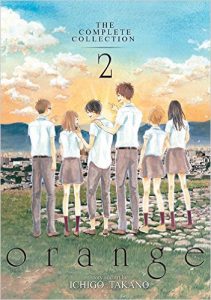
orange: The Complete Collection, Vol. 2

By Ichigo Takano. Released in Japan by Shueisha and then Futabasha, serialized in the magazines Bessatsu Margaret and Manga Action. Released in North America by Seven Seas.

I’d mentioned while reviewing the first omnibus of orange that it wasn’t a slam dunk that Kakeru was going to be saved. Fortunately, the author agreed with me, and most of this 2nd omnibus shows us that trying to change the future is hard, especially when you’re dealing with someone who killed themselves – it’s not always something you can fix just by being really nice. Naho and the others don’t really screw much up here, and they try their hardest, but there’s a lot going on in Kakeru’s head, and even Future Vision can’t solve his own inner demons. This leads to a devastating chapter that is easily the best of the book, as we see from Kakeru’s POV the thoughts and actions that led to his suicide in the original world.

orange2

And there is, of course, the romance between Naho and Kakeru as well. I’m pleased that the future flashforwards we see here show that Naho and Suwa’s marriage isn’t an unhappy one – they’re two people who’ve led a good life, and even have a kid, but they’re both still devastated by the boy they couldn’t save. Perhaps this is why, despite all the suggestions and hints, the romance is mostly left on the back burner, and we don’t get a definitive “and they married and lived happily ever after” here. Much like A Silent Voice, this is a series that’s trying to be about friendship and overcoming difficulties. Because in the end, after everything they changed, and every way they tried to make Kakeru feel loved and welcome, he *still* tries to kill himself.

But they did make a difference – he pulls back at the last minute, realizing he doesn’t want to die. (Admittedly, Hagita breaking his bike helped – Hagita is mostly used as comic relief throughout, being the “friend nobody likes” sort, but he’s also quite clever and absolutely one of the gang here.) I was rather surprised that, in their tearful talk after his attempt, they all confess they got letters from the future, and show them to him. The science of how this happened is very vague, and I don’t think we’re meant to dwell too hard on it. In the end, appropriately, the six friends bury the time capsule we’ve seen before, only now dedicated to a new future.

There wasn’t quite enough orange to fill a 2nd omnibus, so we get a short multi-part romance from the same author, Haruiro Astronaut. It’s not as good as the main story, but isn’t too bad, and has some good twists – the romantic setup is theoretically between the cool guy and the sweet guy, but ends up taking a third option, and there’s some talk about actually trying to care about what girls think rather than just trampling all over them. It’s good, but the main draw of this collection is orange itself. It’s excellent, and both omnibuses are absolutely worth your money.

Franken Fran, Vols. 3-4

By Katsuhisa Kigitsu. Released in Japan by Akita Shoten, serialized in the magazine Champion Red. Released in North America by Seven Seas.

Franken Fran has many grotesque, nasty images throughout. There’s blood, gore, other bodily fluids, and truly disgusting things being done to the human body. And yet the most terrifying thing in the entire series is easily Fran herself, who is quite simply impossible to understand or empathize with, and whose concept of what life is does not remotely cross over with the majority of humanity. Fran is simply a force of nature, and this omnibus shows us several times when your jaw drops at what she carries out. Oddly enough, it’s Veronica, her sister the assassin who was introduced at the end of the last book, who ends up being the voice of sanity in the series (as well as the straight man).

frankenfran3-4

This is not to say that Veronica is a good guy, of course. In one of the more touching chapters in this book, Veronica and walking organ bank Adorea go to a high school undercover to, theoretically, give Veronica “social skills”. (The fact that Fran is the one who says she doesn’t have these is one of the best jokes in the book.) Of course, veronica is a small, sullen, scarred girl, so naturally she proceeds to get bullies to hell and back, with only one other girl nice enough to be friends with her. And then, of course, everything goes even MORE horribly wrong, as we discover a slavery ring and Veronica has to clean house and chop up a few bad guys. If this were a normal, non-funny thriller series, Veronica might be the anti-hero.

And of course there are the plots of the chapters themselves. Franken Fran is to a large degree an anthology horror series, with Fran and her occasional cast dealing with tragic young love, evil matriarchs seeking immortality, and of course at least two chapters dealing with bugs, which are absolutely not for the squeamish. There’s even a cameo by a certain cult religious deity. The two best chapters in the book are two of the most touching (note that I’m defining touching in the venue of Franken Fran, not beyond it) – in one, a suicidal young man who changes his mind is given new life as a children’s mascot, and crosses paths with a young girl who’s being abused by her father. In the other, a young girl’s dog is killed by a truck, and it’s Fran to the rescue, though her new dog is, shall we say, not what you’d expect. The series even mocks itself by having a Hollywood movie made out of the latter chapter, with dire consequences. (“The bestiality was a nice touch.”)

In the end, Franken Fran is about the stories. They won’t make you feel good, they may gross you out, and one or two of them may give you nightmares. But they’re all stories that stay in your head. And Fran, being a protagonist (I refuse to call her a heroine) who is our guide through this twisted world, is just as memorable.