Story by Ryukishi07; Art by Hinase Momoyama. Released in Japan in two separate volumes as “Umineko no Naku Koro ni: Dawn of the Golden Witch” by Square Enix, serialized in the magazine GFantasy. Released in North America by Yen Press.
“Beatrice was dead: to begin with. There is no doubt whatever about that. The register of her burial was signed by the clergyman, the clerk, the undertaker, and the chief mourner. Lambdadelta signed it. And Lambdadelta’s name was good upon ‘Change, for anything she chose to put her hand to. Old Beatrice was as dead as a door-nail.”
OK, sorry, that just had to be done. Welcome to the new arc of Umineko, folks, and here’s 500 more pages of Rokkenjima antics. And yes indeed, Old Beatrice is dead, and won’t be returning. Luckily for us, Battler is a bit upset about that, and so we have new, Fledgling Beatrice. Sadly, new Beatrice acts meek and mild, and seems to regard Battler as more of a father than anything else. Yes, sorry to say, if you thought creepy incest themes were only in the third arc, guess again.
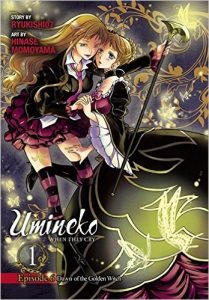
Battler understands how magic really works now, so recreating *a* Beatrice isn’t that hard. But this isn’t his Beatrice, as she has not experienced the thousand years of endless torture that turned her into the Endless Witch. As a result, Battler is a bit upset at her very presence, which is a shame as she really, really wants to be nice to him. Fledgling Beato (the translation does not use the term “Chick Beato” as the games did – I thank them for that) is, personality-wise, much the same as the Beatrice that Rosa found in the secret mansion back in 1967 or so. And Battler is, of course, very reminiscent of Kinzo lately. I don’t like where this is going.
Luckily there are many other aspects to this series, as always. Erika is back as well, and she’s naturally at her best when at her worst, destroying Maria’s concept of magic to such a degree that even Gertrude and Cornelia are calling it completely pointless. Erika is a villain you love to hate, and even though she is also part of the endless cycle of ‘bullied becomes the bully’ thanks to suffering at Bern’s hands, her total contempt for anything other than truth leads her to arrogance and scorn. Also returning, after an Arc’s absence, is Ange, somewhat surprised to not be dead. She’s here to investigate the supposed author of the 3rd-5th arcs, Tohya Hachijo – or rather to her true self, Featherine Augustus Aurora, who seems to be a Witch along the lines of Lambda or Bern, only infinitely more arrogant. (The connection to Higurashi’s Hanyuu, subtle in the VN, is made far more explicit here.)
And then there’s our romantic couples. It is rather sweet seeing Kanon finally work up the courage to confess to Jessica, and she does more happy blushing here than she has in the last five arcs combined. It is also somewhat interesting to see George confess to his past mindset and pettiness – honestly, the entire section makes teenage George sound a bit like an MRA, and I’m glad to see he has matured to a degree where he can confess to how stupid it is. The more interesting question here, though, is the need for magic in order to make them happy. Yes, the whole master/servant relatioship is a worry, but not a big enough worry to require a literal miracle. Why do Shannon and Kanon need magic for their love to be fulfilled? Why is Beatrice so determined to be with Battler even though she keeps calling him father? Why does Ryukishi07 feel the need to introduce a second Greek Chorus to expound just about love? And why does the manga always make Ange a giant brocon, something that isn’t in the VNs? Is it just for the lulz?
The art, by the way, is from the artist who did the Higurashi Massacre volumes, and it’s pretty good. Like several of the other artists, she knows when to emphasize the sauciness in ways readers will like – hence Fledgling Beato and Elder Beato crushing their chests together – but also to make fun of it in the 4komas later. If you enjoy Umineko, there’s nothing to worry about here, except more attention to incestual romances than I’d perhaps like.