Monthly Archives: October 2016

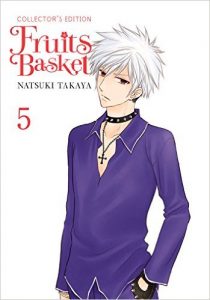
Fruits Basket Collector’s Edition, Vol. 5

By Natsuki Takaya. Released in Japan by Hakusensha, serialized in the magazine Hana to Yume. Released in North America by Yen Press. Translated by Sheldon Drzka.

Fruits Basket is, in large part, about a family and its cycles of abuse, and how it makes everyone suffer and endure. That’s why it’s so nice to see, in this omnibus, that there are at least one or two of the main characters whose families are not torn apart by physical abuse, hatred, neglect, suicide, or death. Hanajima during her childhood is, unlike what I talked about with Hiro last time, going through something that the reader is not going to understand, and she really needs to have someone that’s in her corner besides her little brother. I love the fact that immediately after Hana decides to be friends with Tohru and Uo, despite the fact that she may hurt them, she gains control over her powers, as if a switch is flipped. And then there’s Hiro’s mother, who is not only the one Sohma who unreservedly loves her child, but is also pregnant again, which makes everyone happy because the kid can’t be cursed, as all the Zodiac exist already. (More on this later.)
furuba5

There’s actually quite a lot of setup for future plots and pairings here, as clearly Takaya has been told that this is a big enough hit that she can take as much time as she wants. (Ironically, this is also where she hurt her hand, so a long hiatus came between the last volume and this one. The art style will eventually be greatly affected by this, but not just yet.) We meet another Sohma, but not via Tohru and her all-loving heart – this time it’s Uotani, who runs into a handsome yet absentminded young man in her part-time job and seems to fall for him immediately. (The fact that she says he reminds her of Tohru does not help Furuba’s yuri fans at all.) But Kureno seems to be more attached to Akito than the other Sohmas are, and therefore nothing really happens with it.

And then there’s Mayu, who we’ve met as the teacher of Tohru’s class, and were also told was close friends with Kana, Hatori’s lost love. Here we learn that she was in love with Hatori herself, but was so determined not to get in the way that she ended up dating Shigure, even though they’re clearly toxic for each other. (I suspect Shigure enjoyed this more… he seems to love toxic relationships.) Hatori is the stoic type who’s unable to grieve, and so Mayu is the one that grieves for him, for the life that he was never able to live. And Shigure is the manipulator who enjoys both messing with people for the lulz and also giving hem a push whether they want it or not. It’s quite interesting that this arc ends with a flashforward that shows Hatori and Mayu, many years later, together – things will change soon.

There is, of course, drama here as well, most of it stemming from the trip to the beachhouse the Sohmas take during their vacation. (We do meet Kyo’s father, and it is important to Kyo’s character, but he’s so unpleasant and awful I’d rather just not talk about him.) Hiro continues to lash out at things he finds annoying, and Tohru, who is effortlessly close to Kisa in a way he can’t seem to manage, is the biggest thing. It’s quite telling that Hiro is upset at Tohru’s obsession with her late mother – he’s the only one in the entire group who’s always had a warm and loving mother, and so he can’t possibly understand why she would be like this. Kyo, whose mother, it is heavily hinted, killed herself, gets Tohru far better, and immediately figures out that a) Tohru isn’t her usual self, and b) it’s probably because Hiro was rude. He’s maturing rapidly.

The book ends on an ominous note: Akito has followed the Sohmas and is at a neighboring beachhouse, and they all have to go visit – bar Tohru, who is thankfully not invited, and Kyo, who’s always excluded. Kisa being thankful Tohru won’t be there as she worries that Akito will abuse her is one of the saddest moments in the entire book, and will carry over directly into the next omnibus, where Akito decides to pay Tohru a visit after all. Again, if you haven’t read Furuba before, do so, and if you have, these omnibuses are a good opportunity for a reread.

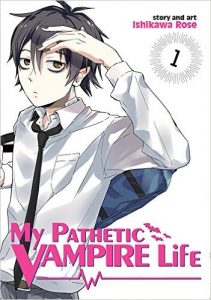
My Pathetic Vampire Life, Vol. 1

By Ishikawa Rose. Released in Japan as “You no Ataranai Koide-kun” by Futabasha, serialization ongoing in the magazine Monthly Action. Released in North America by Seven Seas. Translated by Amber Tamosaitis. Adapted by Carol Fox.

This is, of course, one of the most inevitable titles ever. Japan loves vampire manga. Japan also loves its laid-back school comedies where nothing happens over the course of several volumes. Why not combine the two? But this particular title I think leans a bit too hard against the latter rather than the former. A complete lack of conflict, despite creating many obvious points where conflict could be achieved, makes this manga seem very underwhelming, as if it’s content to simply ride along on its premise: what if a couple of vampire bros had to live the same year in school, over and over again?

pathetic1

Koide is the main character here, a vampire who is governmentally mandated to stay in high school, since he’s still 16 years old. It’s just that this is the 150th year in a row he’s been 16. And of course, being a vampire, just being near the sun is enough to make him collapse. Luckily, he has a few things going for him. His friend Miura is three times his age, so you’d think would be suffering even more, but seems to have come to terms with it. (He’s a bishonen, which helps – Koide has more of a “I just got out of bed” look.) This could be Koide’s year, though – his classmates seem less concerned than usual about his being a vampire (put politely – put impolitely, they’re a bunch of clueless idiots), he has a couple of girls who seem to like him (though he’s mostly completely indifferent to them), and his teachers are there to help him out (even if the school nurse is a bit creepy). What’s not to love?

You know a slice-of-life title is having trouble when I keep wishing that it would turn darker and more serious. There’s lots of ways this series could have done that. The mere fact that there’s a government crackdown on vampires is a fascinating backstory that’s mostly just used as an expositional gag for why they can’t turn the nurse (who desperately wants to become a vampire, as he’s part of “the Haruhi generation” and would like more excitement). You’d think a lot of the plot would revolve around keeping their true nature hidden from the class, but no, the entire class knows they’re vampires, and are totally cool with it. Even Miura’s somewhat serious backstory of being beaten by farmers in the middle ages is used for humor value.

There are certainly amusing moments throughout – I like Koike’s accidentally antagonistic relationship with the girl who sits next to him, as keep depressing each other without meaning to. The class rep’s attempts to have the class get to know Koike are both well-meaning and awful in the best way, and the ‘i have never seen a photograph of myself for obvious reasons’ chapter has a terrific punchline. But I cannot help wanting to shake the author and say “you could have done so much more with this!” It’s a perfectly acceptable slice-of-life comedy that is content to coast.

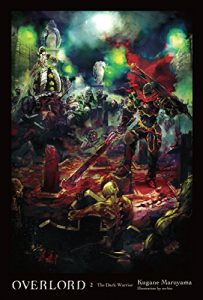
Overlord: The Dark Warrior

By Kugane Maruyama and so-bin. Released in Japan by Enterbrain. Released in North America by Yen On. Translated by Emily Balistrieri.

When we left Ainz at the end of the first novel, he was resolving to find out more about his world he’d been transported into, which was sort of kind of like his old game but not quite, and his evil minions had decided that his wishes amounted to total world conquest. Conquest is put on hold for the moment, though, as Ainz takes one of his minions and disguises himself as a common adventurer. “Common” is perhaps the wrong term, though, as Ainz mostly wants to show off how awesome he is so that his adventurer persona can acquire a reputation. Of course, this would be easier if he could read or write the language. And the minion he takes with him has no social skills whatsoever and regards humanity as worms. Oh yes, and there’s also the evil cult trying to turn an entire city into zombies…

overlord2

As with the first book, Overlord works best when it’s making fun of either Ainz or the world he’s in. Not only is he from modern Japan as a player, but even as Ainz, he sees the world completely differently from someone who actually lives in it. This comes to a head when he has to battle The Wise King of the Forest. He defeats it easily, and the party he’s with, as well as the residents of the city, are shocked and amazed at his badassery. Which is fine, except the Wise King is a giant hamster. Ainz is forced to ride around the city on to prove that he has “tamed” it. He feels a bit foolish, because from our perspective, it’s totally ridiculous. Likewise, his constant frustration with Narberal, who isn’t even attempting to pretend that Ainz is anything other than her lord and master, is equally hysterical.

Sadly, we’re also seeing a bit of what I worried about while reading the first book. As Momon, his adventurer persona he takes on, Ainz is able to cut an ogre in two with his sword just by strength alone. He hands out amazing unseen-before healing potions whose creation flummoxes even the best humans. He chews his way through endless undead with ease, and takes out the smug villain who desperately needs taking out by simply crushing her to his skeletal chest until she breaks. Ainz is not remotely challenged throughout the book. Even as Momon, when he thinks to himself that he was actually slightly damaged or somesuch, we’re quick to recall this is because he’s not using any of his skills as the Undead King, but attempting not to go outside the skill set of an average human. Basically, Ainz is too powerful, and in a book when the rest of the cast is human, it becomes more apparent.

That said, if you get past it, the book is still well written, with evocative descriptions. I liked the way that it tied into the village from the first book (and hey, the one guy in Momon’s party who survived turns out to be the childhood friend (and presumed future love interest, although for once it’s the girl who’s clueless) of the girl Ainz saved in Book 1, who’s still got her goblins. And when it is mocking Ainz and the D&D world he lives in, it can be very funny. There’s a cliffhanger leading into Book 3, which promises less pretending to be an adventurer. I look forward to it.