Monthly Archives: January 2017

The Case Study of Vanitas, Vol. 1

By Jun Mochizuki. Released in Japan as “Vanitas no Shuki” by Square Enix, serialization ongoing in the magazine Gangan Joker. Released in North America by Yen Press. Translated by Taylor Engel.

Steampunk as a genre is usually a sign that fun is about to ensue, and it’s no different in Japanese manga. From Soul Eater to Sakura Taisen, the idea of Victorian fashion and technological advances has always intrigued the promising new creator. And here we have The Case Study of Vanitas, a new series from the creator of Pandora Hearts. (A very new series, in fact – We’re already caught up with Japan, so don’t expect this one to be every other month.) And the story begins with a giant dirigible, looking as ridiculous as you could possibly imagine. Yet all of this is perhaps distracting myself from the simple fact that at its core, The Case Study of Vanitas is a series about various types of vampires and how to deal with them. Yup. More vampires.

My weariness of the glut of licensed vampire titles is well known, but I will quash it when it’s in the service of a good title. And, for the most part, The Case Study of Vanitas is a good title. It’s light and frothy, despite the presence of dark creatures of the night and the occasional horrific death. There’s lots of action scenes in midair, and confrontations on well-lit backroads. Our hero really isn’t the guy on the cover but Noe, a vampire who has come to Paris searching for the mysterious Book of Vanitas, which is said to be able to interfere with the true name of a vampire. Imagine our surprise when he finds the owner of the book after only about 30 pages. This *is* the guy on the cover, who calls himself Vanitas and is seemingly going around trying to be a “doctor” for vampires by using the book.

To be honest, there is one big weakness with the first volume, and that’s Vanitas himself. Normally I’m quite find of the obnoxious guy who rubs everyone the wrong way, but this time he was starting to rub me the wrong way too. Vanitas is simply too unlikable for a series that’s designed to revolve around him. I suspect the author knows this – that’s why Noe fulfills the hero role a bit better – but something just sours me, especially when he forces himself on the Witch Jeanne who’s come to wipe them out at the behest of her young master. I just suspect that I’m supposed to find him funny and amusing in a horrible way, but the horrible is what sticks.

That said, other than its title character, this was a great deal of fun. Lots of vampire lore and blood for those who do love the genre, a few officious bureaucrats and stoic servants, and in the middle of it is Noe, who spends much of the volume staring at Vanitas with a “the fuck?” look on his face. There’s hints of a tragic past with him, which I suspect we’ll get in the second volume. In the meantime, steampunk vampires!
The Devil Is a Part-Timer!, Vol. 6

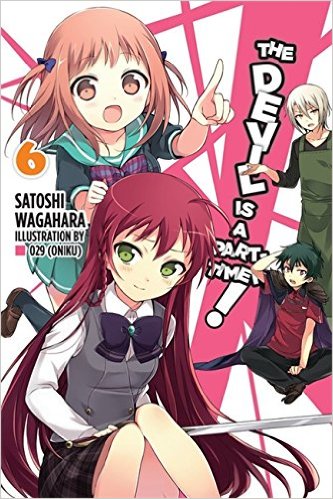
By Satoshi Wagahara and 029. Released in Japan by ASCII Mediaworks. Released in North America by Yen Press. Translated by Kevin Gifford.

The Devil Is a Part-Timer! is one of the few light-novel series currently being released in North America that has not had a multi-volume arc of some kind. By the end of each volume, things are somehow resolved enough that everyone can go back to the apartment complex. And yet each successive volume builds on the last, layering on more backstory revelations, character dilemmas, and (for this particular series) religious imagery until we realize that really, it’s been one big arc all along. Which is just what you want for a series like this. Each new volume makes you want to read the next one immediately. This one in particular, as Maou finally starts to give some answers as to what he was doing back in Enta Isla. Not many, but a few.

Of course, part of the reason that Maou is able to reveal to readers that yes, he was actually trying to conquer the world through war (something he regrets now) is because we now know that he did not in fact horribly murder Emi’s father. She’s still trying to deal with everything she found out in the last book, particularly the identity and status of her mother, and it’s left her a mixture of angry and devastated. Most of these books have been Emi discovering that literally everything she lived her entire life for has been a giant lie, and that a lot of people see her as a giant tool to point and shoot. We’re still nowhere near them being friends, but Emi is finally starting to get to the point where she’s not screaming at Maou every time she sees him, and can work with him against a common enemy, which is happening more and more frequently these days.

And then there’s Chiho’s development, as it turns out that when you fill a girl with divine mystical energies and use her body as a conduit, it can actually have lasting effects. Luckily, this is a still a relatively light-hearted series, and Chiho is so big-hearted, that it mostly means teaching her ways to psychically communicate with the others in case she’s ever kidnapped again – which turns out to be of great use when she is, in fact, kidnapped again. I like the fact that Chiho turns out to be surprisingly adept at magic, to the point where even Suzuno is startled at how fast she’s picking things up, and what she’s doing with it. I also really liked that psychic thought projection is likened to cell phone usage to make things easier to understand, and that imagery may be one reason she’s so good at it.

I’d mentioned in my last review that I loved the pointless daily life segments more than anything else, and while there aren’t as many of them this time, we do get some lovely discussion of how to be a barista. The McRonald’s has now become a McCafe, which means Maou and Chiho will now be serving coffee. This also serves to give us some much-longed for depth in regards to their manager Mayumi, and her discussion of her life’s dream (to be a bartender) leads neatly to Maou discussing his own goals and dreams. Much to his frustration, everyone seems to assume that he’s hiding out in Japan to give up. No, he’s hiding out in Japan to learn how to take over the world… ECONOMICALLY! Because that’s a much less blood-filled way of conquering than the old one. It was nice seeing Maou’s drive to rule the world pop up again, and I suspect the cast will be back in Enta Isla before long – though I assume not permanently.

This series continues to be top-tier. Great plot, the backstory hangs together, the characterization flows smoothly, and the narration can sometimes be quite witty even though it’s third person. I would say I can’t wait till the next volume, but Vol. 7 appears to be a short-story collection, so I’ll likely have to wait till Vol. 8. That’s OK. Like Maou, I’m patient.

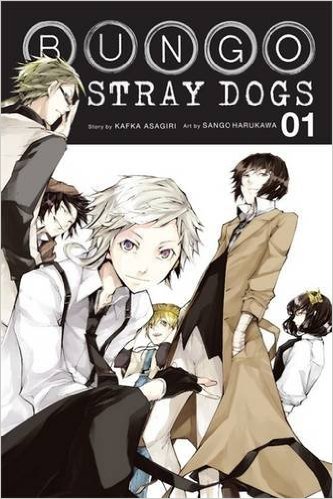
Bungo Stray Dogs, Vol. 1

By Kafka Asagiri and Sango Harukawa. Released in Japan by Kadokawa Shoten, serialization ongoing in the magazine Young Ace. Released in North America by Yen Press. Translated by Kevin Gifford.

I often regret that I haven’t read as much classical Japanese literature as I should. To be fair, a great deal of it is not translated into English, but there’s a ton that is as well, and for all that I’ve wanted to read No Longer Human, it sits on my phone with about 80 million other books I tried to read and then got distracted by. But I suppose I’m going in with the wrong mindset, as I don’t really want to read these works for their literary value, but in order to understand what the hell is going on in all the manga that make references to them. And honestly, do I know any other Dazai than No Longer Human? Did I even know the classic film Rashomon was based on a short story? And if I knew the literary references that flit throughout the first volume of Bungo Stray Dogs, would I find it more interesting than I did?

Without the literary references, what we have here is a somewhat standard superhero team-up story. Our young hero is an abandoned orphan fleeing a monstrous tiger creature that’s been following him around and wreaking havoc; he sees a very eccentric young man supposedly trying to kill himself in the nearby river and rescues him, and their two lives become intertwined. It turns out that a) the supposedly suicidal young man (like Zetsubou-sensei, it’s played for laughs throughout) is part of a group with powers who form a detective agency, and b) our hero IS the tiger that follows him around – that’s his power, though he’s been sort of suppressing it. After a brief test to see if he has the skill and compassion to make it in their agency, he joins up with them and they battle a mafia kingpin who uses his powers not for niceness, but for evil.

The literary references come in because they’re all named after famous Japanese authors and poets, and their powers are based on their most famous work. Dazai is the eccentric man, and his power is No Longer Human. The villain, Akutagawa, has a power called Rashomon, from the short story of the same name. And so forth. Without this, unfortunately, you’re mostly left with something that we’ve seen a lot of before, and I’m not sure the gimmick is enough to keep me interested. It doesn’t help that we get brother/sister incest used for humor value, something that can be done with a light touch, but rarely is a light touch used. There’s no doubt this is popular – it spawned an anime, and the cast are attractive bishies who snark at each other much of the time. The action scenes are also pretty well done. But I’m not sure that’s enough to make me come back. It’s good, but lacks that certain something.