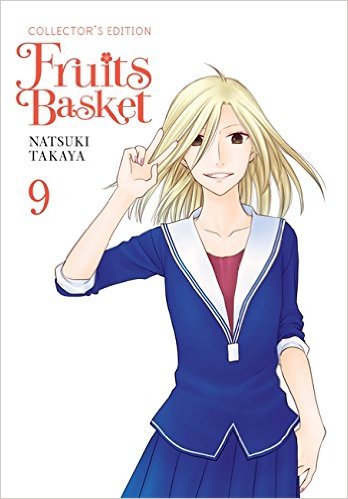
By Natsuki Takaya. Released in Japan by Hakusensha, serialized in the magazine Hana to Yume. Released in North America by Yen Press. Translated by Sheldon Drzka.
This review contains spoilers that everyone knows. If you don’t know them, you can stop reading here.
At the time that Fruits Basket was first coming out, both in Japan and North America, it had a sizeable BL fandom. In fact, one might very well argue the BL fandom was far larger than the het fandom for this particular title. Not really a surprise – the series is filled with pretty boys, and some of them even play up to this stereotype (Shigure, Ayame, I’m looking at you). And BL fandom at the time (and to a certain extent today, though maybe not as much?) tended to demonize and bash any female character that got in the way of their pairings (not Tohru so much, but Rin got hit REALLY hard with this) as well as praise the “bad boy”. Which of course in Fruits Basket was Akito. Akito was a hot guy, so could be forgiven a little abuse here and there, right?

So with the revelation that Akito was actually a girl, raised as a boy (her gender is a secret to most of the cast as well as the reader), the fandom sort of exploded into bits. Half of it reacted much like Tohru did in this book, dropping to her knees and breaking down until Hanajima comes to her rescue (one of my favorite scenes in the entire manga, particularly Hana providing her own fanfare). The other half reacted with rage that Takaya-san would do this to their beloved Akito, who… was no longer as beloved as a girl. In fact, the fandom started to turn on her a bit. Reading it now almost ten years later, I am similarly torn, though admittedly not for the BL. Akito is clearly also part of this giant family of abuse, and we see a lot more of her mother Ren here – indeed, Ren kickstarts the plot that occupies much of the latter half of the book. On the other hand, Akito is still a spoiled, entitled brat, and lashes out in panic whenever anyone shows the slightest sign they’re going to leave her. It’s hard to read, but worth it.
Then there’s Rin and Haru, who’s plots get mostly resolved here. Rin suffers somewhat from being a dark mirror to Tohru, and so her quest to break the curse was always doomed to end in failure. Also, don’t trust the obviously untrustworthy woman, Rin. But Akito’s reaction to finding her opening “the forbidden box”, and her subsequent punishment, is nightmarish – you sense that if Kureno hadn’t found her, she would literally have died there. (Kureno has to talk a terrified maid into helping him, and judging by the head maid’s disparaging words after the fact, I suspect that said maid may have gotten fired after all.) Speaking of dark mirrors, the light side is Haru, who realizes he wanted to possess Rin more than he wanted to protect her. The dark side is Shigure, who wants Akito all for himself and is happy to shatter her preconceptions to do so – in fact, he has to do so due to the nature of the curse.
I admit these two volumes, as well as the first half of the next edition, are where I realized Shigure would always be my favorite. His possessive monologue about wanting to “crush Akito to a pulp”, as well as his dull-eyed stare as he thinks it, is some of Takaya’s finest work in he entire manga. And as if that wasn’t horrifying enough, his conversation with Rin right at the end implies he may have known about her fate and done nothing about it. Shigure can be both fascinating and completely awful, and I could analyze him all day. But I will instead say that this volume of Fruits Basket and the one after are, in my mind, the high points of the entire series. Even if they did crack the internet in half at the time.

