Monthly Archives: March 2017

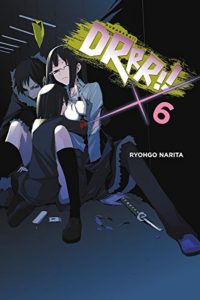
Durarara!!, Vol. 6

By Ryohgo Narita and Suzuhito Yasuda. Released in Japan by ASCII Mediaworks. Released in North America by Yen On. Translated by Stephen Paul.

When you write a book that creates a series of events that spiral into chaos, as Narita specialized in, particularly in this series, it can be many things to many people. For every character that’s involved in wacky hijinks, there’s another who’s undergoing a traumatic life-changing event. The skill is to keep those balls up in the air, and more importantly, to make everyone distinctive and memorable. As the books go on, we introduce more and more new cast members, and you need to be able to care about everyone without consulting the wiki to remember who they are (A Certain Magical Index suffers from this quite a bit). Luckily, Narita is quite good at this, so we can empathize not only with our heroes, but even the passing villains who get curbstomped by yakuza, and said yakuza, who are finding all of these gangs and Russian assassins simply exasperating. It’s all things to all people.
And so Durarara!! can be a comedy. There’s lots of great humor here, even if some of it is pretty twisted. Shinra’s diary of Celty fetish outfits, and her reaction to same. Chikage’s absolutely ridiculous chivalry, with equal measures of “knight in shining armor” and dumb sexism. Speaking of sexism, Erika gets to play the depraved bisexual in this one, groping Anri for no reason other than she wants to and to give the illustrator some fanservice to draw. Not OK, Erika. There’s also her and Walker namechecking Index and Shana in the middle of a pitched fight. And Mairu and Kururi’s chatroom gabbling is always worth a smile.

But Durarara!! is also ridiculously heartwarming. The fact that Shizuo has grown and changed as a person is a literal plot point here, as that very growth is what spoils Izaya’s plans. I loved the way that he bonded with Akane at the end, after saving her from Vorona and Slon. Celty might be weirded out by all the talk of Akane killing him, but it’s sweet in a Ryohgo Narita way. Anri may not be able to admit how close Mikado is to her, but her attempts to protect him are wonderful to see, as are Mikado’s absolutely pathetic attempts to protect her and also stop the Dollars gang from kidnapping Rio and her friends. For all that I like to say that Durarara!! is about terrible, twisted people, a lot of them have a good heart. Oh yes, and who doesn’t get a warm feeling in their heart when they see Izaya get what he deserved at the end of the book? I know I smiled. Well, cackled, really.

But I’m avoiding the elephant in the room, and that’s the fact that Durarara!! Book 6 is also a tragedy. We see a bit of it in miniature with Akane, a genuinely sweet little girl who is broken by events (and helped along by Izaya) to the point where both Celty and Shiki are disturbed by her but can’t quite put their finger on why. Vorona is shown that she’s nowhere near strong enough to take on Ikebukuro (don’t worry, she’ll be back). And then there’s Mikado, who is being used as a pawn by both Izaya and Aoba, and who finally makes a decision to go to a very dark place. Several times in the book we see people seemingly know Mikado better than he knows himself, and he’s given several opportunities to back off, to do the right thing, to become a good person. And he absolutely rejects all of them, agreeing to become the Blue Squares leader so that he can “fix” the Dollars. The most chilling moment in the book isn’t when he stabs Aoba in the hand with a ballpoint pen (though that is the most famous moment). As Aoba also realizes, it’s right after, when he switches back to innocent, kindhearted Mikado like flipping a switch. Mikado has chosen to embrace the darkness, and I appreciate that the narrative shows us how much of a terrible tragedy that truly is.

So we’re at the end of another arc, and that means next time we’ll see a lot of wandering around and setting up future plotlines. Still, books like that are what lead us to books like this, which is a highlight of the series.

Ranma 1/2, Vols. 37-38

By Rumiko Takahashi. Released in Japan by Shogakukan, serialized in the magazine Shonen Sunday. Released in North America by Viz. Translated by Kaori Inoue, Adapted by Gerard Jones.

And so at last we come to the end of the great Ranma 1/2 reissue. Inu Yasha may have had a broader reach, Urusei Yatsura may have had a bigger impact on Japan itself, and Maison Ikkoku may have had more maturity and resolution, but Ranma will still be THE anime gateway for many fans, along with Sailor Moon and Bubblegum Crisis. Having read the series again, I am able to see why it was so wildly popular, as well as why revisiting it can be frustrating. Ranma does not have depth – in fact, it actively leaps out of the way of depth – which makes it perfect for creative fans who want to give it that depth. It’s no coincidence that more than AMVs or fanart, it was fanfiction that was the biggest part of the mid-90s Ranma boom. Still, this does not mean that Takahashi’s manga is not good. It’s very good indeed.

Please do not be fooled by the cover – yes, there is a wedding at the end of the book, but we don’t even get to the ceremony before everything is completely destroyed and we return to the status quo. Well, status quo except that it seems that if there had not been chaos, Ranma and Akane might have gone through with the wedding. But there is always chaos in Ranma, it’s practically the main cast member. This manga ends much the same way that many of the classic UY anime episodes ended – with more and more of the cast showing up, each trying to beat up somebody else, until everything finally turns into a giant pile of destruction. Ranma 1/2 is not a romantic comedy, or a harem manga, or even a martial arts comedy. It’s pure slapstick.

The martial arts gets a good workout in the main part of this volume, though, as we return to China to battle another major villain. You get the sense that Takahashi is trying to figure out a way to top Herb, and she doesn’t manage it, really, but A for effort. The whole main cast is there (poor Ukyou, guess you were supporting after all), and there’s lots of cool fights and dramatic kicks and Akane and Shampoo in distress a lot of the time. That said, even when captured or dehydrated down to the size of a doll, Akane is still thinking hard and trying to get herself out of her predicament. Shampoo, alas, is merely mind-controlled most of the time. (I will note that Akane not noticing Ryouga transforming several times in this beggars belief, but hey.)

And so Ranma ends with our main couple waving goodbye to the readers as they head off to school again. It’s never quite confirmed that they do have mutual feelings for each other, mostly as I think Takahashi hoped people could read between the lines and see that she’d had them show their love without saying their love several times. (UY did this too – Ataru in particular was the poster child for “show, don’t tell”.) It didn’t quite work, and fans who disliked Akane were always quick to point out the open-endedness of the ending meant that they didn’t end up together. Takahashi later did one of those “character relationship charts”, filled with one-sided arrows, except for two – Ranma and Akane, and Ryouga and Akari. So she knew they loved each other.

But we don’t read Ranma for resolution of romantic tension. We read it for genderswapping and bizarre martial arts contests and so many fights and “Ranma no baka!” and in order to flesh out our 800,000 word epic fanfic with smatterings of actual canon. And we read it because we love the characters, flat as they are. Of course, we may not always love the SAME characters, but any Ranma fan is obsessed with at least one of them (except Happosai). Ranma 1/2 was a roadmap to modern anime fandom, and the road may be less traveled these days but it’s worth walking back over.

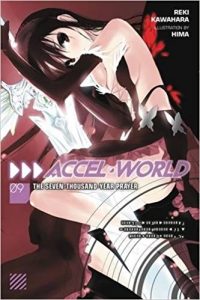
Accel World: The Seven-Thousand-Year Prayer

By Reki Kawahara and Hima. Released in Japan by ASCII Mediaworks. Released in North America by Yen On. Translated by Jocelyne Allen.

And so, at last, we come to the end of the Armor of Catastrophe arc, which was not only deliberately meant to be a long arc but also grew out of the author’s control, as he’s admitted himself in the afterword. The volume gives us a lot of what readers like about this series: good battles with some nice analysis from Haruyuki, some amusing harem comedy, some heartwarming romance with Kuroyukihime, and an examination of the nature of negative emotions and how to cope with them every day, because they don’t just magically go away merely because everyone believes in you really hard. That said, it also has some things that fans tend to not like as well: Haruyuki is not only the bestest person to ever be possessed by the evil armor, but he’s a shining magical beacon of hope for all. Oh, and he gets another girl confessing to him, and is caught with her lying on top of him, because harem comedy. It’s a balance.

The significant development here is a bit of a spoiler, but worth talking about. We learn the true identity of Ash Roller, which turns out to be somewhat confusing, meshing up a tragic tale of an introverted girl and her comatose brother with the nature of the neurolinkers that are omnipresent in this world. It’s left deliberately up in the air what’s going on here, whether Rin is literally being possessed by her brother while in the Accelerated world, or if she’s merely taking on his role to an almost absurd extent. (She genuinely seems to be unaware of what transpires without wearing her brother’s neurolinker, so odds are on the first.) That said, I admit to a bit of irritation at the fact that one of Haru’s only male friends turns out to really be a shy young girl who’s in love with him in real life. (The shyness is conveyed via an odd speech pattern – Rin talks in sentence fragments, and it’s unclear if this is a mental issue like Utai’s or if it’s meant to be natural introversion.)

That said, once again after a lot of harem tease we are reminded that at the end of the day there is only one who is top of the heap, and it’s Kuroyukihime. We get a little more insight into her real-life background – she lives alone in a very rich neighborhood, and it’s implied that the murder of the Red King in the Accelerated World had a counterpart in real life as well. That said, just as Haruyuki is a Pillar of Hope for All despite his omnipresent self-hatred, Kuroyukihime tends towards the perfect accepting girlfriend much of the time, listening calmly as Haru pours out his fears, getting the crap beaten out of her in the AW waiting for him to overcome the Disaster, and bushing cutely when he’s accidentally proposing marriage to her without actually realizing it.

So in the end Accel World has much the same strengths and weaknesses as the author’s other series, Sword Art Online. Which means fans of one will enjoy the other, and those who hate Kirito with a passion probably will find themselves getting annoyed at Haruyuki here. The next book should be standalone and lighthearted, and I fear that may mean MAXIMUM HAREM ANTICS. We shall see.