Monthly Archives: March 2017

Hana & Hina After School, Vol. 1

By Milk Morinaga. Released in Japan as “Hana to Hina wa Houkago” by Futabasha, serialized in the magazines Comic High and Weekly Action. Released in North America by Seven Seas. Translated by Jennifer McKeon, Adapted by Shannon Fay.

This is the third of four quite similar yuri titles due out in February/March. I’ve already discussed Secret of the Princess and Kase-san And Morning Glories, and I have to save some of my energies and words for Kiss & White Lily for My Dearest Girl. Here today we have the new series from Milk Morinaga, author of many other yuri series that have been brought over to North America. It gives fans of sweet yuri exactly what they want – these are cute girls, one short and brunette and one tall and blonde, having a difficult first meeting but gradually growing closer, and the first volume ends with a lot of “but we’re both girls” angst. It doesn’t break any rules or step outside the box, but it performs its function well.

Hana is the short one, and she’s diligent and nice but tends to overthink things, and she works after school at a shop that sells what I’ve always called tchotchkes, borrowing from the Yiddish. Stuffed animals, mugs, things like that. One day she gets a new co-worker in Hina, a tall leggy blonde who appears very standoffish and cold. Of course, this is merely Hana’s read on her. As we learn more about Hina, including her love of all things cute (to the point of almost being a cute otaku), it’s clear that Hina is acting this way around Hana to avoid getting too close – which makes it all the more awkward when the new school year begins and Hina shows up at Hana’s school – yes, the tall leggy blonde is an underclassman to the petite girl. The minimal plot here involves the fact that part-time jobs are against the rules, and this is doubly bad for Hina, who’s also a model, though she’s going to give that up.

What follows is, as I indicated above, predictable, in a way that many Milk Morinaga titles are. Hana is adorable and upbeat, and every time they interact it becomes increasingly difficult for Hina to keep her hands off her. That said, Hina also has a tragic past where she’s been called out for this before, if the minimal flashback we see is any proof, and when she asks some other classmates if they’d think a confession from another girl was weird, they say no… provided it’s just the typical admiration that Japanese schoolgirls are supposed to have. If it’s real romantic feelings… yes, they think it’s weird. And so Hina’s stuck, and stressing about it as the volume comes to a close.

Actually, I’d argue this is a step forward from some other Milk Morinaga series we’ve seen that are even fluffier than this. Real life brings real problems, especially if a girl decides she likes other girls, and they can complicate a relationship even more than “but what if she doesn’t like me that way?”. I’m hoping that the remaining two volumes of the series go into that deeper. In the meantime, this is definitely recommended for fans of yuri.

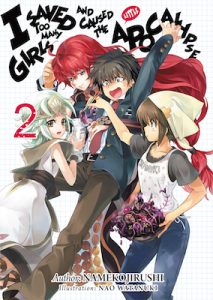
I Saved Too Many Girls and Caused the Apocalypse, Vol. 2

By Namekojirushi and Nao Watanuki. Released in Japan as “Ore ga Heroine o Tasukesugite Sekai ga Little Mokushiroku!?” by Hobby Japan. Released in North America digitally by J-Novel Club. Translated by Adam Lensenmayer.

This was a surprising license for J-Novel Club. Not because of the premise – honestly, the combination of harem parody along with the genre mashing of fantasy, SF, school life, and everything in between is highly appealing to North American markets. No, it’s just that this novel series is 16 volumes long in Japan, which is pretty lengthy, especially for a budding LN publisher. Thankfully, the 16th book seems to be the final one, so we don’t need to worry about it becoming a massive behemoth like A Certain Magical Index. And to be fair, judging by the lengths of these first two novels, 16 Little Apocalypses may be the equivalent of eight Devil Is a Part-Timers. The reason I bring all this up is because we not only get three heroines introduced here, but roles also for the first book’s heroines, and the introduction of (presumably) the next heroine at the end. By Book 16, what will the pileup look like? Well, probably like an apocalypse.

Of course, not all heroines are created equal. Poor Harissa doesn’t really get to do much here except fret and use the occasional spell, and Iris is sent off until the thrilling finale requires her. Satsuki plays a larger role, but that’s more due to her magical wikipedia ability than anything else. This makes sense, given that we get three new girls here, and have fun seeing Rekka try to intertwine their stories in order to solve the problem. Fortunately, two of them are already intertwined: Tetra is essentially a shrine maiden devoted to doing something about the seal that is currently holding back a powerful monster, and Leviathan (aka Lea), the monster in question who turns out to have been imprisoned there falsely. The third heroine is more down to earth: Akane Tendo (cough) pardon me, Tsumiki Nozomuno, who family owns a failing restaurant and needs her to come up with a dramatic menu item to save the day, despite the fact that anything she cooks ends up as a poisonous black sludge, and also the fact that she’s a massive tsundere.

This volume is not quite as good as the first – I suspect the author forgets that he’s writing a parody of the harem genre at times, and when he does, things get rather tedious. The villain was quite good, but the introduction reminded me a lot of Kyubey – possibly deliberately, as I think Madoka Magica was airing when this was being written. There are funny gags, although Rekka in a magical girl outfit is not as funny as the author – and indeed the rest of the cast – think. Worst of all, R’s snark is few and far between here, though when she does make a comment it’s as hilariously sarcastic and bitter as ever. She’s still easily the best part of the book.

As I said, we get a cliffhanger ending to this book, which seems to introduce the subject of the third book. Will it limit itself to just one girl this time around? If we assume 3 girls per book, that would be 48 girls, which is edging close to Negima territory, so I’m hoping that we back off a bit. I’m also hoping for a bit more making fun of the harem comedy and less conforming to it. Still, this is easy reading and fun enough for those who enjoy the genre.

Anonymous Noise, Vol. 1

By Ryoko Fukuyama. Released in Japan as “Fukumenkei Noise” by Hakusensha, serialization ongoing in the magazine Hana to Yume. Released in North America by Viz. Translated by JN Productions.

It was always going to be difficult to live up to that cover, let’s face it. Manga readers, even in North America, have been somewhat trained to think of one thing when they see high school girls wearing cold masks: gang members. That’s not the case here, but I’d argue that Nino, the girl on the cover, does not need to convey her repressed emotions through violence, like many shoujo gang members. She can do so through song, and in fact the best thing about this new manga is the way that her voice is portrayed. Nino loves to sing, but due to the events of the first chapter, her voice comes out as a cry from the heart, a scream to be heard, a cry of loneliness. It’s primal, and the art portrays it beautifully.

The premise will be very familiar to readers of manga – in fact, it may remind people of Chihayafuru, which debuted last month. Nino and her best friend and next door neighbor Momo sing together to try to forget about the fact that their parents fight. But then one day Momo’s family moves away suddenly, and if devastated. The cold mask is to stop her simply screaming out in rage and distress at what’s been taken from her. Fortunately, she meets another young boy, Yuzu, who’s not much like Momo, but he likes to write music. Nino can sight read even at that age, and begins to sing his songs after a brief argument (Yuzu is a lot less nice and cute than Momo was, being more of a brat). But then he has to vanish suddenly too (why are childhood goodbyes always avoided in stories like these?), and all Nino has left is her voice.

Cut to high school, and the hot new band is called In No Hurry To Shout, a terrific name, which is unfortunate as the band is breaking up. No, it’s not Nino’s band – she’s an anonymous high schooler, and still wearing the cold mask. But it is Yuzu’s band, and it quickly becomes apparent that the songs are being written for Nino, even if they’re being sung by her substitute, Miou, who I suspect is going to take Nino coming back into Yuzu’s life very badly. For indeed the two reunite, and before you know it Nino has to be the band’s lead singer at the high school event. This was the scene I alluded to earlier that’s the best in the book – Nino doesn’t even try to follow the actual lyrics, and her hands clutches her face as if she’s doing the Careful With That Axe, Eugene scream by Pink Floyd.

By the way, if you know shoujo you know what happens by the end of this volume – yup, Momo shows up as well, and he heard Nino. This seems to be one of the more dramatic Hana to Yume manga, a magazine that usually has a few more jokes in its material. But honestly, I’m totally on board as long as I can see more of Nino singing. It turns out the cold mask on the cover was holding her back from the reader as well – once you see her pouring her soul into her voice, you’ll have to read more. Definitely recommended.