Monthly Archives: August 2017

Sword Art Online, Vol. 11: Alicization Turning

By Reki Kawahara and abec. Released in Japan by ASCII Mediaworks. Released in North America by Yen On. Translated by Stephen Paul.

I don’t think I’ve ever come across a book that more perfectly summarizes the best and the worst of Sword Art Online in one handy gulp. The high points of this book are excellent, and the low points are incredibly frustrating. Put together, though, we have a series that continues to intrigue even as the main cast that isn’t Kirito continues to be entirely absent – Asuna gets a few pages in the middle, but for the most part we are entirely in Kirito’s fantasy world here. Fortunately, the first half of the book or so gives another break from Kirito’s first person, as we get a long stretch narrated by Eugeo, who is nice and earnest and a good contrast to Kirito. I was expecting that we would see more training at the knight academy, probably ending up in the giant fighting tournament that had been lampshaded earlier. But then things went entirely off the rails.
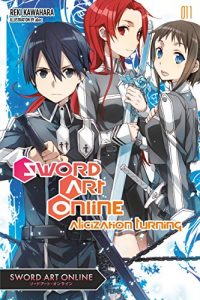
Let’s get the bad out of the way first. We have yet ANOTHER instance where female characters are captured and threatened with rape, so that we may see how irredeemably evil the villains are (Kawahara’s villains remain his giant weak point – he can’t write nuance) and also justify Kirito’s violence towards them. This is even more annoying because we’d barely gotten to know Tiese and Ronie, so the threat doesn’t have as much of a reader impact as it did with Asuna and Shino, assuming the reader impact cannot just be narrowed down to “rolls eyes, sighs”. And then due to the plot moving on, we don’t see the girls after this, which just makes it more blatant it was done for pure “damsels in distress” reasons. I understand in the original webnovel this was taken from, the girls actually were raped – thank heavens for small favors that this was changed. SO BORED WITH RAPE THREATS, KAWAHARA.

Of course, disposing of the two villains does mean that the plot makes a right turn, as now Kirito and Eugeo are captured by the Synthesis Knights and brought to the Central Cathedral… which was their goal, to be fair, but probably not as prisoners to be judged. Things pick up a great deal here, as we find that Alice (remember Alice?) is one of the knights, but doesn’t seem to remember Eugeo at all. Kirito takes up the narration again here, and it works out well, showing off his smarts in knowing when to push hard on “this is a game world with game rules” – breaking the chains was particularly good. What’s more, after a long and highly interesting fight scene that shows us the knights may in fact be brainwashed, we are given a long, long infodump by a new character that actually feels realistic and welcome, telling us a lot more about the Underworld, how it got its start, and the evil woman now at the head of it all.

In the end, this is book 3 of a 10-book arc, so there’s a limit to how far it can take things. But once you get past Kawahara deciding that nothing adds to drama quite like rape threats, it’s enjoyable and fun, with excellent fight scenes. Just… get a new gimmick. I beg you.

JoJo’s Bizarre Adventure: Stardust Crusaders, Vol. 4

By Hirohiko Araki. Released in Japan as “Jojo no Kimyou na Bouken” by Shueisha, serialized in the magazine Weekly Shonen Jump. Released in North America by Viz. Translated by Evan Galloway, original translation and adaptation by Alexis Kirsch and Mayumi Kobayashi.

For all of the cool fight scenes and new arrogant villains, there is a certain sameness to Stardust Crusaders that I just can’t seem to escape from. It doesn’t help that this arc of JoJo’s is essentially a road movie/extended chase scene, and so we don’t really get much plot beyond “who will turn up in which Middle Eastern town to attack our heroes?”. To be fair, some of those villains are interesting, and there’s a lot of “the villain thinks they will be saved by the main villain, but no, they are just another pawn” here, but I’ll tell you; reading Jotaro’s story is a lot like traveling across the Midwest and staying at the same Holiday Inn with the same wallpaper every single night. Fortunately, there is the art if nothing else; JoJo’s always LOOKS really cool.

As I’ve observed before, there is a huge love of Western music that we’ve seen throughout the series, particularly in the naming of its various characters (mostly villains, but let’s not forget R.E.O. Speedwagon too). It reminds me of a previous old-school manga Viz used to release back in the day, Bastard!!. And just like that series, some of the names have to be changed to avoid litigation. Here we have Enyaba on the cover, who is Enya with a -ba added to her name to let us know she’s a wizened granny. There is also Dan of Steel, who is named after Steely Dan, of course, and like the item the band named themselves after, he proves to be a giant dick. An enterprising young fan could probably give us a nice JoJo’s soundtrack filled with songs from the bands and artists mentioned here. It also helps to emphasize the ‘road’ feel of this storyline.

The fights are the same, filled with action and horror, also continuing the body possession from last time. Fortunately, there is also a helping of humor, some of it gross (Polnareff and his tendency to need to use the bathroom – which rebounds nastily on him here) and some of it amusing if a bit sad (Joseph was always street smart rather than intelligent, but a lot of times here he becomes stupid for the sake of the gag). The humor is needed to offset the grisliness of the battles here, with many of the villains being taken out in highly grotesque ways. For all that Dio is meant to be the main villain of this arc, and I’ve no doubt he will be appearing in the final volumes, so much of this is like a video game where you have to battle endless mid-boss after mid-boss. The journey here in JoJo’s is definitely more important than the destination, and therefore this volume gets the same opinion as the others: I liked it, but like the first two arcs better.

The Devil Is a Part-Timer!, Vol. 8

By Satoshi Wagahara and 029. Released in Japan by ASCII Mediaworks. Released in North America by Yen Press. Translated by Kevin Gifford.

Well, I’d talked about how much I love the daily life scenes in this series, and that’s still true. The author even throws in a classic one right at the beginning just to soften us up. But yeah, those days are, if not gone for good, at least gone for now. Because one of Maou’s larger flaws is tending to act impulsively and worry about consequences after the fact, and so the events of the 6th book are coming back at him with a vengeance. I won’t say that he ends the book completely defeated, but what with most of the cast being captured or incapacitated in some way, things aren’t looking good. I also said in the review of Vol. 6 that I suspected we’d be headed back to Enta Isla, and while we aren’t there yet, it’s very clear that we’re setting up a book or two over there next time. Fortunately, despite all these events, the writing remains first rate.

Yes, that’s a new girl on the cover, and if you think she looks like Alas Ramus, you’re on the right track. Her personality seems to be ‘hyperactive child’, despite appearing to be about 13 or so, and Maou has a lot more trouble dealing with her, which doesn’t bode well for his fatherhood skills when Alas Ramus grows up. (Can Alas Ramus grow up?) Of course, Maou is a little bit stressed out, mostly as Emi and Alas Ramus returned to Enta Isla for a visit and have not come back, despite it being well past the time she said she would. Leaving aside the wisdom of Emi returning to Enta Isla after the events of the previous books (Emi is fairly straightforward, so I can see her doing this), the absence makes Maou realize just how much Emi is a part of his life now. Of course, he doesn’t realize this right away, but takes most of the book, and a few talking tos by Chiho and Suzuno, in order to grasp it. Oh yes, and the worst part – he’s trying to get a motor scooter license (for the job, of course), and was so stressed he failed the exam! Which means more expenses.

Emi’s absence is not just noted by the fantasy characters, of course. First of all, if this takes much longer she’s going to need to look for a new job, as she’s currently AWOL at the call center. Secondly, Rika is very upset about the whole thing, and she runs to Ashiya is case he knows anything and ends up caught up in the attack on Japan that the forces of evil have launched to destroy Maou’s “demon generals”. The book balances on an edge as to whether Ashiya is going to tell her all about them or not, but of course he’s spared the choice by the bad guys showing up. The last half of the book has a lot of cool fight scenes, which if they ever do Season 2 of this series will look quite good animated, and Chiho gets to act cool. Still, there’s no getting around that Maou is in trouble, Emi is in trouble, Ashiya is in trouble, and those who can help are either too human or too injured. Excellent stuff, but now we have to wait to see what happens next.