Monthly Archives: December 2017

ACCA: 13-Territory Inspection Department, Vol. 1

By Natsume Ono. Released in Japan as “ACCA – 13-ku Kansatsuka” by Square Enix, serialized in the magazine Big Gangan. Released in North America by Yen Press. Translated by Jocelyne Allen.

It’s rare that I read a Japanese manga translated into English and think to myself “I think I’d have liked this even better in the original French.” But that’s the sort of mood that ACCA gives off. It’s not something that I’m unused to with the works of Natsume Ono, whose art seems designed to constantly be showing people descending into hole in the wall cafes and small, dingy apartments. But even when the canvas opens up – much of the action in this book takes place in large rooms and wide streets – it feels like I’m reading a manga directed by François Truffaut. The plot of this story is fairly standard – various shady goings-on are happening but are for the most part dealt with by our hero, who seems unassuming but is Very Clever Indeed. But honestly, I don’t read Ono’s stories for the plot, I read them for the evocative mood that she sets. With ACCA, she has another big success.

No, that’s not Sanji on the cover, though he is blond and does smoke throughout the volume – indeed, smoking is why he’s famous, in a country where cigarettes are a luxury item. Jean is instead near the top of a group of inspectors whose job it is to inspect other inspectors. The first chapter sets out precisely what he does and his attention to small details, while also dealing with a plot to close down the agency (I wonder if it was devised as a one-shot?). He and a subordinate (who is seen depressed at the end of the chapter, possible as she realizes she’s not in the rest of the book) root out small-time corruption, then he quickly wraps up and returns to not-Paris, where his department survives to audit another day. For now – he’s also beset by jealous regular police officers, mysterious higher-ups with plans and schemes, and his sister, who wants him to just help her run the expensive apartment building they’re in charge of.

As I said before, the plot is mostly irrelevant. There was an anime of this about a year ago, and I’d be interested to see how the dialogue was handled – much of it cries out to be murmured rather than spoken, perhaps with one of the deadpan smirks that Jean occasionally gives us. I also enjoy it when I notice the scenery as much as I do the plot and characters – Dowa, somewhat ridiculously, is a country shaped like a bird, and is filled with fantastic bakeries and high-ceilinged government buildings for Jean and some of the other characters (particularly his female counterpart, Mauve) to sweep out of dramatically. Well, Mauve sweeps dramatically. Jean sort of shuffles like a French Columbo – sorry, like a Dowan Columbo.

There are hints of an expansion on the plot and a possible betrayal in the cliffhanger for this volume. That said, I still say this is the sort of volume you read while sitting out on the 4th-floor balcony of your city apartment, sipping bitter coffee and eating a croissant from the bakery down the road. I’m happy I picked it up.

I Saved Too Many Girls and Caused the Apocalypse, Vol. 6

By Namekojirushi and Nao Watanuki. Released in Japan as “Ore ga Heroine o Tasukesugite Sekai ga Little Mokushiroku!?” by Hobby Japan. Released in North America digitally by J-Novel Club. Translated by Adam Lensenmayer.

Despite the occasional attempt to tie things together between sections, this is what we always knew was coming in a series this large: a short story collection. The good thing about this is that everything takes place around Rekka’s school and neighborhood, so we get to relax a bit after the high stakes of the last volume. The bad thing, of course, is that low stakes events sometimes don’t equal high impact. The first story in this volume deals with Lea, the human-looking leviathan from Volume 2, and her attempts to actually hold down a job and earn money so she does not have to rely on “nice young men” buying her meals. Lea’s ‘clueless yet strong’ character is not really top tier among the heroines, and the addition of a terrible gay stereotype (which I was going to give a pass until he took the perverted customer into the back room for punishment – yes, the guy was a lech, but no. don’t do that) did not help matters. Thankfully, things pick up a bit after that.

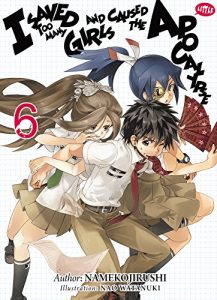
Only two heroines on the cover and added to the pile (that’s a total of 15 now, if you’re counting), but both of them are solid additions. Little Apocalypse sometimes tends to forget it’s meant to be a parody, but it’s a bit better on that front this time around – Rekka has never been more clueless about the fact that all these girls are in love with him. Given that, if you’re going to add memorable new heroines you need to make them ‘types’ so they stand out. Thus we have the teasing, large-breasted literature club girl, Midori, who is thought to be a ghost but in reality is simply quiet and weird – except around Rekka, whom she loves to hug from behind because, well, did I mention the large breasts? Despite the stereotype, she’s a lot of fun – it makes you realize we never really had a ‘tease’ among the heroines till now, and it gives a nice dynamic. The other heroine is Momone, who is not only Student Council President but also a Shrine Maiden and Demon Hunter. Honestly, you could fit three heroines in that description, but she does it all herself. Her blunt forcefulness is also something new added to the heroine lineup.

Neither one of these girls needs saving by Rekka, as R notes – they aren’t “traditional” heroines the way the rest of the group has been, they’re more like Hibiki (who gets a short story at the end dealing with a vengeful ghost, which reads like an episode of Urusei Yatsura so much that I’m going to check my DVDs to see if they actually did that one). That said, it’s fairly clear by the end of the book that they both like Rekka just as much as the rest of them. The final story here is R reporting to her superiors on her progress, which is pretty much near zero. It does have R serving to remind us that this is technically HER story – the story of how she’s stopping the Apocalypse by going back in time and helping Rekka. Which so far seems to involve dragging him around then house as he sleeps so that she can watch TV late at night.

So overall a decent addition to the series, and these books are always so short that they’re a light, snack-like read as you wait for the next Arifuerta or something similar to come down the pike.

The Promised Neverland, Vol. 1

By Kaiu Shirai and Posuka Demizu. Released in Japan as “Yakusoku no Neverland” by Shueisha, serialization ongoing in the magazine Weekly Shonen Jump. Released in North America by Viz Media. Translated by Satsuki Yamashita.

This review, out of necessity, talks about the first volume of The Promised Neverland. If you want to be unspoiled, go read it first.

Holy Mother of God. It’s been a long, long time since I’ve had a manga, particularly a Jump manga (which tend to be slow starters), make my jaw drop quite as much as The Promised Neverland did. Everything seemingly comes together in this. The art style fits with the writer perfectly, there are many, many page turn reveals and amazing facial expressions. The three leads are likeable, whip-smart and yet not perfect, and you really, really want them to win out. There’s also a love of friendships and family that I will always adore when it’s handled this well. And yes, let’s just get it out of the way, there is some amazing horrific stuff here, with most of the book being a tense, nail-biting thriller but occasionally dipping its toe very effectively into pure horror. The Promised Neverland is RIVETING.

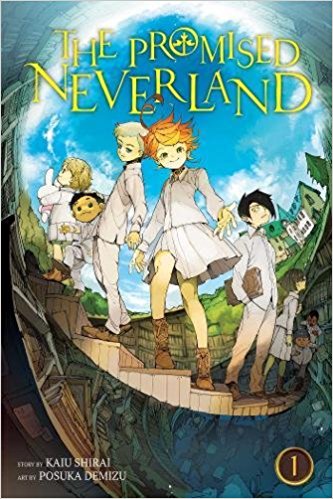
The cover and first couple of pages might lead you to believe that we’re going to be seeing some sort of warm, fluffy, Anne of Green Gables style story. We meet Emma and get her POV of the orphanage she’s spent most of her life in. Sure, the title page may look a little grim and ominous, but let’s disregard it for now as she seems so happy! Emma is one of the oldest in the orphanage, and along with her best friends Norman and Ray she spends the day herding the younger kids, having immense amounts of fun, and taking the DAILY TEST, the first of those page-turning reveals I mentioned above. At this point, the reader knows something grim is coming. Still, it’s not until we hear that one of the youngest kids is leaving that day that we think “uh oh”. And sure enough, soon we’re up to our neck in mysteries, from “what’s outside the orphanage?” to “why did that happen to Conny?” to “why are we still here even though we’re all 11 years old?”. Now Emma, Norman and Ray have to outsmart the adults – something easier said than done.

I feel like going on and on about the things I loved in this. Ray’s cynical intelligence and Emma’s boundless emotional enthusiasm are balanced nicely in the middle by Norman, and honestly I’m glad Emma is not beaten down by this (yet), as without her the title would be even grimmer than it already is. I also love the fact that Emma refuses to simply try to run away with just Ray and Norman – she absolutely won’t save herself at the expense of all the younger orphans. Again, there are some nice themes of family throughout this volume, and I appreciate that Emma’s viewpoint was allowed to carry the day. We hear that the three kids are incredibly intelligent, and see this displayed throughout the book… except they’re also outsmarted quite a bit by adults with more experience than they have.

Flaws? Well, Krone skirts the edge of being a racial stereotype, but part of that may be simply due to the fact that she’s meant to be a villain, and honestly compared to some other ways Jump has treated black people I’m willing to let it pass for now, especially as I enjoyed the way the cast is multiethnic. Mostly, though, The Promised Neverland hits it out of the park. I want it to be February already so that I can read more. Highly recommended (unless you really hate horror-based stories – it’s pretty damn dark, trust me).