Monthly Archives: January 2018

Under the Air

By Osamu Tezuka. Released in Japan by Akita Shoten, serialized in the magazine Play Comic. Released in North America by Digital Manga Publishing. Translated by Grady Martin. Adapted by Nate Heneghan.

One of the difficulties in reading the so-called God of Manga is that there is a certain tendency to try to see everything as a masterwork. This can be quite difficult with Tezuka, who has written SO MUCH already. But just as there is good Tezuka, there is also bad Tezuka. And there is also Tezuka feeling things out, trying to grow and learn and make the manga industry grow and learn with him. Under the Air is one of those types. Created for the more mature Play Magazine, it’s a series of unrelated short stories – unrelated except for an interconnected theme of good and evil. As an experimental collection, it’s very hit-or-miss in terms of enjoyment. As a document of Tezuka, I found it far more interesting, and you can also see how it improves as it goes along – my favorite story was Under the Air itself, which is the final one in the volume.
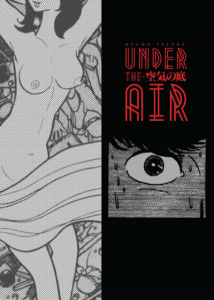
Yes, as the cover art indicates, this is definitely one of Tezuka’s work for adults. There’s violence, murder, racism, death, sex, incest, and all sorts of human frailties along the way. The manga has a high bar to clear – because it’s meant to be about the nature of evil in many ways, its protagonists tend to be horrible people. Frequently his goal is to show them have some sort of revelatory experience that leads, if not to a change of heart, then at least to a changed state. At the start, this doesn’t work out so well – the star of Joe’s Visitor is SUCH a loathsome human being that there is absolutely no way I bought him returning at the end – in fact, I was initially baffled as to what was happening. A couple of the stories also “star” Tezuka as himself, usually looking for story ideas or visiting friends, and running into trouble. Tezuka, amusingly, does not portray himself in a very likeable way either, though he’s certainly more likeable than a lot of these people.

As the volume goes on, the stories get a bit more ‘fantastical’ in nature, ranging from hallucinatory images to experimental drugs to swapping your wife’s mind with that of a donkey – yes, really. You can also see Tezuka getting a handle on what he’s actually trying to do – the characters are not as “bwahaha, I am a BAD PERSON!” as they were at the start, and therefore the moral of whatever story he’s telling makes more sense and flows better. This culminates in the final story, featuring two innocents raised by themselves in a spaceship-style environment who grow up and become curious about the world outside their little bubble – which shows off the fact that good innocence can lead to just as many tragic consequence as evil heartlessness, though the story ends on a bittersweet rather than bitter note.

This volume came out via Digital Manga Publishing’s Kickstarter efforts, and there is theoretically a lot more coming in the near future. Under the Air is never going to be placed up there with the best mature Tezuka titles such as MW or Ode to Kirihito. But it’s an excellent example of seeing Tezuka experiment, sometimes fail, sometimes succeed, and push boundaries as far as he thinks he can take them.

Invaders of the Rokujouma!?, Vol. 8.5: The Silver Princess and the Blue Knight, Part Two

By Takehaya and Poco. Released in Japan as “Rokujouma no Shinryakusha!?” by Hobby Japan. Released in North America digitally by J-Novel Club. Translated by Warnis.

A lot of the things I said about Vol. 7.5 apply here as well, with the conclusion of Koutarou in the past. There’s a lot less humor in this book than in the regular series, as for the most part our heroes are in a desperate battle to save their lives and the kingdom, not in that order. Koutarou eventually comes clean with Alaia about who he is and where he’s from, which helps towards the end as they’re actually allowed to bring out Clan’s futuristic lightsabers and nuclear weapons without the rest of the heroic cast boggling too much. And Koutarou’s armor gets beaten to hell and back, which ties in nicely with Ruth discovering its condition in Book 8. It is, as always, a very enjoyable volume in a well-written series, but there are thankfully one or two other points I can expand on to fill up a review.

The first is the surprising reappearance of the ancient temple from Vol. 1, which I admit I had 100% forgotten about (as had Koutarou, but my memories haven’t been deliberately wiped). I’m not sure how it ended up as an ancient Earth ruin, but hey. The temple, of course, was the basis for the start of all the chaos in his life, as it’s only after falling into its ruins that he can see Sanae and we set off the mad dash to get control of the room. Here we see that it’s essentially home of a mythical sacred sword, which given it’s a myth in Alaia’s time makes it a super-old myth by the time we get to Theia’s present. The sword essentially is imbued with Alaia’s life force, which causes a few problems for her (I hope that she does not die too young, as the text hints – then again, Harumi is basically her reincarnation, so…) but also allows her and Koutarou to bring out its full potential. Rokujouma is not based on a webnovel, and it’s times like this you can tell – the series feels planned in advance in ways webnovel series do not.

The other interesting point is Koutarou’s acceptance of the fact that he, by himself, is not powerful at all, and that every awesome thing he does is through borrowed power – Sanae’s spiritual sense, Yurika’s magical protection, Theia and Ruth’s powered armor, etc. He accepts this, and keeps his humility. This contrasts him with the power-mad villain of the story, who is desperate to get power and will use any means necessary, and what’s more sees Alaia’s sword as a symbol of the power, to the degree that if he gets the sword he doesn’t actually need the princess or the kingdom. This is, of course, what makes him the villain. As for Koutarou, one could argue his natural charm, which allows the girls to fall for him and thus give him their strength, is his true power, but given the sort of series this is, I don’t expect him to realize that anytime soon. He never even realized he was the historical Blue Knight.

So another good Rokujouma, though I am definitely looking forward to returning to the present for the next few books. I do wonder if we’ll see the giant dragon that Koutarou and Clan befriended at the end of the book – it’s certainly set up that we will. In the meantime, Shizuka is on the cover of Book 9, meaning presumably that Book 10 will develop her, under the Rokujouma cover art rules. Despite its length, Rokujouma remains one of J-Novel Club’s best series to date.

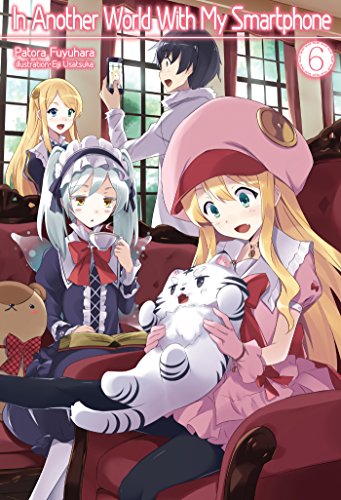
In Another World with My Smartphone, Vol. 6

By Patora Fuyuhara and Eiji Usatsuka. Released in Japan as “Isekai wa Smartphone to Tomo ni” by Hobby Japan. Released in North America digitally by J-Novel Club. Translated by Andrew Hodgson.

Last time I said that the volume was jam-packed, and that goes double for this one – if I didn’t know this was based off of a webnovel, I’d start wondering if the author was being told to wrap it up. The anime’s last episode spoiled the fact that Touya would eventually end up with nine wives, and now the light novel does the same thing, though we only get one “official” new fiancee at this point. But if the first volume of Smartphone read like “Baby’s First Isekai”, then this one s the isekai of a hyperactive teenager who wants to tell all the stories at once. So Touya gets to help take down ANOTHER evil usurper, and we get to fight more magical beasts, as well as more of the enemy Phrase, who continue to be lurking in the background as a threat. I’d say the book is just watching Touya be cool, but honestly half the time it’s Touya passively watching the other women around him be cool – something he lampshades.

It’s sometimes difficult to know what to actually criticize with this series, as to a certain degree being exactly what you’d expect is part of its charm. For all I talk about the “strong female characters” in this series – and we get even more of them introduced here, including Battle Maid Training – they have the depth of paper. But so do the male characters, so everything’s equal there. More seriously, I am very grumpy about the villains in the first half of the book. I know that a lot of Japanese works seek to make the villains as bad as possible, and the evil prince here gets some rape and murder, and is also a pedophile. He’s also described as ugly and with a bowl cut, and his mother is described as ugly and fat. That’s far more annoying, and I didn’t like it at all. (The afterword implied it was deliberate, so no excuses.)

As for new things, Sue is now a fiancee, though Touya admits she’s really too young, so it’s more provisional in order to stop the evil guy. (There’s a brief line about the years in this world being much longer than our own, which I wish were made a bit more explicit.) We’re also introduced to a young woman Touya rescues from near-death, who has unfortunately lost her memories (Touya names her Sakura for now), as well as a genuine Princess Knight named Hildegard, who Touya rescues from some Phrase and gives cool swords to. At the moment, they’re both basically laying down new plots and then moving on, but again, anime watchers will likely recognize the faces. Touya also helps fight against counterfeiting, brings caramel corn to the world, and fights monsters that turn people to stone, which serves mostly as a way to give Some Lu fanservice (and remind the reader that Lu exists).

So everything’s Smartphone as usual, and honestly, I suspect I’m more grumpy about the villains being stereotypically “ugly and fat = evil” than the average reader will be. Those who have already read the book will note I left out the most important part of it. I like to think I’m saving it as a surprise for the reader. Let’s just say that Smartphone is moving ever closer to becoming Mazinger Z.