Monthly Archives: April 2018

Dead Dead Demon’s Dededede Destruction, Vol. 1

By Inio Asano. Released in Japan by Shogakukan, serialization ongoing in the magazine Big Comic Spirits. Released in North America by Viz. Translated by John Werry.

This was the series that came directly after Goodnight Punpun for Inio Asano, and he’s on record as saying that he wanted to give readers something a bit lighter and easier to read after Punpun’s depresso-fest. Having read the first volume of this series, it’s… sort of correct? There’s definitely an attempt here to do a sort of Asano version of a slice-of-life series a la Strawberry Marshmallow, with Kadode and Ontan as a sort of grown up Chika and Miu, doing weird things in their day to day life. But of course this is an Asano version of slice-of-life, not actual slice-of-life, and so it’s hard not to see the grey clouds piling up bind the series. Kadode’s family life is depicted starkly but without drama (big drama is rarely seen in Asano’s works), and her attempts at relationships are meant to make the reader feel uncomfortable, I suspect, and succeed. Oh yes, and then there’s the other reason this slice-of-life is odd: aliens invaded Japan three years before, and are still hanging around.

The idea of an alien invasion that has gone on so long that it’s become part of everyday life is not unique to Asano, I believe, but usually in other cases the aliens play a major role. Here they hover offscreen in their giant mothership, occasionally sending out smaller ships to get blown up by pissed-off humans. The flashbacks to the initial invasion are played relatively seriously, but most of the story takes place once everyone is thinking “now what?”, as after that first strike not much has happened. And so life has gone back to semi-normal, allowing the kids to keep going to high school, Kadoda to continue to hit in her teacher, and Ontan to be loud, rude, and eccentric, which seems to be her entire character. There are games to play, love affairs to be gossiped about, and college choices to be mulled over. At least till a possible cliffhanger, you get the sense that “now what?” may be the point of the entire story.

There are a few flaws here, in my opinion. As I said before, Ontan does not seem to have as deep a character as Kadoda, and various scenes suggest that the author kind of wants to set the two girls up as a couple but can’t bring himself to do it. The relationship between Kadoda and her teacher is meant to be vaguely offputting and unsettling, and certainly fulfills its function there, but I also get the sense there’s a “will they or won’t they?” question that is speaking to an audience far more comfortable with teacher/student romance in their manga. Also, please try not to make your high schoolers look like they’re eight years old. On the flip side, of course, this volume is filled with what Asano does best, with evocative art (the contrast between the hyperrealistic backgrounds and the cartoony characters is excellent) and a mood that I think I can best describe as “repressed ennui”. I read an Asano book to feel things, and I certainly did with this one, even if some of those things were frustration.

If you’re an Asano fan, you should absolutely get this. If you avoided him for one reason or another, you may want to give this a try. He seems to be trying to compromise with his audience a bit, and the journey should be fascinating. Also, who could resist that cover?

I’ve Been Killing Slimes for 300 Years and Maxed Out My Level, Vol. 1

By Kisetsu Morita and Benio. Released in Japan as “Slime Taoshite 300 Nen, Shiranai Uchi ni Level MAX ni Nattemashita” by Softbank Creative. Released in North America by Yen On. Translated by Taylor Engel

The premise for the start of this book may seem a tad familiar: a young woman dies and is told by an apologetic angel that she can be reincarnated in another world, and is entitled to 1 (one) cool power. Azusa wasn’t actually killed saving a young boy or murdered by a jealous colleague, though – she just worked herself to death as a corporate wage slave. Since dying for her job proved to be very unsatisfying, she asks to be immortal in her next life, and is reincarnated as a perpetually 17-year-old witch in your standard fantasy land. (If this is made into an anime, she’d better be played by Kikuko Inoue or I’ll be sad.) She meets the local villagers, finds a conveniently abandoned house, and spends her days killing off low-level slimes. Then 300 years pass…

If this sounds like I just spent a paragraph explaining the plot of a book whose plot is actually explained in the title, well, welcome to the world of Japanese light novels, where the longer and more pedantic the title, the more popular it seems to be. Yes, after killing slimes every day for 300 years, Azusa is rather shocked to find she’s now a Level 99 powerhouse. This upsets her, as for 300 years she’s also been doing the opposite of what she did in her former life – taking life easy, slow, and not really doing anything at all. Unfortunately, now that word’s gotten out, she suddenly finds adventure coming for her. A dragon wants to challenge her, two slime girls are here for revenge, a busty elf arrives demanding protection from a demon… you get the idea. Will she be dragged into dangerous yet compelling adventures against her will?

Well, no, she won’t, in fact. The conceit of this series, and its most entertaining aspect, is that everyone who tries to fight Azusa ends up pulled into her “my pace” lifestyle. The dragon, once defeated, transforms to human form and lives as her apprentice. The slime girls are really children who need a family more than anything else. And what’s more, Azusa benefits from this as well, as she realizes that while living alone and relaxing for 300 years was all very well, her new found family is even better, and she’s even willing to protect them in a pinch, despite that not being very relaxing. (I haven’t mentioned the elf girl, who is the weak point of the book, being a busty airhead with lesbian tendencies who is in the book because it’s written by a male author for a male audience that wants to see a busty airhead elf with lesbian tendencies. She’s not as funny as everyone would like us to think.) The general theme of this book is “relax and take it easy, do things at your own pace”, and I quite like that.

The book has several volumes out in Japan, and I’m not sure how well it will succeed going forward, but I’m perfectly happy to find out. Another “don’t read if you hate overpowered characters” warning, but if you can get past that, Killing Slimes for 300 Years will put a nice smile on your face. A good beach read.

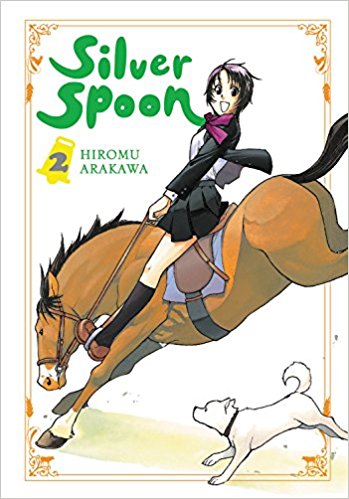
Silver Spoon, Vol. 2

By Hiromu Arakawa. Released in Japan as “Gin no Saji” by Shogakukan, serialization ongoing in the magazine Weekly Shonen Sunday. Released in North America by Yen Press. Translated by Amanda Haley.

It seems a bit startling for our hero and his classmates to be headed into summer break right at the start of the series, but that’s the Japanese education schedule for you, which begins in April. And summer break at an agricultural school means everyone goes back to their farms… except Hachiken, who has no farm but does have an intense desire not to go back home. So he takes up Mikage’s offer to go to her farm for the holiday. You’d think cute romance would ensue, but that’s pretty much still just in Hachiken’s head right now. Instead we get more examples of Hachiken as a fish out of water, and a lot of discussion of the various aspects of farm life, including butchering deer and watching a cow give birth. But before that, there are more important things to do. Things like pizza. Priorities, please.

One of the many things I love about Silver Spoon is the way that Arakawa portrays Hachiken, the male lead. It would be all too easy to turn him into your standard harem drip, a la Keitaro Urashima. But while Hachiken is inexperienced in the ways of farming life, and still having difficulty with the idea of “animals become food”, he’s smart as a whip and quick to understand things. Moreover, he’s a planner who sees ahead, which will become very important as the series goes on. For now it’s important because it allows him to see everything that needs to be done with the pizza oven, which ends up requiring the help of most of the school in order to repair it and procure ingredients to make the pizza. He’s also getting a little more buff, which is inevitable when you’re doing the daily farm routine he has to do. But most importantly, he feels realistic. He feels like an actual person. This is what Arakawa has always excelled at, and it goes doubly for this series.

I also love the attention to detail we see here. There’s discussion of what kinds of pizza cheese work best in Japan (gouda, not mozzarella), and we see three kinds of farms: Komaba’s small one where even the elementary school twins are pitching in constantly, Mikage’s medium-sized one (which she is expected to take over, something she clearly doesn’t want to do but is unwilling to open up about just yet), and Tamako’s huge industrial farm showing off the finest in modern advancements. When we kept joking that Silver Spoon was a farming manga back in the pre-licensed days, we weren’t kidding. This book is here to tell you what farming is really like, and that it requires a lot of labor, time, money, and care. No matter how big or how small your farm is, things need to be done constantly.

Aside from Mikage’s worries about her future and Hachiken avoiding his parents, there’s not really a lot of forward progress on a “plot” here per se. But the plot is a coming of age story, and in that sense we see Hachiken grow and change a lot in this volume. If you like Arakawa’s books, farms, or just good manga, Silver Spoon is essential.