Monthly Archives: April 2018

Cutie Honey a Go Go!

By Shimpei Itoh, Go Nagai and Hideaki Anno. Released in Japan by Kadokawa Shoten, serialized in the magazine Tokusatsu A. Released in North America by Seven Seas. Translated by Zack Davisson, Adrienne Beck and Wesley Bridges.

Another day, another reimagining of a classic property that I enjoyed a lot more than I thought I would. Indeed, I enjoyed it a lot more than the Japanese audience apparently did, as not only was this cancelled after ten chapters, but the second volume was never published until this omnibus edition. The afterword is filled with the author’s apologies, but I’m not sure they’re merited, because I thought this was a pretty terrific adaptation. The cynic in me wonders if the series didn’t take off because it’s not filled with high school girls – Natsuko, aka the reason everyone should read this, is an adult police detective in this version, and I can’t help but think that this was Cutie Honey’s StrikerS. But I’m not going to complain too much, as what we do have is silly, over the top fun with lots of fighting, a lot of over the top bloodshed, and some yuri subtext. Everything you’d want from Cutie Honey, in other words.
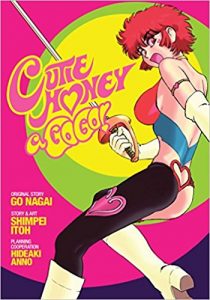
As noted, Natsuko is a police detective with a penchant for being “a cop on the edge” – she exists in a constant haze of cigarettes and violence, beating the crap out of anyone who pisses her off, which is everyone. She’s having a particular bad day due to Panther Claw, an evil organization which has started destroying the city and its inhabitants due to the city not answering its demands – which no one actually seemed to receive. Fortunately, there is one woman here to save the day and defeat the bad guys (OK, bad girls – Panther Claw is an all-female monster team). Honey Kisaragi is an android built by her “father”, Dr. Kisaragi. She’s a combination of sentai warrior, magical girl and cute young airhead. Unfortunately, her father doesn’t last long in this series, and it’s noted that Panther Claw keeps coming after her. There’s only one thing left to do – go undercover at a Catholic Girls’ school.

If this sounds a bit ridiculous, it’s because it is -despite all the bloodshed, the ‘a Go Go” version of Cutie Honey is very much in the lighthearted vein. It was produced in tandem with the anime “Re: Cutie Honey”, which explains why Anno is listed as one of the creators. Natsuko’s angry reactions have those classic “all teeth” faces you see in a lot of Rumiko Takahashi works. That may be why the manga didn’t do as well – the ending, where the author was clearly told “you’re cancelled, wrap it up”, is noticeably darker than the rest of the series, with people getting their heads cut off and put on display or simply sliced completely in half. The main cast survives to fight another day, though, and readers might want to look towards the anime for a less ambiguous ending. There are other things going on here (a “reporter” who’s meant to be charming and irritating but is mostly the latter), but honestly the best reason to read this is Natsuko vs. everything around her.

The Irregular at Magic High School: Yokohama Disturbance Arc, Part 2

By Tsutomu Sato and Kana Ishida. Released in Japan as “Mahouka Koukou no Rettousei” by ASCII Mediaworks. Released in North America by Yen On. Translated by Andrew Prowse.

Last time I mentioned I did not want any more romantic comedy hijinks, and it’s safe to say I got my wish, though that does not necessarily translate into a better book. The focus of this book is the Thesis Competition and the terrorist attack that disrupts it, and I think the entire problem with the book can be summed up by the fact that the competition never finishes after the attack and we never find out who won. It’s irrelevant. That actually pops up pretty frequently in this book, as we see moments that seem like they’re going to lead somewhere or develop a character… except they don’t. They’re there to “look cool” and that’s about it. (Honoka gets hit particularly hard with this.) The exception to this, as always, is Tatsuya. Miyuki seems to long for people to treat her and her brother as normal people rather than superhuman monsters, but it’s getting a tad difficult as the books move on.

As noted above, we start with the Thesis Competition, with our heroes going second to last. Their presentation is awesome, and yet here comes Third High and Cardinal George. But before he can start… explosions, invaders, rampaging monster trucks crashing through the walls. (This may – may – get wrapped up in a book or two with an offhand mention, but I will assume that First High wins. Did Third High even get to present again? “Yeah, look… um, can you just mail it in? We promise we’ll give it equal attention, but everyone’s kind of moved on.”) The rest of the book is taken up with repelling the attack, and, to its credit, it’s only about half “Tatsuya solves everything by dint of superpowerful magic awesomeness.” The rest of it is the rest of the cast contributing in their own little way, from actively killing terrorists with giant swords to using the power of Daddy’s Little Girl to summon helicopters to rescue civilians.

And yes, I said killing. There is a whole lot of bloodshed in this book, as the terrorists (whose identity I will try to keep a secret, in case someone anyone hasn’t guessed) amount to a bunch of cannon fodder. The cast take to it based on their personalities and strengths – Erika and Leo are basically fine with it, some of the others less so. Fortunately, absolutely none of our heroes are hurt all that badly – two of them get mortally wounded, but fortunately Tatsuya pulls out an “I can reverse this” magic that puts them back together again. I tend not to gripe about super overpowered heroes as much as the average light novel fan – I mean, if you’re reading this genre you have to basically accept it – but I admit to rolling my eyes a bit at this. Miyuki helpfully tells us how much pain it causes him, which is all very well and good, but it might have been nice to see that from his point of view, rather than just assume “stoic endurance”.

As the book ends with Tatsuya literally being the trigger of a nuclear magic explosion, one wonders where we’re going to go from here. Not back to the thesis competition, as Book 8 is apparently a prequel taking place three years earlier. In any case, while it is filled with cool battle scenes and the like, I didn’t enjoy this volume quite as much as the previous ones. It’s OK for the other characters to treat Tatsuya like some inhuman God, but don’t let the author do it as well.

CITY, Vol. 1

By Keiichi Arawi. Released in Japan by Kodansha, serialization ongoing in the magazine Weekly Morning. Released in North America by Vertical Comics. Translated by Jenny McKeon.

It’s always interesting when an established author ends their popular title and moves to a new company to start something new. In the case of Keiichi Arawi, creator of Nichijou, he’s moved to Weekly Morning for this new series, which has a significantly older readership than Young Ace, his former home. That said, I don’t think Nichijou fans need to worry too much about things getting overly serious or normal. CITY contains most of what readers love about Arawi – bizarre situations, a cast filled with overreacting idiots, and the occasional page that reminds you that the author may be at his best when designing backgrounds. And if you already miss Yukko and Mio from his previous series, rest assured, Midori and Ayumu will have you scratching you head and saying “they seem strangely familiar”. Basically, everything you liked before is here again, except perhaps for Mai. (I miss Mai.)

As the title suggests, this is a story of various characters living in the midst of a reasonable-sized city. And I say ‘characters’ rather than people because it’s obvious from the first that funny gags are what’s on the menu. Midori is sort of a main character, the way Yukko was sort of the main character of Nichijou, but as the book goes on it shows itself as more of an ensemble piece. Which is for the best, most likely, as Midori can be difficult to take in large doses. She’s lazy, conniving, and hyperactive, and also has a streak of bad luck, all things that make her very funny, but we haven’t really had any of the heartwarming moments in Nichijou that made us open up to the cast. Probably as this first book is establishing said cast and locale, rather than expanding on them.

There are others in the cast. I mentioned Midiori’s best friend Ayumu, who is meant to be the “normal” one by contrast, but seems to have a few silly interests. There’s a family restaurant, which Midori starts to work at in an effort to pay her rent, staffed by a boy who relies a bit too much on horoscopes. There’s an over-earnest police officer who tries to do the right thing but frequently ends up way over his head. There’s a young woman whose name isn’t given but who is basically Nano from Nichijou without a screw in her back, and she’s sweet and ditzy and obsessed with point cards. There’s even a manga artist and editor, though given the manga artist’s series gets cancelled in this first volume and they replace him with someone far more famous, I’m not sure how long that will last.

CITY likely needs a few more volumes to play out before I know whether I’ll enjoy it as much as I did Nichijou. But the basic elements are all still there, and I still found myself smiling as I read it. Arawin fans will definitely want to check this out, as will fans of “quirky” manga.