Monthly Archives: July 2018

Go for It, Nakamura!

By Syundei. Released in Japan as “Ganbare! Nakamura-kun!!” by Akaneshinsha, serialized in the magazine Opera. Released in North America by Seven Seas.

It may come as a surprise that I’m reviewing a title like this – I try not to be one of those “girl on girl is hot, but guys ew!” fans, but it has to be said that BL is not a genre I generally cover. But there was a big buzz about this title and its style, and it’s also done in one. The main reason I likely picked it up to review was that it made me nostalgic for the old days of manga. The art style is right out of the Ranma 1/2 and KOR playbook, and I was pleased to see that once I started reading the book, the humor was as well. Indeed, Ranma fans might find themselves thinking that if you took Gosunkugi from that series and made his obsession a guy rather than Akane, it wouldn’t be too far off from our titular hero here. The main reason to read the book is Nakamura, who is a big introvert, has an otaku-esque obsession with octopuses, and is, overall, a bit of a hot mess.

Nakamura is also gay, which is probably why you’re seeing this series run in the BL magazine Opera rather than, say, Weekly Shonen Sunday. The object of his affection, who you see dotted around the front cover, is Hirose, who is a nice, extroverted, upbeat young man – he’s the sort who’d be the “best friend of the hero” in a typical manga. Nakamura wants to be more than friends, but he can’t even work his way past that first hurdle. As the volume goes on, we see Nakamura work himself into a frenzy trying to get the courage to have a normal conversation with Hirose. There’s drawing him in art class. There’s helping out with the school play. He’s even getting dating advice from a BL manga. Admittedly, it’s a BL manga involving anthropomorphic train bento, so he’s not having much luck there. It takes a class trip and an aquarium to finally get Nakamura and Hirose to communicate properly, and though there’s no relationship at the end, the friendship step has finally been conquered.

As you may have gatehred, the main reason to get this book is the humor. It’s simply very funny in a lot of places – Nakamura’s imagined smooth conversations leading to romance are also fun and relatable, and it’s also great to see him fretting. As the cast expands (I liked the author’s note where they said they were worried about adding girls to a BL manga) we also get new veins of humor that aren’t just Nakamura’s somewhat obsessive personality – poor Kawamura has a crush on Nakamura, but he’s only interested in her sketches of him and Hirose, and the occult club president is scheming and clever – in most other titles she’s the sort who’d be the newspaper club girl. That said, the main reason to read this is Nakamura, and seeing his fumbling attempts to get closer to Hirose, which do finally pay off. The ending is rather sweet.

In the end, I’m glad I picked this up. It was entertaining, and if you want to start off your BL reading on the milder side, it’s a good choice.

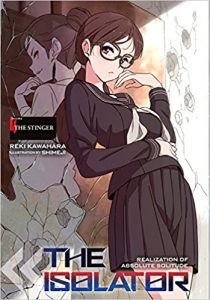
The Isolator, Vol. 4

By Reki Kawahara and Shimeji. Released in Japan by ASCII Mediaworks. Released in North America by Yen On. Translated by Jenny McKeon.

This is the first time we’ve had a villain as the cover girl of this series, though it is not the Stinger of the subtitle, who we never quite get a good look at and may not even be completely human. Instead it’s Liquidizer, who was the evil mentor to our hero’s evil counterpart Trancer in the third book. Both of them have major roles in the fourth book as well, which seems designed to show that it’s not merely a case of Good Guys vs. Bad Guys here. This is, frankly, much appreciated, as whenever Kawahara tries to show off how evil his bad guys are the result is never all that good. I’m all for nuance if it keeps us away from mad ranting and rape threats. Even better, as Minoru’s overall psyche improves so does the series. He angsts here, yes, but far less than the previous books. There are even good things happening! Overall, it pleases me, as it means that, while not a book filled with happiness and sunshine, The Isolator is no longer a depressing slog.

We pick up right where we left off (like Accel World, Isolator is not really interested in down time), right after the last big battle with Trancer and Liquidizer. Minoru is jogging around, awkwardly chatting with his high school friend Tomomi (who may have lost her memories of their traumatic battle, but still has a giant crush on him), and getting some New Year’s mochi, which he shares with the Professor. If you think this may sound a bit like a harem protagonist, you’re not wrong, but Minoru’s Charlie Brown-ish sort of personality keeps things from getting too cliched. At the same time, Trancer and Liquidizer are licking their wounds and talking about what to do next. We get this from Trancer’s viewpoint, and also get a bit of his backstory, as he has a frozen childhood friend in a warehouse that he’s sort of hoping the Ruby Eyes can fix, even though she’s pretty dead. You get the sense that the choice between “jet eyes” and “ruby eyes” may be purely arbitrary.

The main problem – for both groups – arises with The Stinger (another lame Jet Eyes code name), whose gender and appearance is unknown but who can apparently do absolutely anything with insects, including gruesomely killing several soldiers and civilians, and trying to kill both Minoru AND Trancer. The most interesting thing about this half of the book is seeing Trancer’s hatred and self-loathing get the better of him, as he becomes convinced that this is an assassin sent by his organization because he failed them. This leads to a wonderful heartwarming moment, which is all the more amazing given it’s Kawahara writing villainous depth, where Liquidizer shows she does, in fact, care about Trancer’s well-being. It all leads to a cliffhanger, and who knows where we’ll go from here, but it’s a wonderful thing to see.

There are other things going on I didn’t talk about much, such as whether Minoru’s shell can heal the comatose and possibly have a connection with his sister in heaven (I’m winning to bet “no” on that second one), but I’ll save that for the next book, which may come out in 2020 given the author’s other projects. Still, this was probably the best book in the series, and Minoru proves to be an excellent protagonist when he’s not moping. Worth the wait.

Demon Slayer: Kimetsu no Yaiba, Vol. 1

By Koyoharu Gotouge. Released in Japan by Shueisha, serialization ongoing in the magazine Weekly Shonen Jump. Released in North America by Viz.

It has to be said that the title of this series is not its strong point – you get the sense that they kept the Japanese title as a subtitle in order to make it searchable on Amazon, separated from the countless other demon slayers. The premise, too, seems to be fairly traditional and straight down the middle. A young man living with his family out in the boonies (it’s later shown this is the Taisho era – around the 1910s or so) returns home one day to find his family slaughtered and his sister a demon. A demon hunter also shows up to take care of the sister, but her brother defends her, and proceeds to try to a) learn how to get stronger so he can protect his sister, and b) try to find out how to stop her wanting to eat humans. The latter is easily done as she simply comas her way out of the story after a bit, so the former takes precedence. This means the series lives and dies on its action sequences.

The good news is that the action sequences are good. There’s lots of horrific images, and this is not a manga to read if you don’t want to see limbs flying off and people you love lying in a pool of their own blood. Tanjiro is a very earnest young lad in everything he does, and he takes on his training in that mode as well – he is here to SAVE HIS SISTER and kill demons, and he’s all out of sister. He’s a nice kid at heart, which proves to be a bit of a stumbling block for everyone teaching him about demon slaying, as they think he’s not suited for it. He proves to be far more effective than they’d expected, though. His training is not the most original in the world (I have to split that giant boulder in only one blow?), but I was never bored, and the demon we meet in the cliffhanger is pretty damn awful. You want Tanjiro to succeed and be able to save his sister.

The sister, unfortunately, is the weak link here, as once she’s a demon she doesn’t really get to speak. There was a brief moment when I thought she might actually be the comic relief – the bit where we see her bottom half sticking out of the far-too-small basket Tanjiro brought to carry her made me laugh out loud. Sadly, it’s about the only comedic bit in this otherwise very serious series, and once he actually starts his training she rather conveniently slips into a coma so that she’s not off trying to eat people while he gets stronger. I am hopeful that she will wake up, and slightly less hopeful that she might gain some character depth as well. The series is 11+ volumes in Japan, so clearly we have a ways to go. But this is a good start, if a bit straight-laced and serious minded. I’d read it if you enjoy horror/action in an about equal ratio.