Monthly Archives: September 2018

Tomo-chan Is a Girl!, Vol. 1

By Fumita Yanagida. Released in Japan as “Tomo-chan wa Onnanoko!” by Star Seas Company, serialization ongoing on the online site Twi 4. Released in North America by Seven Seas. Translated by Jennifer O’Donnell. Adapted by T Campbell.

When you’re doing a 4-koma series based around a very simple premise, it takes a lot of care to make sure that the audience comes back on a daily basis to see what happens next. The characters have to be interesting but not annoying, and the premise has to amuse but not bore. Tomo-chan Is a Girl! does a pretty good job of this. In Japan it’s helped by being released daily on a website, one comic at a time, much like a Western comic strip. Here, however, we read it in volumes, so the bar to clear is a bit higher. Especially when three of the four main characters are, for lack of a better word, dense in some degree or another. If you’re reading the series and thinking “man, I hope that they figure things out and get together soon”, I would drop it right now if I were you. Payoff will eventually come, but the whole point of series like these is a long, slow burn based around comedy and frustration.
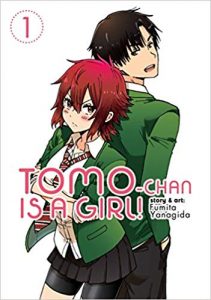
Tomo is the titular heroine. She grew up as a tomboy, learning karate at her father’s dojo and hanging out with her best friend Jun. Now they’re in high school, and Tomo has grown tall and busty, but is still very much the rough tomboy sort. This is a problem, as she’s in love with Jun, but he just sees her as one of the guys! Can she make it clear that she likes him the way a girl likes a boy? And if she ever did this, would she even notice, as it rapidly becomes clear that she’s just as bad at noticing the obvious when it comes to matters of love. Indeed, Jun’s obliviousness may be played up to hide his real embarrassment over the whole thing. Added to this mix are Misuzu, Tomo’s best friend who is there to offer jibes and support, in that order, and Carol, an exchange student who may be flightier than the rest of the cast, and is definitely bustier. Will anyone end up making their feelings clear?

Not so far, but I’m enjoying the journey. The first few chapters are rougher and a bit less fun, and it’s very clear that Jun is not playing things up, something that rapidly changes as the book goes on and the author realizes he can’t keep that going forever. Tomo is a likeable yet very fallible girl, who longs for reciprocated affection but wouldn’t know what to do with it if she had it. And I know, you’re shocked) Misuzu is my favorite character, as her dry retorts and “war” with Jun over who’s closest to Tomo ground the series a bit and also adds a new vein of humor. This is 7+ volumes in Japan, so I’m not sure it can quite keep up the pace, for reasons I mentioned above. But for now I’m amused by Tomo-chan Is a Girl!, and want to see how far the series can go with its (seemingly) dense leads.

Sorcerous Stabber Orphen: The Wayward Journey, Vol. 1

By Yoshinobu Akita and Yuuya Kusaka. Released in Japan by TO Books. Released in North America by J-Novel Club. Translated by Andrew Hodgson.

Most of the time, when reviewing books this old (Fujimi Fantasia Bunko put out the first volume in May 1994), I have to remind myself not to think of things that may have been newer or fresher as hopelessly cliched. I had less of an issue here, though, possibly as Orphen is such an old-school fantasy it actually feels slightly fresher these days. The tropes are taken mostly from a) fantasy BOOKS, and b) your typical comedic anime cast. This means that the usual RPG nattering is entirely absent, and no one mentions hit points at all. It’s a very direct and straightforward book. Unfortunately, there is one thing the creator does that does still resonate here in 2018: the book starts to grate when it’s being “funny”. There is overly plucky girl, put-upon nerd, and above all, obnoxious, angry and “lovable coward” guy, all of whom made my teeth grate a bit as I read the book, though the first two not nearly as much as the third. But setting that aside, this was a good, solid debut volume.

As you may imagine, Orphen is our hero, though it’s a name he took on when leaving the fancy school of magic in protest, saying he’s an orphan now. (Magic is his specialty, but spelling is apparently not.) Five years earlier, he watched in horror as his mentor turned into a horrible monster, and the magic users vowed to destroy her rather than try to return her to normal. Now he roams the land looking for her. Unfortunately, currently he’s dealing with two dwarf brothers who owe him money and are very bad about finding “schemes” to pay it back, which include things like “pretend to be a merchant and marry the local rich lady’s daughter”. This ends up being fortuitous, though, as the rich family is also the home to endless ancient artifacts, one of which is desired by both the sorcerers who are still hunting the “monster” down, and the monster herself, still presumably looking for a cure.

I’m going to get this out of the way right off the bat: Volkan, one of the two dwarfs, almost caused me to stop reading this book entirely. He is very loud, very annoying, abuses his brother in what is supposed to be a funny way, is not particularly bright, and is also a coward. Now, this is deliberate. He’s meant to be annoying, and well done! But he’s meant to be annoying in a “look at this funny annoying guy!” way, and that did not happen for me. I want him to fall in a pit. Dortin, who has comedy “manga nerd” glasses and spends most of the book whining about his brother’s abuse but not saying it out loud for fear of provoking more abuse, and Claiomh, the younger sister in the rich family and (I suspect) future love interest of Orphen, who is bright and impulsive and very much a “bratty younger sister” sort, are far more tolerable. But the reason to read the book is the main plot, which deals with Orphen’s tormented relationship with Azalie, his mentor and crush, which is both admirable and frustrating, and causes him to make some teeth-grinding decisions that turn out to pay off in a well-written ending.

I’m not sure I’m going to continue with this – Volkan was THAT annoying, my friends – but for those looking for a nice old-school fantasy light novel, Orphen would be a very nice choice.

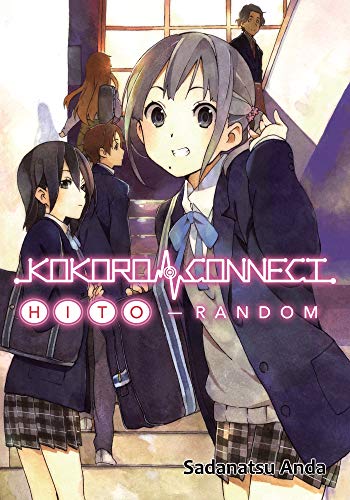
Kokoro Connect: Hito Random

By Sadanatsu Anda and Shiromizakana. Released in Japan by Enterbrain. Released in North America by J-Novel Club. Translated by Molly Lee.

I had enjoyed the manga version of Kokoro Connect when it came out a few years back, so was delighted to hear that I’d get a chance to read the novel version that spawned it. And for the most part it does not disappoint me. Ostensibly a book about an alien being who toys with a high school club by causing them to swap bodies at random (each book, in fact, will have the title _______ Random), in reality it’s a good example of the turbulence that is life as a hormonal teenager with issues, some of which are larger than others, but all of which are the most important thing in the world for that person. It also has a very likeable cast, including a fascinatingly flawed hero (Taichi is our 3rd-person viewpoint character, so I’ll call him a hero even though the series is about the five kids as a unit) whose selflessness is called out as nothing of the sort.

The club is one of those sorts that was created mostly because everyone HAS to be in a club, and it functions more as a hangout for the main cast than anything else. Iori is happy, joking, and energetic; Inaba is serious, foul-mouthed, and seems to exist in a perpetual state of near-fury; Yui, who is a pint-sized powerhouse whose knowledge of karate can’t quite make up for a terror of men; Aoba, the big goofy guy who loves Yui but is mostly there to be “the friend everyone picks on”, and Taichi, who I’d mentioned above, another serious guy whose function so far is to be “the male lead”, something I suspect we aren’t quite done with even as the cast does call out his “martyr complex” over the course of this book.

But of course the point of the book is that each of these kids are more complex than you’d expect. I love series where the protagonist is boggled by the fact that their friend may have more than one side to them, and we get that here – in fact, Iori’s main concern is that she’s spent so long showing other sides to people that she can’t remember who she’s supposed to be. Her monologue about loss of identity is one of the highlights of the book, along with the climax of the book where the characters all have to decide, literally, who lives and who dies, and Iori shuts them right down. Meanwhile, the most interesting thing about Inaba (who is my favorite, sorry to be predictable), whose panic about her own personal issues, which are not related to a “traumatic past” like Iori and Yui, is that everyone will hate and pull away from her, is that it really IS overblown. This is quite a funny book when it tries to be, but the funniest line may be Iori’s blithe “So basically… you have anxiety?”.

I also want to give props to the translator. These kids sound like high school kids, and their dialogue does not read like it’s written by someone who grew up in a different time. It’s also not afraid to get coarse for realism – Inaba is meant to curse like a sailor to a degree, and she does. That said, the main reason to pick up Kokoro Connect is the characters, who make you root for them and want to see how they handle whatever’s coming next. I’m very happy this is being released.