Monthly Archives: September 2018

Legend of the Galactic Heroes: Tempest

By Yoshiki Tanaka. Released in Japan as “Ginga Eiyū Densetsu” by Tokuma Shoten. Released in North America by Haikasoru. Translated by Daniel Huddleston.

This volume seems to be the best at balancing out the political; intrigue and the cool space fighting, as both really get a good chance to capture the attention of the reader. On the political side, we see the final decline and fall of the Free Planets Alliance, and much snarking about the negatives of democracy. But Yang is also there to remind us that even with all those negatives it’s still worth fighting for, and the author does a much better job of reminding the reader that the only reason the dictatorship is looking like the better option in this series is that Reinhard is not evil – that’s pretty much it. We see a few scenes where he reminds everyone who’s trying to do dictator-ey things that this is what leads to rebellion and unrest. That said, Reinhard may not be evil but he’s still having trouble with the whole “what’s next?” thing. Luckily, Yang may help him there, as the end of the book seems to tell us we’re headed for one final confrontation.

Last time Yang got more to do than Reinhard, so it’s appropriate that we get the reverse here. It’s interesting seeing all of his aides worry about his seeming passivity, and we see that it’s not just Reinhard worrying about what to do once he’s conquered everything – none of the Empire wishes to follow a bored leader. That said, behind the scenes machinations may be taking care of that soon. Someone is out to get von Reuentahl, and they’re being helped along by the man himself, who seems to have no interest whatsoever in self-preservation. He’s safe for the moment because of Reinhard, but there are seeds being sown here, and I’m wondering if he’s going to end up an antagonist sooner rather than later. Poor Mittermeier, who tragically has to be the one persona in the Empire with a happy, satisfying personal life.

Meanwhile, on the other side, we see Bucock make one final awesome stand against the Empire. It’s a futile one, but he does absolutely everything right, and the admirals on the other side are filled with praise for him. It must have looked fantastic animated, especially Bucock’s final “screw you” before his death. Unfortunately, his death briefly sends Yang into a tailspin. Yang is trying somehow to avoid the role that fate keeps spelling out for him. He does not want to be a leader of anything, and yet here he is. Fortunately we also see a bit of the Admiral Yang of old, as his retaking of the fortress is both impressive and a bit hilarious. And he’s also reunited with Julian, meaning the family is together again.

So it looks like we’re headed for one big Reinhard vs. Yang battle – again. We’ve got three more books left in the main series, can it really be strung out that long? Probably not. Something else is bound to happen to upset the apple cart. What that is, we’ll have to see. Till then, enjoy another excellent (if dryly written, as always – we get a lot of history textbook stuff this time around) book in this space opera series.
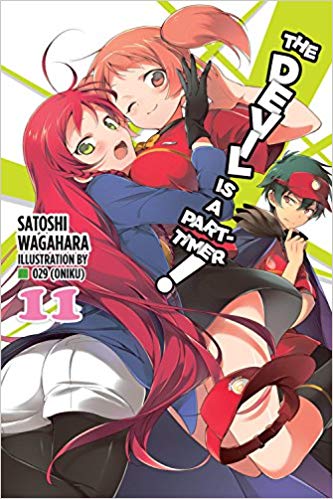
The Devil Is a Part-Timer!, Vol. 11

By Satoshi Wagahara and 029. Released in Japan by ASCII Mediaworks. Released in North America by Yen Press. Translated by Kevin Gifford.

This book can mostly be divided into two parts, and while I won’t say that they’re good and bad, I will say that they’re good and less good. The less good involves three large scenes that serve as giant infodumps, telling us a lot about the backstory of some of the characters and revealing most of the worldbuilding and machinations that have been going on. It’s framed all right (at least the first two – the third is just the landlord blatantly spelling things out for them), but it can read awkwardly at times, as it amounts to a lot of listening to other people talking, and, unlike Emi and Suzuno, I am not particularly lovestruck by how Emi’s mom and dad fell in love. I’m not entirely sure that writing Alas Ramus and company out of the series is a thing that’s going to be happening, but certainly it’s the next big crisis, and will no doubt carry us through the next book or two. Hopefully along with some McRonald’s antics, as that’s where this volume shines.

Honestly, Emilia working at McRonald’s is such an obvious plot complication that I’m amazed that it hadn’t come up before now. She’s not living at the apartment complex yet (the explanation apparently involved her swank apartment being haunted or something, so the rent is cheap – I think the author just likes keeping them separated), but having her work with Maou and Chiho will certainly add to the fun of this series, and help keep us from, well, long infodumps. This is all kicked off by Maou possibly being the stupidest he has ever been, misunderstanding Emilia’s pride and acting (seemingly) like such an ass that Chiho tears him up one side and down the other. Of course, his goal and Emilia’s are the same, but she’s absolutely right in that she needs to get the job and commit to it on her OWN terms, not his. Maou spends much of this book getting yelled at and humiliated, and it’s actually pretty fun.

There is also some attention paid to the love comedy in this title, which honestly takes a backseat a lot of the time. The question is whether Maou actually has romantic feelings for anyone. With Emi he’s having enough trouble simply acknowledging her as a friend, so we have a long way to go there. With Chiho it’s far more practical – he doesn’t want to get a normal human involved with everything that being the lover of Satan of Enta Isla, and there’s also the fact that he and the other demons are very long-lived, and Chiho as a human isn’t. Honestly, though, all this boils down to “I am keeping her at a distance”, and I get the feeling Chiho is somewhat aware of this. Despite the snarking of the other male McRonald’s employees, the harem does not appear likely to be resolved anytime soon.

The cliffhanger ending (of a sort) promises even more backstory revelations in the next volume, but I hope that it finds time for fast food wars as well. Devil Is a Part-Timer! is at its best when it’s thinking small, and not dealing with demons vs. angels and where Enta Isla actually is in relation to Earth.

The Asterisk War: Festival Symphony

By Yuu Miyazaki and okiura. Released in Japan by Media Factory. Released in North America by Yen On. Translated by Haydn Trowell.

The author admits in the afterword that this was supposed to end with the start of the next school battle, but that things got out of hand. As such, we have another volume that is theoretically marking time and having fun before the next round of fights. In reality, of course, what we get here is more insight into the six other schools, with attention paid to almost all of them. We finally find out what Claudia’s wish is, and why the entire world seems to want to stop her. And Ayato gets another girl falling in love with him, and like the others, she’s intensely likeable. The drawbacks of the series remain the same – every plot twist is quite predictable, and the characters sometimes seem to be types rather than real people. But as a book that puts the “light” in light novel, it’s fun.

The majority of the book, as the title might suggest, is taken up with the Culture Festival that all six schools are giving. Ayato has agreed to take Sylvia on a date around the schools, something which the other girls in his orbit are all very well aware of. I liked the differing approaches to dealing with their jealousy – Julis hides from the entire festival and works on training, Saya does a bunch of events where she can just destroy everything, etc. Ayato, meanwhile, being terminally clueless about romance, has no idea why any of this is going on, which can sometimes be a problem, as he and Sylvia put on disguises but he keeps breaking their cover. The date itself also serves as an excuse to talk a bit more about the different schools and the types of students they attract, and we also meet some new recurring cast members, both comedic (the idol group that’s trying to top Sylvia) and serious (Jie Long’s new powerhouses, though Hufeng’s “long suffering” attitude is sometimes funny).

We’re gearing up for the next tournament, the Gryps, which depends on teamwork. As such, Claudia discusses her weapon and what the drawbacks to it are, and also shares why she wants to win: she wants to talk to a supposed criminal that’s been imprisoned. Ayato and Sylvia, meanwhile, may not be at the same school, but their desires also hinge on the book’s later plotline, with Ayato being offered a way to wake his sister up that involves a “deal with the devil” sort of bargain, and Sylvia finding out that her old teacher is not who she once was. Sylvia seems to have a large amount of “I don’t want to burden others with my own problems” to her, which I’m sure will get her in danger sooner rather than later.

The Asterisk War is never going to be among the best light novels out there, but it’s always readable and fun, and I’d argue it’s perhaps the most “typical” example of the genre.