Monthly Archives: October 2018

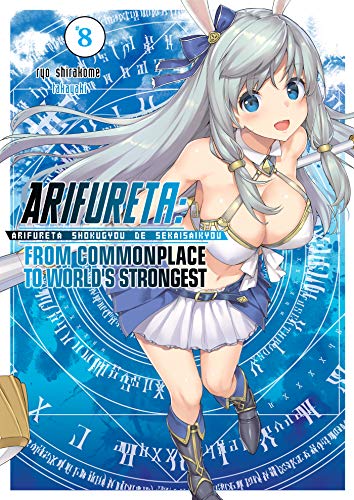
Arifureta: From Commonplace to World’s Strongest, Vol. 8

By Ryo Shirakome and Takayaki. Released in Japan as “Arifureta Shokugyou de Sekai Saikyou” by Overlap. Released in North America digitally by J-Novel Club. Translated by Ningen.

The last few reviews I’ve talked about Hajime as Christ figure, Hajime as overpowered author fantasy, and Hajime as nerd. Given the events in this volume, particularly near the end, it seems appropriate to talk about Hajime as asshole. Hajime’s experience in the dungeon in the first volume broke him in many ways, and aside from his power levels the most obvious has been in his attitude towards… well, almost everything. And while we’ve seen occasional nudges back towards non-sociopathy, particularly thanks to Aiko, there’s still an awful lot of Hajime making the choice that will upset people the most, either because he wants to or, more frequently, because he can’t be bothered. And the main reason he does this, of course, is that the author (and I assume readers) find it funny. Honestly, given all the attention focused on humiliation being a subset of arousal in this book, I suspect we learn a bit TOO much about the author’s mind here. But at the end of the book, Hajime seems to genuinely mellow out.

The bunny girl on the cover is one of the big reasons, to be honest. Much has been made by Hajime of the fact that Yue is the girl he loves and the rest of his harem are far, far below her. And while that’s still fairly true, Shea’s actions over the course of the series, and particularly in the last two books, have led Hajime to realize that he does, in fact, love her as well. Not the same way he loves Yue – there’s no sex here, much to Shea’s disappointment, though I’m not sure “platonic” is how Hajime feels either. But Shea makes Hajime happy, and he wants her to be with him – and not with anyone else. This is helped along by the other big thing that mellows Hajime out, which is that he gains magic that should finally lead him to being able to return home to Japan. Just the idea that he can escape this, let’s face it, pretty dystopian world makes him smile like his old self, much to everyone’s surprise.

Speaking of ‘harem tiers’, the majority of this book is spent clearing another dungeon, this one designed to tend the bonds of love, friendship, and teamwork. Along for the ride are the B-team Japanese group, and let’s just say they don’t do really well. Dungeon-wise, the ‘tiers are Hajime & Yue -> Shea, Kaori and Tio -> big gap -> Shizuku -> Kouki, Ryutarou, and Suzu. You’ll notice Shizuku is a level higher than the others, and indeed we also see it becoming more obvious that she’ll be part of the harem eventually, which everyone else seems to have accepted but her. Indeed, at the end of the dungeon the bottom three don’t get the reward for clearing it – they weren’t good enough. That said, props to Suzu for stepping up and asking to go try the next one anyway, especially because she tells Hajime her reasoning is to be powerful enough to try to talk sense into Eri when they next see her. I suspect the reader knows this is futile, given the epilogue, but I was honestly surprised that the whole group is going to stick around. Even Kouki, who was on his best behavior in this book.

The author says we’re in the home stretch, though I suspect that still means about 3-4 more books. Till then, this volume is very long but satisfying, particularly if you like sweet, heartfelt scenes – that last short story was almost pure sugar. On the other hand, when you get to the scenes with the “slime creatures”, take my advice and skip a few pages. What is it with Japan and “fake bukkake”?

Magi, Vol. 32

By Shinobu Ohtaka. Released in Japan by Shogakukan, serialized in the magazine Shonen Sunday. Released in North America by Viz. Translated by John Werry.

Once again, I finished a volume of Magi and thought about how to convey what I felt about it into a 150-word brief only to realize that I would need a bit more space. And so here we are, with Magi heading into what proved to be its final arc. You get the sense of a lot of strings being drawn back together here, as Sinbad’s ambiguity is becoming a bit less ambiguous – is he going to be the final Big Bad? – and we also get some excellent political drama. And yes, cynical readers will be shaking their heads and saying “you just wanted to gush that another of your ships is canon, didn’t you?”. And there is a bit of that, yes. I have been very fortunate – or perhaps my tastes are merely dull – in that most of my shonen ship preferences have tended to work out over the years. So I am happy to see Alibaba and Morgiana happy, no doubt. But there’s more to this volume.

Shinobu Ohtaka has come a long way as a shonen author from the days when I was reading Sumomomo Momomo and was thoroughly unimpressed. The fight scene that opens this volume is one of the best in the series, with lots of dynamic action and plot twists that are entertaining but don’t verge on ridiculous. It’s always hard to find a way to amp up the drama in scenes like these without heading into meme territory, with “this isn’t even my final form!”, etc. In fact, we even seem to make fun of that sort of thing, as Hakuryu makes a big dramatic deal of being stung by Arba’s possessive scorpion only for it to be him essentially mocking her (and the audience). It also helps that Arba is wearing Hakumei’s body here, as it’s entertaining to see so many insane and evil expressions on such a pretty face.

The second half of the book is romance and politics, as Alibaba and Morgiana reunite (though, in one of the few ‘bad art’ parts of the book, Morgiana looks about twelve years old in the panel where Alibaba sees her) and he almost immediately proposes. It’s a good proposal, as he draws on the fact that peace has returned to the land and many are starting families to express the desire to start his own. We also get judicious flashbacks that show off just how far Morgiana and Alibaba have come from the start of the series (Morgiana also gets in some awesome kicks in the fight scene I mentioned earlier, by the way). Still, the spotlight may be taken away from them a little by Kogyoku, who is struggling with being the leader of the Kou Empire but finds her inner resolve and decides to break away from Sinbad and have the nation struggle on its own. It’s a brave decision, and I suspect Sinbad is really not going to like it.

Magi does not get as much attention as the other big shonen series out there, possibly as it’s in Shonen Sunday and thus couldn’t get the buzz of weekly updates that Jump subscribers get. But it’s really stayed at a high level of quality for some time. With only five volumes to go, readers should look forward to seeing how the series handles its big finish.

The Unwanted Undead Adventurer, Vol. 3

By Yu Okano and Jaian. Released in Japan as “Nozomanu Fushi no Boukensha” by Overlap, Inc. Released in North America digitally by J-Novel Club. Translated by Shirley Yeung.

Last time I complained about the dullness of Rentt’s POV, and though the cast remains as small as ever, it appears the author remains cognizant of it, as we get Rentt thinking about the fact that since he became undead, he’s become relatively flat and emotionless. Fortunately, though Rentt is still undead, he does level up a bit here, so at least we don’t have to read his halting, shambolic speech anymore in the second half of the book. In fact, I found the book very much felt like an inverted U as I read it. The middle two sections are easily the best, and I genuinely enjoyed them. I was not as enamored with the first section, which was essentially wrapping up events from the last book and meandered quite a bit, and the final section, which features far too many magic lessons. There are times when you can tell that the author is still learning the craft.

As I noted earlier, we pick up where we left off, with Rentt getting the flower that will help heal the woman in charge of the orphanage. While there, he meets an adventurer who turns out to be a butler (not named Sebastian, alas) and gets a request to visit the butler’s master… or mistress, as it turns out. This second section sees Rentt navigate a confusing hedge maze and then search through a pile of valuable magic artifacts for his “reward”, as well as making a contract to get more of that healing flower. Due to events in that section, Rentt is able to evolve further, becoming… sort of vampire-ish? He has bat wings, and is very pale. But he’s not QUITE exactly what the textbooks say, and he can still use his divinity, mana, etc. Finally, the young girl at the orphanage who hired Rentt to cure their caretaker is made a magic pupil of Lorraine’s, and she and Rentt attend a magic class which is made up of equal parts amusing pettiness and boring worldbuilding.

The best parts of the book are the ones where Rentt is allowed to wander outside the “boring old undead adventurer” narration. The sequence with the toy airship, and Rentt’s nerd infatuation with it, made me smile, and is absolutely terrific. That whole section was good, as Laura, the head of the family hiring Rentt, is intelligent and fun without being a brat (and knows the value of good tea). I also liked the aftermath of Rentt becoming a vampire-like being, as he and Lorraine take turns going over his body and exactly what he can and cannot do now. (I was disappointed that Lorraine didn’t ask if he was “fully functional”, so to speak, but then she seems just as shy as he is in many ways.) This was one of the sections where the worldbuilding and back and forth conversations worked quite well.

The end of this volume implies things may not go nearly as well for Rentt in the fourth volume, as we’re getting new characters who I suspect won’t take kindly to heroic vampire adventurers. That said, it may be a bit of a wait – the 4th volume is out in Japan in November, so I expect at least 3 or 4 months. Till then, The Unwanted Undead and Uneven Adventurer is still mostly keeping my attention.