Yearly Archives: 2018

High School Prodigies Have It Easy Even in Another World!, Vol. 1

By Riku Misora, Sacraneco and Kotaro Yamada. Released in Japan as “Choujin Koukousei-tachi wa Isekai demo Yoyuu de Ikinuku you desu!” by Square Enix, serialization ongoing in the magazine Young Gangan. Released in North America by Yen Press. Translated by Caleb D. Cook.

I’ve talked before about whether we’ve reached isekai critical mass in terms of the sheer number of titles. If you went by message boards and forums, you’d think the trend was long over and that fans were desperate for something else. But from what I understand, sales don’t really support that – in fact, they seem to support the opposite, and it’s “anything but isekai” that is suffering. That said, I certainly understand feeling a little burned out by the variations on a theme. This new title, based on a light novel (unlicensed here in North America) hits a lot of the standard fantasy isekai buttons, and reminds me quite a bit of Realist Hero. But the very title itself implies that there will be a minimal amount of conflict, and warns the reader in advance that these are not your “average harem hero” isekai students – they’re top tier. OP is what they have for morning coffee.

We’re briefly introduced to the titular group in their own element – seven teen geniuses who between them control most of Japan. They also all know each other from school, which is why they’re all together on a plane that has a fateful plane crash. When they wake up, they’re in another world, with magic and dragons and overendowed elf girls like the one on the cover, who is absolutely not one of the teen geniuses, but she’s cute, right? They’re not sure if they can get back, but looking around at the poor farming village and the folks who saved them from the wreckage, they are sure they can do something to repay them by bettering their life. But they’ll have to deal with tributes to the local lord, and bandits, and merchants who control the economy, and (inevitably) slavery. Can they turn things in their favor? Easily.

As you’d expect in a series supposedly starring seven kids, not all of them get focus here. Also unsurprisingly, it’s two of the guys who get the bulk of it in this first volume. Tsukasa is Japan’s prime minister (yes, he’s still in high school) and seems the “sensible yet compassionate bishonen” sort, and is also clearly being romantically paired with the elf girl, as if the “I’ll feed you by mouth” wasn’t obvious enough. There’s also Masato, a genius businessman who’s the perfect person to help the village sell their wares and not knuckle under to gougers. They’re both likeable types, but they’re also very obviously types, not people yet. As for the others, the only other one who makes an impact is Shinobu, the reporter/ninja girl who’s there to be perky (and also punish Masato when he reveals she isn’t a virgin, in a tired gag that is nevertheless the best gag in the book). This is very much a first volume, and we’re waiting for more depth.

I suspect I might have enjoyed this more in prose, but it’s all right. If you’re looking for another isekai with cute girls, this is perfectly serviceable. But like its premise, it promises absolutely nothing to the reader who dislikes overpowered heroes who cruise through everything. That is what these kids are. But they invent mayonnaise, so we’re good.
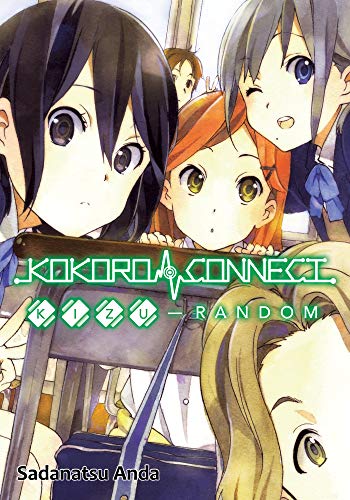
Kokoro Connect: Kizu Random

By Sadanatsu Anda and Shiromizakana. Released in Japan by Enterbrain. Released in North America by J-Novel Club. Translated by Molly Lee.

The current fashion in North American releases seems to be not to translate something if it’s already better known to fans by the Japanese. I suspect that’s why we see each subtitle in the Kokoro Connect series this way: Hito Random meant Random People, which fits well with the bodyswapping nature of the book. Now we have Kizu Random, which I personally think might have had a greater impact were it translated, as it means Random Wounds. Likewise, due to the nature of the bodyswap, the first book out of necessity had to keep the group as mostly a tight-knit group of friends. This book, however, is darker in tone, and shows how easily such friendships can be sabotaged – mostly by overthinking things, or self-loathing, or any number of details that add up to “we are teenagers”. Indeed, what Heartseed is doing is something I think ideally suited for teenagers, who are going through this kind of thing anyway, and you could argue it’s just helping them along. Of course, you could also argue Heartseed is a sadistic jerk.

A couple of weeks after the events of the first book, our five heroes are told by the alien that is toying with them that they’re going to have moments where they suddenly lose control of their emotions and desires and act on them. Having experienced this sort of thing before, and not looking forward to it at all (mostly as she was the first to be affected, stripping and getting on top of Taichi in the clubroom), Inaba convinces the others that they can get through this as long as they keep an even emotional keel and just try really hard. That… doesn’t work, and soon Yui’s beating up delinquents (which causes her to shut herself at home), Taichi has a lot more desire to “save” people than he normally does (which is amusing, given it’s quite high to begin with), and Inaba is forced to deal with a fact that she’s been avoiding for quite some time. Friendships can be fragile, especially at this time of your life, and by halfway through the book no one is speaking to anyone.

The strengths of this book are once again the writing of the characters, who feels their age and also sound it. There’s a lot of angst and melodrama here, but it’s never really overwrought except where it’s supposed to be. For the most part the book is 3rd person Taichi POV, but we also have several chunks where it’s first-person Inaba, and those show off how screwed up her mindset is and how easy it can be to filter everything you say or do through a negative, self-loathing filter. And then there’s the “love triangle”. Taichi and Iori like each other, but don’t want to date while Heartseed is messing with them. Inaba finally admits she loves Taichi and confesses, but is rejected – for the moment. It’s a very “mature” rivalry so far, but that’s mostly because it resolves itself after a huge outpouring of emotional release from both Iori and Inaba, and I’m curious as to how messy it might get in the future.

Kokoro Connect remains a well-written teen drama, and is a refreshing change of pace for those who are bored by the idea of yet another isekai. Even if you’ve seen the anime, you should pick it up.

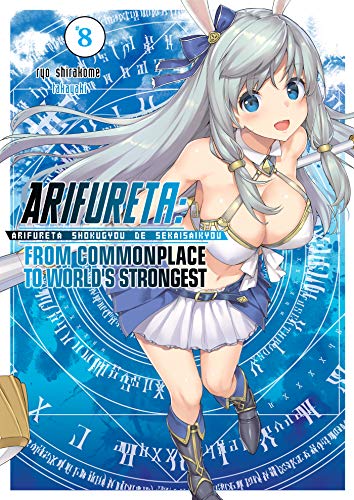
Arifureta: From Commonplace to World’s Strongest, Vol. 8

By Ryo Shirakome and Takayaki. Released in Japan as “Arifureta Shokugyou de Sekai Saikyou” by Overlap. Released in North America digitally by J-Novel Club. Translated by Ningen.

The last few reviews I’ve talked about Hajime as Christ figure, Hajime as overpowered author fantasy, and Hajime as nerd. Given the events in this volume, particularly near the end, it seems appropriate to talk about Hajime as asshole. Hajime’s experience in the dungeon in the first volume broke him in many ways, and aside from his power levels the most obvious has been in his attitude towards… well, almost everything. And while we’ve seen occasional nudges back towards non-sociopathy, particularly thanks to Aiko, there’s still an awful lot of Hajime making the choice that will upset people the most, either because he wants to or, more frequently, because he can’t be bothered. And the main reason he does this, of course, is that the author (and I assume readers) find it funny. Honestly, given all the attention focused on humiliation being a subset of arousal in this book, I suspect we learn a bit TOO much about the author’s mind here. But at the end of the book, Hajime seems to genuinely mellow out.

The bunny girl on the cover is one of the big reasons, to be honest. Much has been made by Hajime of the fact that Yue is the girl he loves and the rest of his harem are far, far below her. And while that’s still fairly true, Shea’s actions over the course of the series, and particularly in the last two books, have led Hajime to realize that he does, in fact, love her as well. Not the same way he loves Yue – there’s no sex here, much to Shea’s disappointment, though I’m not sure “platonic” is how Hajime feels either. But Shea makes Hajime happy, and he wants her to be with him – and not with anyone else. This is helped along by the other big thing that mellows Hajime out, which is that he gains magic that should finally lead him to being able to return home to Japan. Just the idea that he can escape this, let’s face it, pretty dystopian world makes him smile like his old self, much to everyone’s surprise.

Speaking of ‘harem tiers’, the majority of this book is spent clearing another dungeon, this one designed to tend the bonds of love, friendship, and teamwork. Along for the ride are the B-team Japanese group, and let’s just say they don’t do really well. Dungeon-wise, the ‘tiers are Hajime & Yue -> Shea, Kaori and Tio -> big gap -> Shizuku -> Kouki, Ryutarou, and Suzu. You’ll notice Shizuku is a level higher than the others, and indeed we also see it becoming more obvious that she’ll be part of the harem eventually, which everyone else seems to have accepted but her. Indeed, at the end of the dungeon the bottom three don’t get the reward for clearing it – they weren’t good enough. That said, props to Suzu for stepping up and asking to go try the next one anyway, especially because she tells Hajime her reasoning is to be powerful enough to try to talk sense into Eri when they next see her. I suspect the reader knows this is futile, given the epilogue, but I was honestly surprised that the whole group is going to stick around. Even Kouki, who was on his best behavior in this book.

The author says we’re in the home stretch, though I suspect that still means about 3-4 more books. Till then, this volume is very long but satisfying, particularly if you like sweet, heartfelt scenes – that last short story was almost pure sugar. On the other hand, when you get to the scenes with the “slime creatures”, take my advice and skip a few pages. What is it with Japan and “fake bukkake”?