Yearly Archives: 2018

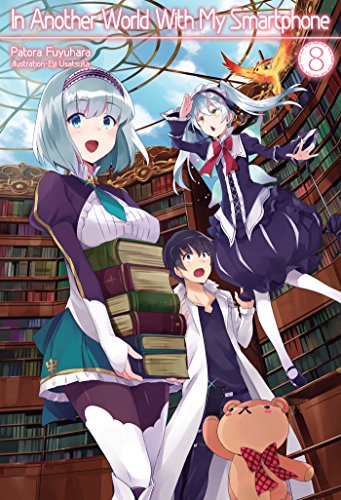
In Another World with My Smartphone, Vol. 8

By Patora Fuyuhara and Eiji Usatsuka. Released in Japan as “Isekai wa Smartphone to Tomo ni” by Hobby Japan. Released in North America digitally by J-Novel Club. Translated by Andrew Hodgson.

Sometimes I wonder if the author of this series is even aware of the disquieting implications of what he writes. At times it looks like he is. The start of this volume has Touya discovering, at last, the Library of Babylon, with its ridiculous number of ancient scripts. Leen, who is over the moon about this, proposes to Touya on the spot. Touya is rather nonplussed by this, as is the reader, because in the last seven volumes we’ve seen nothing that puts Leen on the same level as the other girls in love with Touya. Indeed, later on the rest of the fiancees confront her and express doubts as well. It’s nice to see the author realized he didn’t really do enough foreshadowing. Sadly, the entire situation is resolved in about three paragraphs, after which she’s given a pass. So maybe the author is not as aware as I’d like.

That said, Leen is now a fiancee, which means she gets the main bonus of Touya turning into a raging villain whenever anyone threatens to rape her, something which happens a lot more in this series than I’d like. Again, because Touya is so bland of a protagonist, the fact that he’s casually cursing evil mooks with curses that are brutally horrific gives the reader a giant sense of disconnect. We also get more examples of his ridiculous power here, though that’s downplayed by the occasional bout of stupidity he has, like “oh, right, I really should give my kingdom laws”, or “maybe I shouldn’t have gone off somewhere with my new fiancee and not told any of the others.” (This also allows Leen to be blushy and embarrassed, which honestly seems grotesquely out of character for her.)

The plot, as with most Smartphone books, is divided into three. First we get the discovery of the library and its bookaholic maintainer, as well as Leen’s proposal. Next, young dragons are attacking cities, and it’s up to Touya and company to teach them a lesson. Finally, there’s a new dungeon that’s been discovered, leading Touya to do some dungeon crawling, something he really hasn’t done in his series, as opposed to most isekai titles like this. This leads to the discovery of a slaver ring, which Touya needs to break up. Oh, and we also have the Storehouse and its dojikko maintainer. Side stories include Leen needing to get permission from the fairies to get married, which mostly involves her upset kohai, as well as Regina Babylon, who does a lot in this series despite being dead, tricking Touya and company into playing an embarrassing real-life board game, which is mostly an excuse for fanservice. It also allows Touya to briefly have a libido, something he only seems to gain in these side stories.

Again, Isekai Smartphone is one of those series you’ll enjoy if you’ve enjoyed previous volumes, and after briefly making me think it would turn it up a notch has settled back down into “not good but entertaining”. Which is fine, I like being entertained, but don’t think I don’t notice the major characterization issues on display here.

The Asterisk War: The Triumphal Homecoming Battle

By Yuu Miyazaki and okiura. Released in Japan by Media Factory. Released in North America by Yen On. Translated by Haydn Trowell.

New semester, new characters, new translator, it’s all new on the Asterisk War front. That said, I would not call this the start of a new arc, really. This book seems to be entirely concerned with putting pieces in place to set up the next few books. Sometimes this works well – the villain of the book is suitably arrogant and snotty, and you will enjoy his defeat – and sometimes it feels like it’s been shoehorned in – Orphelia essentially drops in to reveal who she is and her connection to Julis before going away for the rest of the book. Everyone’s schemes seem to have one think in common, though, which is to stop Claudia winning the next section of the tournament. This is because of her wish, which we are told several times we’re going to hear but never do. And certainly our main five characters would make quite a team if they can all work together, so the bad guys have good reason to worry.

We’ve moved a few months along after the battle of the last three books, and I am very happy o see we won’t have to deal with wacky classroom comedy like a lot of other magical school series. Instead Julis invites everyone to her home country, which is the ever popular “tiny country somewhere in Central Europe” that fantasy authors seem to love, so that she can visit the orphanage she saved by winning the tournament and also catch up with her brother the King. Of course, Julis lacks self-awareness (something she shares with Ayato at times), so is not sure why there’s suddenly a giant parade in her honor, or a party set up to show her off. She’s insanely popular now. Also, the country and various organizations seem to be shipping her with Ayato, which should go well as the author is as well, despite all the fanservicey harem illustrations. Unfortunately, there’s also a group out to kill her, and they’ve sent an assassin who can create magical beasts. Oh yes, and Julis’ old childhood friend shows up. Sadly, she’s evil now.

As I’ve said before (possibly in every single review), no one reads Asterisk War for the plot twists. Everything develops the war you think it is going to develop. But the book also exhibits a basic level of competence that makes me quite happy to keep reading it, and the girls are all harem ‘types’ without quite being boring cliches. I am looking forward to the main cast teaming up with Claudia, if only as I find Claudia’s powers and backstory the most interesting of them. Everyone gets something cool to do in the final battle, and there’s some decent discussion of politics. And oh yes, after Ayato asid his wish was for his sister to be found last time… his sister is found. Sadly, that doesn’t really do him much good, abut at least he knows her circumstances now.

This takes us to the end of the Asterisk War anime adaptation, so new volumes should be new content. I am aware that the anime was unpopular, but I’ve never had an issue with the books. Perhaps it reads better in prose. (More likely it’s because I’ve never read Chivalry of a Failed Knight.) I’d still recommend Asterisk War to anyone who likes magical fighting school series, it is a nice light snack of a novel.

Hungry for You: Endo Yasuko Stalks the Night, Vol. 1

By Flowerchild. Released in Japan by Shonen Gahosha, serialization ongoing in the magazine Young Comic. Released in North America by Seven Seas. Translated by Christine Dashiell. Adapted by Casey Lucas.

Mever let it be said that the author isn’t putting all her cards on the table here. The cover, which features our titular heroine carrying a blood bag stand, boxes of tomatoes, drinking tomato juice, with with garlic streaming behind her… yeah, this is a vampire manga. And a very silly vampire manga – indeed, the selling point is the humor, rather than the vampirism, though there is the occasional semi-serious element. Mostly what we see here is Endo Yasuko (the vampire) becoming friends with (somewhat by force) Mikaoka Shizue, her self-proclaimed emergency rations. (Given this is a Shonen Gahosha title, I have to wonder if the Excel Saga allusion is deliberate or not.) There has been a string of murders of young women at their school… but is Yasuko really responsible? And perhaps most importantly: is this series actually yuri, or just suggestive and fanservicey?

There’s actually more going on here than I expected with a premise like “comedic vampire girl’. It’s not as slice-of-life as you’d think. As the book goes on, Shizue tries to subtly figure out what really happened with the murders of the three girls, and also see how Yasuko actually deals with her victims. She herself is a victim (mostly willingly) a few times, but it’s clear Yasuko is holding herself back. There’s also a few new characters introduced to help expand things – the overly bitter student who has an ax to grind uses her daddy’s money to hire a vampire hunter from Texas of all places. Vampire hunter is also a teen girl, and in perhaps the most surprising move of the volume starts off as being completely unable to speak Japanese but by the end of the book is almost fluent in it – she is a funny foreigner, but it’s less because of her mangled Japanese and more because of her growing obsession with manzai humor.

This series runs in Young Comic, which is not QUITE as salacious and sex-filled as its sister magazine Young King but comes close. As such, I was rather surprised that there wasn’t more fanservice – this is definitely a Seven Seas title, rather than their Ghost Ship line. There’s the occasional emphasis on Yasuko’s large breasts, and Yasuko and Shizue share a bedroom but nothing really happens. Honestly, this is really somewhat pure. It becomes fairly clear by the end of the book that Yasuko likely ISN’T responsible for the murder of the three girls, though it’s not made clear who is, and Yasuko is going to have a lot of trouble proving her innocence, especially since the police are now sniffing around. There’s also Itami Mitsuri, who seems to be a typical Gal but one or two scenes suggest she may also have supernatural origins. That said, right now she seems to be harassing the heroine more through social media than anything else.

This is a cute, funny title, though I’m not sure where it’s going to be going. If you like vampires and are looking for a less serious take on the genre, you may want to give it a try.