Yearly Archives: 2018

Giant Spider & Me: A Post-Apocalyptic Tale, Vol. 1

By Kikori Morino. Released in Japan as “Owari Nochi, Asanagi Kurashi” by Mag Garden, serialization ongoing in the online magazine Alterna pixiv. Released in North America by Seven Seas. Translated by Adrienne Beck. Adapted by Ysabet Reinhardt MacFarlane.

I suppose I should not have been surprised. We’ve seen BL titles that are really cooking manga. We’ve seen Shonen Jump cooking manga, both with monsters and without. We’ve seen dungeon crawl cooking manga where you eat the monsters, and fantasy manga where you’re eating dragons. Heck, even the monstrous Fate/Stay Night franchise, which has always had a heavy element of cooking involved in it, has given in and offered us pure slice of life foodie manga. And now we see Giant Spider & Me, which is a post-apocalyptic story of life after the Earth seems to have suffered a great disaster that left the cities flooded. Except it’s really a slice-of-life heartwarming story about a girl and a giant spider bonding and learning more about each other. Except, well, it’s really about the food. Update your recipe cards, because you’ll be adding new entries after reading this.

Our heroine is Nagi, a young girl who lives alone in a cabin in the woods, about a medium-sized walk away from a grand view of the flooded remains of a large city. Theoretically she lives with her dad; in actuality, he’s been out exploring for a long time and has not come back, so she’s living by herself, foraging, and making do. (There are mentions of other villages, and a stranger shows up in the last chapter, so there are still people around.) One day she runs into a large spider, which as you can see by the cover is VERY large – about the size of her dining room table. I appreciated the fact that she was actually terrified for a while – in titles like this, usually the protagonist is a girl who has no sense of danger or fear, and I liked that Nagi is aware that yes, this is a GIANT SPIDER. That said, it rapidly becomes clear that said spider (quickly named Asa) acts more like a puppy looking for a new home, and after Nagi takes pity and invites it back to her place, the bonding begins.

The cooking and slice-of-life war for supremacy throughout this first volume, until perhaps the cliffhanger at the very end, which seems designed to be a cliffhanger more than anything else. Nagi is sweet and elf-sufficient, and a good cook. Asa, as I said earlier, acts like a rambunctious puppy at times, knocking things over and such. That said, they’re also able to protect Nagi from more dangerous and less adorable predators, so it’s not entirely a master/pet relationship – it’s meant to be a budding friendship. There are also hints that we might eventually hear what happened in this world, and expand the cast a bit. That said, this isn’t the sort of series you want getting too complicated. It’s a story of a girl, a spider, and delicious food. Not much else is needed.

The Combat Baker and Automaton Waitress, Vol. 2

By SOW and Zaza. Released in Japan by HJ Bunko. Released in North America by Bookwalker. Translated by David Musto.

It took me a while to get into this volume of the series, but once the main plot got into gear it practically flew along. I felt uncomfortably like Sophia while reading this. She’s the soldier and childhood friend of Lud’s who wants him to return to the military rather than trying to atone for his crimes by baking bread in some town in the middle of nowhere. Lud, over the course of the book, realizes that’s not why he’s doing this, and that being a baker and seeing people happy *is* what he wants going forward. That said, I have to admit that the book really comes alive once the terrorists arrive and things turn a bit Die Hard. Lud may be a baker, but he is also an excellent soldier. That said, I was also pleased that a large amount of the saving the day fell to both Sophia and Sven, who have no need for Lud to come and rescue them.

The book starts off at the bakery but doesn’t stay there long, as fantasy not-Germany is trying to win over its conquered people and therefore is having a party on the not-Hindenburg, and the\y want Lud’s bread to be part of that. Of course, there are a few small problems. 1) Lud will have to give an interview, and his smile still terrifies people. Luckily, Sven takes over with help from some hair dye and glasses. 2) His former commanding officer/childhood friend is there as well, and she wants him to join the military again so he can be with her… um, I mean do what’s he was meant to do. 3) This is all a publicity stunt, so once Lud actually boards the airship he finds himself cruelly mocked and belittled. And of course 4) Terrorists have boarded the ship and are going to crash it into a major city, killing thousands. Add in Milly, the angry girl from the first book who now has a massive crush on Lud, and has stowed away, and you have a lot going on.

There is, of course, a bit of a harem here, but given Lud’s personality, nothing is really going to come of it. That said, I wonder how much of Lud’s obliviousness is genuine – there’s a clear moment here where he reveals he knows exactly who Sven really is, to her surprise, but it’s just as quickly forgotten. I suspect he’s trying to keep things as they are, which is always a dangerous thing to do in Japanese series – “I wish things could stay like this forever” is a classic death flag. The series also has some very interesting worldbuilding in regards to the supposed “peace” after the war, and how fragile that really is, especially if some of the soldiers who know nothing else are trying to stir up war again. I could have done without the dickhead terrorist stripping and threatening Sophia with rape, the go-to standard for “I want readers to see my villain is eeeeeeevil”, but at least she kneed him across the room and stepped on his goolies, rather than get rescued by Lud. Sophia can take care of herself.

I still wish I could change the font in Bookwalker’s app to a different one, but the translation seems much improved in Book 2. It also comes with a very short story about the world of the series. If you’re looking for a light novel that’s not quite the same as the “standard”, but still has enough tropes to be comfortable, this is an excellent series to read.

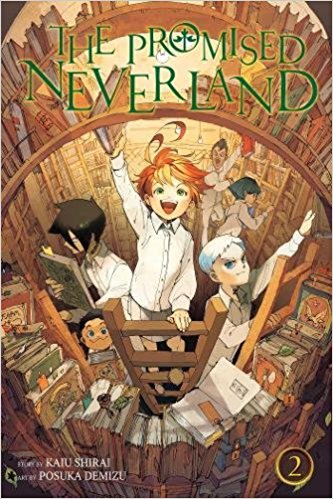
The Promised Neverland, Vol. 2

By Kaiu Shirai and Posuka Demizu. Released in Japan as “Yakusoku no Neverland” by Shueisha, serialization ongoing in the magazine Weekly Shonen Jump. Released in North America by Viz Media. Translated by Satsuki Yamashita.

(As with Vol. 1, and likely going forward, these reviews spoil the volume in question. Because that’s exactly what reviews are for.)

After all the revelations of the last volume, I had expected this one to slow down, and it does a bit, but that does not mean there are not still jaw-dropping moments within. One of the strengths of this series is its ability to pull the rug out from under the reader and make them want to reread everything that’s gone before with the new information in mind. There’s also a wonderful depth of character, something which you do normally see in Jump series, but rarely this early on. A lot of this book comes from Norman’s POV, and shows off how clever he really is, a balance between the cool and logical Ray and the impulsive, naive Emma. In fact, Emma’s naivete is explicitly called out as her weakness. So it’s also wonderful to see that she hasn’t just been saying the most idealistic option without trying to think of ways to make it happen, including the best tag game ever.

Planning a mass breakout of thirty-five or so kids, most of whom are somewhere between four and six years old, is a tough job. Ray is right – it would be so much easier for only a few kids to escape. But Emma is even more right – they can’t escape and leave other innocent kids behind to get killed or eaten or whatever it is that the things outside are doing to them. The tag game is Emma’s way of toughening the kids physically and also forcing them to think on their feet and trust their impulses (which is Emma’s greatest strength). Of course, the game of tag does not only help develop the kids physically, but shows off more of Krone as a character, after she decides to join in in order to prove to herself that she’s the one who has the upper hand. Krone can be terrifying, but I found her a bit less discomfiting than last time, mostly as she’s gained added depth – her war with Mother to see who’s in charge going forward is chilling, as is her scene with Gilda.

And then there’s Ray, who pretty much steals the volume by design. I had expected the “who’s the traitor?” question to be spun out over a few more chapters, but if the reader thinks about it, the traitor has to be someone the reader is already very familiar with, which narrows the list of suspects exponentially. As for Ray himself, I have a sneaking suspicion that he’s going to be headed for a fall in a volume or two – being a double agent is just as difficult as it sounds, and something else is going to go wrong – possibly right away, if that cliffhanger involving the impulsive Don is anything to go by. I also loved the scene with Emma interrogating him – like Norman and Ray, the reader assumes her to be the “Luffy” of the group, an optimistic bright shining light who’s nevertheless a bit simple. But she’s as smart as they are, and her deduction of how he figured out the tracking devices is topped only by her chilling response.

I haven’t even gone into the artwork, which is wonderful, be it the detailed, almost Escher-esque backgrounds or the gloriously silly expressions on Emma’s face. For those who worried that The Promised Neverland couldn’t surpass its first volume, the second book should show you that it’s still a cut above. Highly recommended.