Monthly Archives: January 2019

Katanagatari: Sword Tale, Vol. 1

By Nisioisin and take. Released in Japan in three separate volumes by Kodansha BOX. Released in North America by Vertical, Inc. Translated by Sam Bett.

This is the third major series of Nisioisin’s to come out over here as a novel, after the popular Monogatari Series and the cult classic but poor selling Zaregoto Series. These books reunite Nisio with the artist for the Zaregoto books, and the art is sufficiently stylistically awesome. As for fans of Nisioisin’s wordplay, not only do they get tons of that in these volumes, but we get footnotes from the translator (which he indicates are totally optional) explaining many of the original lines and why they’re puns, as well as his own translation choices. It’s the sort of thing I wish that we could have seen with the Monogatari books, as it might have made several readers less dagnabbit mad. The book is also very metatextual, a common thread in Nisio’s work, with suggestions that certain elements will be followed up with in future books, or announcing the tragic backstory of one of the characters is coming. That said, it’s a very Nisio series, but how does it hold up as an actual book?

Our hero is Shichika, who lives on a little-known island with his older sister Nanami. He’s the heir to a school of swordsmanship, the Kyotoryu, that does not use swords – but aside from not using swords, it’s handled exactly like a classic sword school. As a result, Shichika is essentially a blade himself, which makes sense given that sometimes he tends to have the emotional depth of an inanimate object. Into this island steps Togame, who is there to hire Shichika to help her locate twelve Mutant Blades, katanas that rightfully should belong to the Shogun but are instead being used by twelve other people. After the events of the first book, which involve the first of those swords, Shichika agrees to accompany her, leaving the island and his sister and going to get each sword one by one – though that always means a battle.

As I hinted before, Shichika is almost a parody of the “simple country bumpkin’ type who isn’t so simple, and much is made of the fact that he has never really had to think before now, so isn’t used to it. This makes him a pleasing contrast at least to super-genius Ii-chan and overly florid Araragi. He’s fine with leaving the thinking to Togame, who is a self-titled “schemer” but whose schemes haven’t really been able to do much but postpone the inevitable fights so far, and whose fragility makes her easy to use as a hostage or a distraction. She’s also less clever than she thinks, as the best gag in the book, a misuse of a British greeting she has, attests to. Together they make each other more interesting, which is all one can ask. As for the sword wielders, by the end of the first omnibus three are dead, though you are only meant to feel sympathy for the last one – indeed, the ninja clan that start the book as the main antagonists have become, at the author’s own insistence, the comic foils of the story.

It’s clear who this book is meant for: fans of the anime, as well as fans of Nisioisin’s eclectic narrative style. Both should find this series very entertaining, though even I found Shichika somewhat wearing by the end. I’ll definitely be getting the next set of three this spring.

The Irregular at Magic High School: Visitor Arc, Part II

By Tsutomu Sato and Kana Ishida. Released in Japan as “Mahouka Koukou no Rettousei” by ASCII Mediaworks. Released in North America by Yen On. Translated by Andrew Prowse.

This is very much a book of two halves, and I must admit that I preferred the first half to the second, though they both had issues. The first half is a continuation of the plot from the first book in this arc, as Tatsuya and Lina separately and together try to figure out what’s “possessing” these people and how to stop them, but are almost undone by a traitor in Lina’s midst. The traitor is… a character we met once before in the last book, but I must admit “minor character X’ does not really make it very dramatic – I was expecting it to be Lina’s aide Sylvia, which would have been more tragic. There’s also a pretty nice fight with said minor character traitor at the climax of the first half of the book, which actually gives Mizuki something to do. And we get a great way to present boring exposition and still make me laugh – Shizuku calls from California to give intel to Tatsuya, but she’s shitfaced drunk when she does so, and he’s trying to explain things to her as she slurs her words more and more. It’s pretty funny.

I was less impressed with the second half of the book, as it’s Valentine’s Day at the school, and you know what that means: wacky hijinks. I’ve talked before about how I’m not fond of Honoka being defined just by her love of Tatsuya, and I realize that the author is trying to let her and Shizuku get developed by the Honor Student manga author in that regard, but man, here her love for Tatsuya is literally weaponized by the runaway parasite, who possessed a robot named Pixie that’s part of the school’s robotics experiment. As you can imagine, instead of being driven by self-preservation and killing witnesses like the other possessed folks, she’s driven by the intense and disturbingly submissive love for Honoka that Honoka accidentally activated her with. That said, most of the valentine stuff was merely okay, and not actually irritating. And Mayumi’s revenge chocolates made me smile.

The irritating, as so frequently happens in this series, was saved for our two leads. I realize that Miyuki gets jealous sometimes, but what she did with Tatsuya’s chocolates was so petty and immature my jaw dropped. This is not helped by Tatsuya basically saying “welp” and just going along with it. (Tatsuya is not at his most likeable throughout the book – there’s a sequence where he lets Miyuki answer a difficult conundrum they have as he wants her to be “more than a pretty doll” that made me want to punch him.) And, of course, Miyuki is also dealing with her incestuous feelings for her brother, which are sometimes used as the usual gag (Lina’s reaction to Miyuki saying she and Tatsuya are just siblings) but in Miyuki’s inner thoughts are very much taken seriously. She feels guilty about these feelings, but honestly the whole thing makes me feel deeply uncomfortable.

When you add in some “Japan is good, everyone else is less good” speeches, and Lina getting chewed out for daring to fall in love with Tatsuya (a fact that she denies, but no one believes her, least of all the reader), and you have a typically easy to read but frustrating volume of Mahouka. Next volume should wrap up this arc, at least.

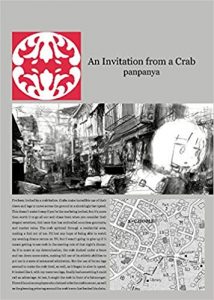
An Invitation from a Crab

By panpanya. Released in Japan as “Kani ni Sasowarete” by Hakusensha, serialized in the magazine Rakuen Le Paradis. Released in North America by Denpa Books. Translated by Ko Ransom.

Iev always been a fan of those sketchy, semi-slice of life (except they’re too weird) manga that you see towards the back of a lot of seinen and josei manga magazines. It used to be that the chances of such works getting licensed over here was nil, but Denpa has quite a few eclectic titles coming out now, and An Invitation from a Crab is one of the first. It’s more of a collection of interconnected short stories, along with the occasional essay discussing the importance of paying attention to things. Our unnamed heroine is theoretically a high school student, and occasionally we do see her in class. But the world she’s in is not quite the same as ours, featuring normal humans but also animal-headed people, as well as the bizarre lemon with an eye that seems to be a ‘boss’ sort of type. Essentially, An Invitation from a Crab is a “what kind of stories will the author spin next?’ sort of book. And they’re good stories.

The stories here range from a few pages long to larger chunky narratives. The title comes from the first story, where our heroine follows a crab that is lying in the road and seems to know where it’s going. That said, the “punchline”, as it were, amounts to not much, and that’s also the case with most of the rest of these stories. You’re reading this for mood, not for jokes or characterization, and so frequently the stories feel like “shaggy dog” stories, where the ending does not justify the effort expended. Which is absolutely fine given much of this is about enjoying the journey. We see our heroine wearing a Chinese communist outfit in a factory breaking coconuts so they can be used to create electricity. That is a sentence I can’t believe I just typed, and it’s probably the weirdest of the stories in here, but there’s other dreamlike sequences as well, including one that literally is a dream, where our heroine’s spirit gets off a train but her body doesn’t.

There is quite a bit of humor here, despite my saying earlier that there weren’t punchlines per se. Sometimes simply seeing the situation makes me laugh, such as our heroine and her dog/roommate/whatever searching to try to find anyone who knows where pineapples come from, or the heroine gleefully preparing for her Sunday day off by doing piles of things (this reminded me of the Zetsubou-sensei chapter where the class had a “preview” of their field trip). And sometimes the mood can be disturbing – there’s a lot of dark shadows in this world, and while the coconut and lost body stories are not dark in any way, they’re unsettling and have a sense of unreality to them. Even some of the shorter stories in the volume, such as when our heroine is sold a giant salamander and tries to return him to the Amazon (a plot that lifts directly from an old Bugs Bunny cartoon), has an ominous feel to its humorous ending.

If you’re interested in a skewed look at life in a world that’s not quite this one, or wonder what it would be like if you did follow that crab into the side alley, you should definitely pick this up.