Monthly Archives: May 2019

Torture Princess: Fremd Torturchen, Vol. 1

By Keishi Ayasato and Saki Ukai. Released in Japan as “Isekai Goumon Hime” by Media Factory. Released in North America Yen Press. Translated by Nathaniel Hiroshi Thrasher.

I do try not to be glib in my reviews too often, but I will admit it was tempting to have my entire review of this volume be “Loved the princess, hated the torture”. Honestly, it was a surprise to many people that I started this at all, given my wariness of overly dark and bloody titles. But I was on one of my “read the first volume of everything” kicks, so I worked my way through it. It was difficult at times, I will admit. The torture is no lie, and this isn’t even the pointless “torture them to get information” that you see in other, more annoying works. This is torture for the sake of gore, torture porn. Fortunately, the book also has three very distinct, likeable leads with expressive character voices and interesting through processes. I liked the way they went, and I want to see more of them. That said, it’s hard not to read this and think “the author wanted to write pages of torture description, so wrote a book around it”.
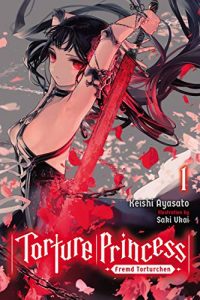
Kaito is a young man who has suffered at the hands of his abusive father his entire life, and finally is killed by said father. However, he ends up being transported to the land of the Torture Princess, Elisabeth Le Fanu. She brought him there to be her servant, and help (or at least watch) as she defeats thirteen demons and the people who have sold their souls to said demons. The demons enjoy torture and despair, and (seemingly) so does Elisabeth, so there’s an awful lot of it going on, and for a while the somewhat stoic Kaito is simply going with the flow. After a while, they also gain a robot maid, Hina (OK, a ball-jointed doll who is sentient maid, but for all intends and purposes she functions as a robot maid) with a devotion to Kaito that borders on the obsessive… well, OK, has moved into the obsessive and set up a knickknack shop there. Can they stop those contracted with demons from torturing innocents? Well, no. But they can at least punish them after the fact.

I will admit, I found Elisabeth, Kaito and Hina a lot of fun. Despite her name, Elisabeth is not a vampire, but she shares some of the same character traits, and the relationship between her and Kaito reminded me at times of Shinobu and Araragi from the Monogatari series. Kaito is snarky but not too much so, and most of this first book is seeing him regain a desire to actually find happiness and a purpose in life. And cliched as Hina is, she’s also hilarious and fun… and also provides the heart of the book, right near the end. It’s a good solid basis for a series. That said, dear sweet merciful Christ, after a while you will start flipping pages as you read about people lying in various bits, or having limbs chopped off, or being staked by demon crows, or… it almost went beyond exhausting to boring. It fits the florid Elisabeth’s Grand Guignol style, but that does mean that this is a book I can recommend only to the strong of stomach.

Urusei Yatsura, Omnibus 2

By Rumiko Takahashi. Released in Japan in two separate volumes by Shogakukan, serialized in the magazine Shonen Sunday. Released in North America by Viz Media. Translated by Camellia Nieh.

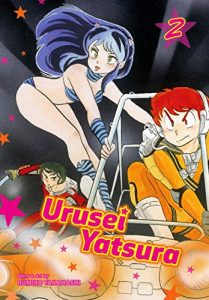
UY gets a bit of a reboot about a quarter of a way into this omnibus. The cast is streamlined, with a lot of the alien girls after Ataru vanishing (some will be back – Benten, Oyuki – and some won’t – Kurama), and Megane and his three friends also vanishing from the manga (the anime will keep them around, for good and ill). In their place we get Shutaro Mendo, and he immediately shows us that he is going to be a main cast member fot the long haul. Indeed, after Ataru, Lum and Shinobu he’s the biggest member of the cast, and much of this volume is dedicated to showing off his best features (his money, his looks) and his worst features (everything else about him). Takahashi makes a point of showing early on that without his wealth and good looks, he’d be just like Ataru – but of course, he DOES have wealth and good looks, so the girls all fall for him anyway.

This includes Shinobu, who the endnotes at the end of the volume call out for having bad taste in men, and it’s hard to deny, as Mendo will forever be willing to abandon her at a moment’s notice if he can get Lum instead. (Shinobu will get a happy ending, but you may have to wait till Omnibus 16 or so to start seeing it.) There are a few chapters that show off Mendo trying to woo Lum, but he’s at a huge disadvantage, as Lum’s love for Ataru never really wavers at all – even when she’s dating others, it’s in an effort to make him jealous. Here we see her even disguising herself to save Ataru from his own foolishness, or alternatively so he can pretend she’s a real Japanese girl when they go out. As for Ataru, at the start we see he has the same attitude about Lum as he did before – he wants her gone – but this also changed as the story moves forward.

Ataru is, for the most part, a womanizing creep, and this won’t change, though it’s worth noting that even with these traits he’s still one of the better catches in the class. The ‘fake girl for Ataru’ chapter, which the anime put at Christmas and expanded greatly, is the first time that he actually realizes that Lum is gorgeous, and that plus the fact that she clearly went out of her way to help him leads him to soften his stance on her. He still declares that they aren’t going out or married, but she’s become an ally to him now. Two chapters in a row show this off best. In one, he befriends a caterpillar that wants to eat everything – and we do mean everything – and he and Lum try to protect it from the rest of the class, who find it creepy. This works out better than anyone could expect. In the other, possibly the most famous chapter of the series (its anime adaptation was voted the #1 episode by Japan), Lum vanishes, leaving behind only a cute little doll that looks like her, and Ataru worries that he genuinely drove her off.

Heartwarming moments like these are far more common in the anime than in the manga, but they do happen, and for a good purpose – now Ataru is fighting against his affection for Lum, rather than just seeing her as an invader. Now that the core cast of four has been solidified, we can also start to expand the world once more, and we’ll see that in the next volume. Also, Takahashi’s art settles down here – there are some gorgeous pieces of art on display in these pages.

Ascendance of a Bookworm: I’ll Do Anything to Become a Librarian!, Part 1: Daughter of a Soldier, Vol. 1

By Miya Kazuki and You Shiina. Released in Japan as “Honzuki no Gekokujou: Shisho ni Naru Tame ni wa Shudan wo Erandeiraremasen” by TO Books. Released in North America digitally by J-Novel Club. Translated by quof.

There are people who read books about characters who are transported/reincarnated to another world in order to see fantasy battles, game-style powerups, harem antics, and a lot of plot packed into the first volume of the series. And I am here to tell you that those people should run screaming from Ascendance of a Bookworm, which I loved but is the very definition of “slow buildup”. In a way it’s sort of like Mushoku Tensei, in that a “loser-ish” protagonist is killed and reincarnated as a small child. But Rudy is born with lots of skills and gets training to use them fairly quickly. Myne, meanwhile, not only wakes up as a six-year-old in a fantasy medieval town that has few to no books, but she’s also constantly feverish and weak – even walking a short distance exhausts her. But, and I’m sure she’d be yelling at me for glossing over this, the important point is that there are NO BOOKS for her to read.

In Japan, Urano loved books so much that she was reading them in her family’s book-filled room when an earthquake struck, burying her under the books and killing her. Now she’s woken up as Myne, the youngest in a family that loves but doesn’t quite know what to do with her, as she’s almost always bedridden. Even now that she has Urano’s memories, she’s still weary after only a little activity, and it takes the entire book to get to the point where she can walk around town normally. Worst of all: no books, no paper, ink is super expensive, and the literacy rate for “commoners” is low. Sure, nobles have books, but Myne isn’t one of those. What can she do? Buy a book? Her family is poor, and there are no booksellers. Make paper? Much harder than it sounds. Clay tablets? Foiled by her sketchy knowledge from her prior life. Sure, she can read and do math faster than most kids, but with only one erasable slate to her name, what’s a book girl to do?

As you might guess from the unwieldy title, this is a long-runner. Part 1 is three volumes long. This first volume is fairly lengthy, and it’s also the shortest in the series – others will be longer. It does, however, reward a patient reader. There’s some terrific worldbuilding here, with Myne finding out about things at a reasonable pace. Myne can be very frustrating – her selfishness and anger is a problem throughout the book – but it makes sense given her health and situation. She really is that weak and feeble till about halfway through this, and seemingly has none of the “when you reincarnate, you get this cool sword/goddess/smartphone” cheats we’ve seen in other series. Thankfully, Urano read constantly, so has book knowledge… but the series does a good job of showing how that’s frequently not enough. (Helpfully, her mother was also a super handicraft woman, so Myne can break out a few skills beyond reading.) The book rewards patience, but it can be very frustrating seeing Myne bash her head against a wall over and over. While complaining.

There’s a revelation right before the end of the book that I won’t spoil, but it sounds like it will lead the way towards future arcs in the series. In the meantime, if you’re looking for a different kind of isekai, or are weary of “OP” heroes, this may be right up your alley.