Monthly Archives: June 2019

Classroom of the Elite, Vol. 2

By Syougo Kinugasa and Tomoseshunsaku. Released in Japan by Media Factory. Released in North America by Seven Seas. Translated by Timothy MacKenzie. Adapted by Jessica Cluess.

Tempting as it is to paste my review of the first volume in for the second and see if anyone notices, I will make an effort to say new things. The series’ strengths and weaknesses remain the same. It’s compulsively readable, always a good thing. Its premise can be teeth-grindingly annoying, especially when everyone turns into a vicious sadist for no reason, with a lot of “ha ha, you will fail forever now” sneering. I’m still not entirely clear if this school has a purpose beyond abusing 1/4 of its student body, and I suspect this is not a question I’m going to get answered anytime soon. We do get a couple of new characters here, though, including one who I actually did not want to punch in the face, which is a monstrous improvement from the first book. Sadly, she isn’t in Class D, meaning I am probably out of luck unless we get a spinoff series or something. Plus honestly, shee likely has a dark side too.

The other new character introduced is Sakura, who isn’t annoying so much as passive. In fact, her very passivity is the problem, as she’s also an important witness to an assault by Class D hothead Sudo on three Class C students. He now faces suspension, of course, and every single thing over the course of the entire book does not help his cause. First off, he’s claiming self-defense, but that’s hard to prove when you beat up three guys and you’re fine. Secondly, no one believes him anyway because his first response is to punch everything. Of course, if Sudo gets suspended Class D will lose the few points they gained from the first book (which aren’t given to them as money, by the way – it’s implied they never will be). Can the rest of the class overcome their antipathy towards Sudo and apathy in general and help clear his name? Or will they need to be a bit more… creative?

As I said, there’s also a girl from Class B that we briefly met in the first book but who gets a genuine introduction here. Ichinose is so refreshingly normal that I was almost crying in happiness. She’s friendly and outgoing without (so far) having a scheming dark side like Kushida. She tries to use Ayanokouji to help her with a problem (girl is confessing to her, need a pretend boyfriend). She ends up being of great help to them in the climax of the book. Really, I want her to be the star. She’s certainly more fun to read than grumpy Horikita, who spends the book attempting to help Sudo while being miserable about it, or our “hero” Ayanokouji, whose desire to be average and not stand out is so great that even his own inner narration lies to us – frequently he talks about Kushida as if he knows nothing about her secrets, and there are other points where I suspect he’s straight up lying to the reader. Which is the point – their teacher is trying to get Horikita to figure out why he’s like this – but again, it’s not what I’d call fun.

I can see why this is popular – I sped through it very quickly, and want to read more. This despite the fact that I was frowning most of the time and occasionally wanted to slam the book against a wall. Classroom of the Elite is a war between the writing and the characterization, and it may take more than two volumes to figure out who’s winning.

Classmates, Vol. 1: Dou Kyu Sei

By Asumiko Nakamura. Released in Japan by Akaneshinsha, serialized in the magazine Opera. Released in North America by Seven Seas. Translated by Jocelyne Allen. Adapted by Lillian Diaz-Przybyl.

This is the latest in a series of “OMG, I can’t believe we’re finally seeing this title!” LGBTQ releases that we’ve seen in North American this spring. Technically, we’ve seen this one before, as it came out digitally via JManga, then digitally again via the Digital Manga Guild. But this is a print release, newly translated, and looking very nice. It’s not a new title, having come out in 2006, but the story is certainly timeless. There’s a handsome, outgoing boy. There’s a serious, introverted young boy. They fall in love. But as with most really popular titles, it’s not just the story that makes people want to read it. Classmates has a number of individual story beats that I paused and read slower, or went back to read again, because they were handled so well. There’s also some excellent art here as well, as sometimes even a sketchy background shot carries impact. It’s a manga by an author who knows craft.

Hikaru is the easygoing, handsome, long-haired blond, who’s cool, in a band, etc. He’s in an all-boys school, which is practicing for a choral presentation, and notices that a classmate, Rihito, is only pretending to sing. Later he finds Rihito in an empty classroom, trying to learn the song (his vision is poor, so he couldn’t see the music earlier) and Hikaru offers to teach him. Over the course of this, the two fall in love, helped along by Hikaru’s kissing, which is not entirely consensual at first but eventually reciprocated. As the volume continues, you see the passion they have for each other, but is there anything behind it? Moreover, college is coming up, and Rihito, pressured by his parents, is boning up to get into a prestigious university. Is this a long-term thing, or is just another high school romance?

As I said earlier, individual chapters or scenes were what caught my attention here. Student/teacher relationships are a staple of Japanese manga, but you usually see them coming from the POV of the student. Here we get a chapter devoted to Manabu, their music teacher, who tells us why being a gay guy at an all-boys’ school is not all it’s cracked up to be (they’re mostly immature brats), but then runs into Rihito and falls for him immediately (Rihito has a knack for being unconsciously smooth). There are also a couple of fights that were very good, the first after Rihito sees a girl hitting on Hikaru at a concert and drunkenly runs off (Page 114 made me smile hugely) and Rihito’s explosion of emotions (he’s normally pretty repressed) about how he knows nothing about what Hikaru is doing for college or the future. (To be fair, I don’t think Hikaru knows either.) It’s scenes like this that make a series really enjoyable, and I’m very pleased that Seven Seas has also picked up the two-volume sequel to this.

If you like teen romance with passion or classic BL, this is absolutely a series to buy.

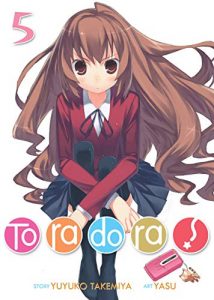
Toradora!, Vol. 5

By Yuyuko Takemiya and Yasu. Released in Japan by Dengeki Bunko. Released in North America by Seven Seas. Translated by Jan Cash & Vincent Castaneda. Adapted by Will Holcomb.

This is a light novel series that is coming out in America well after both the manga and the anime (though the manga remains unfinished as it crawls along in Japan), so to a certain degree there’s very little “surprise” involved in the contents. I knew that we would eventually be dealing with the volume with Taiga’s father, and here it is. As such, a good deal of the book consists of the reader yelling at Ryuuji “NOOOOO, DON’T TRUST HIIIIIM, YOU IIIIIDDDIOOOOOTTT!”, which to be fair Minori does as well. It’s actually rather refreshing, as usually Ryuuji is the sensible, down-to-earth core of these books, so it’s somewhat startling to see him so taken in by Taiga’s dad. Of course, it’s spelled out why he is; he longs for a relationship with his father he can never have, and now he can sort of get it via Taiga. Of course, this means it’s not about what Taiga wants at all, something that he realizes in a horrified sort of way when everything goes wrong.

Before we move on, I want to note that, while Toradora! is quite funny and has some excellent gags, it does lean on one running gag through this book that I wasn’t very fond of. Yuri, the class teacher, turns thirty in this book, something that she and the author make you very aware of. There is a bit of sympathy for her near the end (bless you, Ami), but for the most part the joke is that she’s 30 and unmarried, and the constant (30 years old) tags after her name grow annoying. Of course, without that we would not have had the class wrestling play, which has to be read to be believed, although I admit I think it worked better in more visual mediums. Taiga and Ryuuji really do make an excellent evil duo. And then there’s the race at the end, where Ryuuji and Minori, both incredibly furious with themselves, get involved in a nasty little race to see who can crown Miss Taiga with a tiara of “I’m most important to you!”. The race is fantastic, though I do wonder, given the apparent injuries that occurred during it, why no one got in trouble.

Ryuuji and Minori have a huge fight here, of course, Ryuuji coming from a position of ignorance and Minori from one of having been here before. She withholds that from him, though, deliberately. Minori is upset that Taiga is not only closer to Ryuuji these days, but seems to be getting herself hurt again by making up with her father purely for Ryuuji’s sake. The series to date has been about Taiga and Ryuuji having one-sided crushes, and in the last book we wondered if Ryuuji’s was really one-sided after all. Now we see Minori wondering, out loud, after her struggle to be the one most dear to Taiga, if she’s a lesbian. Leaving aside Ryuuji’s response, which is understandable but won him zero points in the fandom, it’s an interesting question, and I wonder if the author will develop it later on or if it merely serves as an odd coda to this excellent volume.