Monthly Archives: November 2019

Urusei Yatsura, Omnibus 4

By Rumiko Takahashi. Released in Japan in two separate volumes by Shogakukan, serialized in the magazine Shonen Sunday. Released in North America by Viz Media. Translated by Camellia Nieh.

I’ll be honest, I wasn’t looking forward to this volume quite so much. Don’t get me wrong, I love UY with all my heart. But I knew we were going to get a heaping helping of Ten here, and Jariten has always grated on me. That said, as I re-read these manga chapters, he didn’t come off quite as badly as I’d expected. The thing is, Ten was SUPER popular when he first appeared in Japan – if not with the readers, then definitely with the animators of the soon-to-come anime series, which took the liberty of inserting Ten into the third episode and having him shoehorned into most episodes after that. But “bratty little kid” has always been a harder sell in the West, particularly if they’re not the ‘sarcastic adult’ kind of brat – look at the four or five failed attempts to sell Crayon Shin-chan here. So it was always hard for me to not just grit my teeth. But here, in the manga chapters written specifically for him, he’s a lot of fun.

Ten, like Mendo before him, is meant to set up a basic truth of the series. Many of the male characters are set up to be contrasts to Ataru, only for it to turn out in the end that they’re exactly the same as Ataru. Ten is a “cute little baby” to most of the women around him, which he uses shamelessly, as he notes he’s not into young girls his own age. (What age that is is left up in the air – he certainly seems very angry when someone calls his tiger skin a diaper.) But of course, Ataru never gets anywhere with any girl not named Lum, and the same applies to Ten – sure, he can snuggle in some bosoms, but he’s essentially just as much of a sad sack as everyone else in the book. He’s also naive enough to be taken in by Ataru’s really, really obvious schemes – see the chapter where he and Sakura go on a “date” that is meant to have her beat him like Ataru but doesn’t work as Ten is a x-year-old boy.

Elsewhere, Ran settles in as a main cast member, though when the focus isn’t on her, her characterization can vary – during the poetry competition, she seems like a different person! There’s a 3-chapter arc set during the Heian period… sort of, note they’re all watching TV and have electricity… which is basically there to show that the cast’s crazy adventures are timeless. Probably my favorite chapter is one where Ataru has made an “anti-teenage gang” movie for the school. It’s absolutely terrible, and Mendo tries to have it destroyed, but instead, thanks to Lum’s alien projector, the delinquents in the movie come to life and terrorize the school… then fend off an invasion by delinquents from another school. From seeing the main cast dressed up as stereotypical delinquents, to movie-Ataru’s ‘LOVE AND PEACE!’, to movie-Lum and Shinobu literally being able to fire huge missiles from under their skirts, it’s pure Takahashi hilarity.

With Ten’s arrival, we’re almost at UY’s middle period here. Takahashi has settled in and is doing what she does best – writing zaniness. Anyone who loves seeing what comedy manga was like at its peak should be reading this.

Do You Love Your Mom and Her Two-Hit Multi-Target Attacks?, Vol. 4

By Dachima Inaka and Iida Pochi. Released in Japan as “Tsujo Kogeki ga Zentai Kogeki de Ni-kai Kogeki no Okasan wa Suki desu ka?” by Fujimi Fantasia Bunko. Released in North America by Yen On. Translated by Andrew Cunningham.

There is a certain weariness to this volume of Do You Love Your Mom?. The author implies at the afterword that they had not expected this series to run quite as long as this, and taking that one gag and making it go over and over is hard. It shows in this volume’s villain, who manages to make the villain of Book 3 look competent. She has one trick, and when it doesn’t work she essentially whines and moans. There’s also a pile of mothers who are lured into the plot because, well, they’re not all that good at being mothers. It’s meant to set up the final moral, which is that it doesn’t matter if you’re bad at cooking and sewing as long as you have feelings for your children, but I do wonder: are there any dads in this world at all? Why can’t they do the housework? It likely won’t come up, as the premise is moms and children, but I am curious.

Our heroes wind up in Casino Town, and the goal is immediately to get rich so they can buy items and not have Mamako steal all the glory and level ups. Naturally, this goes badly. Masato and his mom end up going on a day-long date where Mamako dotes on him to a hideous degree (the entire “let me wash your back” scene can just go away), while the other three try to cheat at the casino and are immediately captured and converted into bunny girls. Yes, even Porta. Now Mamako and her son must invade the casino to win back the others, and also find out about a sinister plot that involves the mothers of this town disappearing, and their children imprisoned. Fortunately, Mamako has had an entire day of spoiling her son, so her mom powers are higher than they’ve ever been…

I am, as always, most pleased by the appearance of Shiraaase, a one-gag character whose gag never gets old to me. (Oddly, her gag seems stunted in this book, possibly as the villain talks in looooong, draaaaawn-out vowels and thus Shiraaase holds back to avoid confusing the two of them.) She even manages to achieve things before getting thrown back in her coffin. Speaking of which, the most satisfying scene of all may be one where Masato has to get through an army of skeletons to get at the big bad. He’s alone, and the fact that he actually has to rely on his own strength and weapon makes him so happy that he simply mows them down like they’re weeds. Now, this is undercut by the Big Boss essentially letting up on him because of a mom thing, but hey! He briefly did a thing!

The series is 9 volumes and counting in Japan, so any danger of the main plot wrapping up is nil. And the fanservice aspect of the series is, to be blunt, really irritating. If you really like Shiraaase or enjoy the main conceit, it’s still worth reading, but if you’re looking for a series to drop as it’s not good enough anymore, this one works fine.

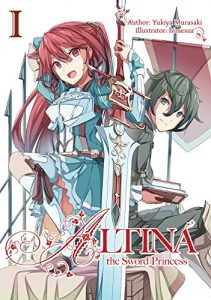
Altina the Sword Princess, Vol. 1

By Yukiya Murasaki and himesuz. Released in Japan as “Haken no Kouki Altina” by Famitsu Bunko. Released in North America digitally by J-Novel Club. Translated by Roy Nukia.

We live at a time when most light novels are trying to get readers attention by a gimmick. It might simply be an excessively long title. It might be a premise so ridiculous that people buy it out of curiosity. It might be piling on the fanservice or ramping up the angst and violence. As such, it’s refreshing to see a series that has a normal title, a normal plot and normal characters. I’m not criticizing here: this really does feel refreshing, coming across as a simple medieval fantasy, lacking even magic (so far) and relying on its two leads to make the reader stick around. (It helps that this series began in 2012 in Japan – its title might be more elaborate were it to come out nowadays.) An overly reckless princess, a needlessly self-hating strategist, and a fort in the middle of absolutely nowhere. No bells, no whistles, and I quite liked it. It does have a very snarky maid, I will admit. But that’s all.

Regis is an administrative officer who’s been demoted… well, OK, reassigned… to the northernmost provinces after a tragic battle that saw his mentor get killed. He is quick to take all the blame on himself, and in fact has a case of self-hatred that seems ridiculous and one suspects stems from some childhood issue. Once near the area, he finds, to his horror, that books up north are rare and expensive – he’s also a book nut. Fortunately, he runs into a girl headed to the fort who can take him there on her coach. Given she asks him to call her Altina, the reader is not in the dark about her identity, but Regis is, at last till they run into a blizzard and are attacked by wolves. So he’s met the princess and settled in… but can he get anything accomplished? Especially as no one at the fort takes Altina seriously?

This is by the author of How NOT to Summon a Demon Lord, which worried me briefly, but it seems the author is quite good at writing to his intended audience. There’s a brief scene of Regis walking in on Altina changing, but that’s about all, and the fact that she’s fourteen, and thus too young to think of romantically, is constantly in his head. Which is good, as I think they both need to mature a bit. Regis desperately needs to have some good things happen to him to get rid of the “everything I do sucks” mentality, and Altina is going to get herself killed one day by her impetuous behavior. Her final battle with the fort commander, which has “if I win, you listen to what I say” as the prize, is very nearly a savage beatdown for her, and she’s saved mostly by her ludicrous sword (which, to be fair, is wielded by her ludicrous strength).

There’s clearly a lot of backstory here, some of which is given in this volume, involving the empire and its current power struggles among the sons and daughters. Altina’s goal of “don’t get married off to become a trophy wife” is a good one, and I look forward to seeing more of the family in future volumes. There’s nothing in this book that really knocks it out of the park or anything. But it’s a very solid read with likeable flawed people, and the flaws don’t irritate. Definitely getting more of this.