Monthly Archives: January 2020

Invaders of the Rokujouma!?, Vol. 31

By Takehaya and Poco. Released in Japan as “Rokujouma no Shinryakusha!?” by HJ Bunko. Released in North America digitally by J-Novel Club. Translated by Warnis.

And so I finally finish my Rokujouma catchup. This is also where the upcoming print boxset that was Kickstartered will end, as it had to cut off somewhere, and this is as good a place as any given the series is still coming out in Japan. It’s another one of those “three short stories from the online site and one half-book original” novels, only in this case the half-book overwhelms the short stories even more than usual. The short stories aren’t bad – first there’s a Triathlon our heroes are competing in, and we focus on Clan, who is out of shape, and Yurika, who is in shape but has little motivation. It’s cute, even though they’re also both very pathetic. We then get Harumi and Maki playing board games, which if nothing else shows off how desperately these two nice introverts need someone else to bounce off of. And Shizuka and Ruth have another sentai battle, bringing back Ruth’s beetle phobia, which, let’s face it, no one wanted to bring back.
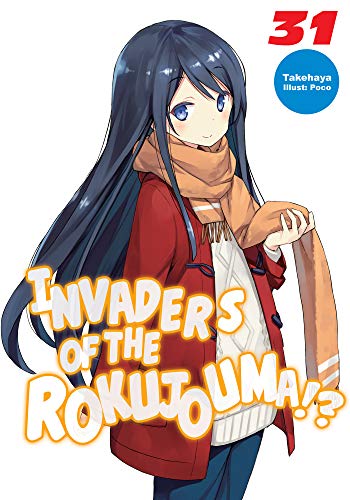
The half-novel is the first of the “what ifs” the author said he was doing, but it’s framed as also being canon – in the brief interval between when Koutarou and company bring Nalfa back to Room 106 and when she wipes everyone’s memories, the idea of alternate universes comes up. Koutarou was relieved to hear that there are universes where his mother is alive, and Nalfa offers to show him one of those in a dream. (Pointedly, we don’t see that world, possibly as I suspect it would be rather sweet but dull.) The girls all then realize they can look at a world where they won and Koutarou is their boyfriend, and after a jan-ken-pon competition, Harumi is the first to see what that life would be like. She ends up sort of providing color commentary on the dream world, which works because it’s her but I was relieved when the afterword said it would not continue after this.

The “Harumi wins” world is very similar to this one, oddly – it takes place over about the first 8-9 books, and the rest of the cast still arrive and are trying to get control of Room 106. They’re barely in the story, though, as here Koutarou is all about Harumi. Amusingly, it’s because their initial meeting went worse than in canon – when trying to pull away from the dude harassing her, she sprains her wrist and Koutarou has to give first aid. This allows two very hands-off people to touch earlier than usual, and everything springboards from there – Koutarou opens up to her faster, she realizes she’s in love faster, and they confess rapidly. That said, which that world’s Koutarou and Harumi are blissfully happy, OUR Harumi is dissatisfied. A life without the rest of the cast just isn’t the same, even if their real-life romance isn’t resolved. Another reminder that found family story beats sappy romance story.

In Vol. 33 we’ll apparently get Clan’s “what if” story next, but before that it’s back to the ongoing plot. Till then, enjoy this what if that also reminds you that the main plot is best.
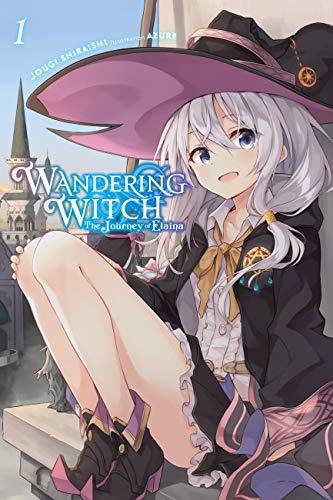
Wandering Witch: The Journey of Elaina, Vol. 1

By Jougi Shiraishi and Azure. Released in Japan as “Majo no Tabitabi” by GA Novels. Released in North America by Yen On. Translated by Nicole Wilder.

I suspected going in, judging by the blurb, that this would be less a light novel and more of a short story collection, and I was mostly correct. Elaina is our protagonist, and we do learn bits and pieces about her as the book goes on, but it’s clear the main thrust of the series is “Elaina goes to [X], events happen, Elaina leaves [X]. Which is fine, as some of the stories are quite good. The publisher did a good job not just giving in and calling it “Elaina’s Journey”, because yes, this does remind the reader of a certain motorcycle-riding protagonist we all know. Elaina’s short stories are less concerned with a moral than Kino’s, though – in fact, some of the weaker stories in this book come from when it does seem to try to awkwardly hammer home a “deep down we’re all the same” sort of lesson to be learned. Fortunately, Elaina is not really the sort to take in valuable lessons. She just wants to walk around.

As the title implies, Elaina is a young witch who is wandering around her world, which is one where witches are known and tolerated in most countries, visiting cities, towns and villages to take in what they’re like. As she does this, some of the places she goes are very entertaining and funny; some are rather creepy and horrific; and some are designed to tell us more about Elaina herself – in both flashbacks and the present day – to show us how she got to be a witch and why she’s so dedicated to wandering around and not staying longer than three days (again, does this sound familiar, Kino fans?). The supporting cast is pretty much zero; there is a recurring gag about a muscle-headed brother searching for his sister that pops up a few times, but that’s less for the character development and more for the gag.

Elaina herself is somewhat dry and frosty; at times the book can feel like a tsukkomi wandering the world of bokes. She used to be worse – one of the better stories involves us meeting her teacher when Elaina was an apprentice, and having the arrogance stripped out of her. Now she’s helpful… sometimes despite herself… but still seems removed from events, never getting too emotionally involved. Several stories here do not have happy endings, or end on a sad or scary note; we see Elaina leaving the country on her broom and never looking back. In the final story of the book, where the present-day Elaina meets her old teacher, there are hints that there’s more to Elaina than meets the eye (I’m curious about her mom as well), and I suspect we may find out she’s more important than she makes herself out to be.

As you’d expect given the format, the book is quite variable; some stories hit hard, some miss entirely. And, as I’ve hinted in the review, you do get the sense that the publisher would have been better off just license rescuing Kino’s Journey instead. But Wandering Witch is certainly an interesting journey in the end, and I enjoy Elaina’s matter-of-fact, slightly smug narrative voice. I’ll be looking for more of this.

The Rose of Versailles, Vol. 1

By Riyoko Ikeda. Released in Japan as “Versailles no Bara” by Shueisha, serialized in the magazine Margaret. Released in North America by Udon Entertainment. Translated by Mari Morimoto.

At last, one of the most iconic manga ever has reached the shores of North America. It’s been a long wait since the license was first announced, and I’m sure there are some asking whether it was worth it. I am here to tell you that yes, it was. The volume of Rose of Versailles I am holding in my hands (both hands, it’s quite heavy) is gorgeous, a hardcover with high-quality paper, the first of five omnibus volumes (the “Complete Edition” from Japan). The art is breathtaking – I normally read manga fairly quickly, but it took me days to get through this book, as I kept stopping every panel to look at some fresh new detail. The characters are all compelling and drive the story well, although I admit that I like some of them more than others. The dialogue is also fantastic and will make you go back and reread when you aren’t going back to reread because of the art. It’s just… really amazing, folks.

The story frames itself as being about three people born the same year: Hans Axel von Fersen, a Swedish prince; Oscar Francois de Jarjayes, a noblewoman raised as a man; and Marie Antoinette Josephe Jeanne de Lorraine D’Autriche, better known as just Marie Antoinette, future Queen of France. The first half of the volume is very much about Marie Antoinette in its entirety; Oscar is there, but as a mere supporting player, popping up to snark at the other nobles and then getting back to her job with the Royal Guards. We see Marie as a well-meaning but naive and gullible teenager, thrust into the spotlight far too soon, and later in the book this gets even worse when Louis XV dies and she becomes Queen. Oscar is there at timees to try to guide her towards being more mature, but is not very successful at it, mostly as there are any number of hangers-on who are trying to manipulate a lonely and innocent Queen. And then there’s Fersen, who arrives at court and falls deeply in love with Marie Antoinette.

This is soap opera, of course, but of the best kind – if you’re going to go big and overdramatic, the court of Louis XV and XVI is the place to do it. Marie Antoinette is both sympathetic and frustrating, and you can see how difficult it can be to do the right thing when you have so many people who are standing besides you “giving helpful advice”. There’s also a subplot involving a pair of poor sisters, Jeanne and Rosalie; one manipulates men to move up into nobility, the other ends up attached to Oscar after her mother is killed by a mysterious noblewoman. I was, I admit, less enamored of these two; Rosalie, in particular, can grate. And then there’s the art. Rose of Versailles is most familiar for its iconic shoujo poses, and those do look beautiful and dramatic, but there’s also lots of silliness as well, and much of the humor in the volume comes from over the top comedy reactions to everyone’s antics. (Oscar, in particular, gets some magnificent funny faces.)

I hope I don’t need to tell everyone that this is worth reading immediately. If you were beginning to despair worrying it would never come out, fear not; it’s here, and it’s magnificent. Immerse yourself in it.