Monthly Archives: February 2020

Sweat and Soap, Vol. 1

By Kintetsu Yamada. Released in Japan by Kodansha, serialization ongoing in the magazine Weekly Morning. Released in North America by Kodansha Comics. Translated by Matt Treyvaud.

I will note right off the bat that the lead couple get together very fast in this manga – which makes sense, as the first chapter was written as a one-shot. It’s also a good thing, because if this had been a slow-burner I might have dropped it. There’s a weird consent thing going on at the start, where Asako, the heroine, is clearly uncomfortable with the attention of Kotaro, but also finds him immediately attractive and magnetic. He’s also doing his best to hold back while also begging her “let me smell you every day!”. Fortunately, there’s a better reason in this manga than the usual one you’d expect. Also fortunately, once the manga settles in beyond one chapter it becomes less about smelling this woman’s natural body odor and more about a shy and awkward woman navigating her first romance, with all the highs and lows that this entails. It ended up being quite a sweet read… especially as it does end up doubling back and talking about when things are appropriate and wne they aren’t. Mostly.

Asako has grown up sweating a lot, which caused her to be a bit of an outcast as a kid, and now as an adult she still has the same issues. As a result, she’s happy to be working at Liliadrop, makers of soaps, toiletries, and other bath products that help her get through her day. Then one day she runs into the chief product developer… who can smell her natural scent. And really likes it. Like, really REALLY likes it. To a somewhat inappropriate level. Of course, he’s also attracted to her as a shy, sweet girl. And so, after saving her from a subway creeper, they go back to her place and make love. Now she has to negotiate this new relationship in reverse, getting to know Kotaro and finding boundaries where he can feel free to smell her but perhaps not when it’s too embarrassing. That said, he’s very popular at the company, so she chooses to hide their relationship for now. A choice she may regret…

I really liked the two leads, which was a bit of a surprise given one of them is introduced by “I’m not going to hurt you, I just want a good sniff”. But Kotaro is merely socially inept, and when he realizes how uncomfortable he’s making Asako, he backs off… mostly. Well, somewhat. Fortunately for the reader, the artist is good at drawing embarrassment, and Asako is very cute. The best chapter is the one where they go on a date, and we see a) Kotaro trying to stop himself smelling her in public, and consequently getting more and more uncomfortable, and b) Asako thinking this means he’s having a horrible time. In the end, it’s about good communication, as always. The manga is not that explicit, but it’s worth noting that there are a couple of sex scenes here… including the morning after where we see blood on Asako’s bedsheets, something not normally seen in titles like these.

So yes, there is a bit of fetishism here for the natural body odor of a woman. But come for that, and stay for the attractive leads and their adorable if hella embarrassing romance.

Konosuba: An Explosion on This Wonderful World!: Yunyun’s Turn

By Natsume Akatsuki and Kurone Mishima. Released in Japan as “Kono Subarashii Sekai ni Bakuen wo!” by Kadokawa Sneaker Bunko. Released in North America by Yen On. Translated by Kevin Steinbach.

I have to admit that I was less thrilled with the second volume of Megumin’s spinoff series. This is pretty much because the middle half of the book is filled with Zesta and Cecily, the two Axis Church members that we’ve seen in KonoSuba books 4 and 8. I don’t mind Aqua, mostly as she’s not a creeper, but the same cannot be said for the acolytes of her church. The running gag here is that, because the Axis Church basically has as its creed “do whatever the hell you want”, it tends to attract the wrong sort of people, and we see that here, played, of course, for comic effect. Zesta is infamous for his behavior, to the point that when he’s arrested and falsely accused of being a traitor to the human race, no one wants to bother to defend him. Cecily is also pretty bad, taking opportunities to feel Megumin up in the bath, etc. Fortunately, the first and last parts of the book are much better.

Despite the subtitle of the book, we do not get Yunyun’s narrative POV here, alas. Which makes sense, as the fun of Yunyun is watching her flail, not getting inside her head. That said, she does come off pretty well in this book. Following Megumin to Arcanletia because, well, because life without Megumin terrifies her, Yunyun as always tends to alternate the ‘sensible’ role with Megumin when the situation calls for it. The last quarter of the book shows the two on a carriage to Axel Town with a number of other people, and various monsters keep attacking the carriage. This leads to the funniest part of the book, as Megumin can’t use Explosion without hurting the other travelers, so ends up being pitied and looked down on by everyone else as Yunyun, who can use various magics, takes out all the monsters. Of course, at the end Megumin does end up showing off and regaining people’s respect – it’s her series, after all.

The plot, aside from shifting Megumin to Axel Town (the book ends right as the first in the main series begins – Megumin sees Kazuma and Aqua arrive in this world, though she resolves not to have anything to do with them), involves Chomusuke being sought after by a demon who is convinced (and not without good reasons, as readers of the main series will know) that Chomusuke is Lady Wollbach. Megumin, despite verbally not caring about Chomusuke, ends up defending her against this demon, despite also taking the cash offered to hand her over. (This is how the broke Megumin can finally afford to leave the village.) This, of course, sets up events in Book 9, which had not been released at the time this came out in Japan (this came out between Books 5 and 6). Again, seeing the contrast between Megumin’s seemingly blase attitude towards everyone and everything and her actual feelings deep down is the main reason to get these books.

So yes, I wish there had been less Axis Church, but overall this was still pretty good. Next volume likely will see things end up how they were at the start of the series proper – with Megumin and Yunyun separated, and Megumin meeting Kazuma and Aqua properly.

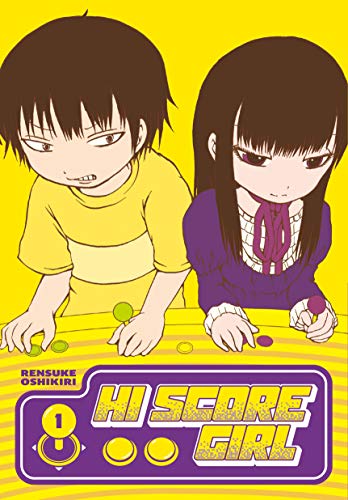
Hi Score Girl, Vol. 1

By Rensuke Oshikiri. Released in Japan by Square Enix, serialized in the magazine Big Gangan. Released in North America by Square Enix Manga. Translated by Alexander Keller-Nelson.

I admit that at first I did not get the double meaning in the title – before reading the manga, the reader might think that ‘Hi’ is a simple affectation, sort of like saying ‘U’ instead of you. But as you get to know the two leads, with each chapter beginning with Haruo running into Akira in one arcade store or another, you get the impression that it’s also meant to be “Hi, Score Girl!”. Because these two can’t get away from each other – at first by accident, and gradually as the book goes on by choice. They come from completely different backgrounds, but are united in their need to escape their daily lives, and also their skill in any number of games. What’s more, the series clearly takes place in 1991, and so this is also a massive nostalgia-fest for the games of that era – especially Street Fighter II. Those who read other manga (Hayate the Combat Butler) may be surprised that the titles and characters are uncensored. Well… there’s a lawsuit behind that. But it all worked out in the end.

Both kids are twelve years old, though the end of the volume implies there may be a small timeskip coming. Haruo is your standard loser kid with bad grades – in fact, ludicrously bad grades… given his skill at games and his excellent analysis of other people, I have to assume these zero tests are exaggerated for comic effect. Disliked by most of the class, his sole respite is the local arcade (yes, remember, it’s 1991… though he does have a small game system at home). There he plays games… mostly Street Fighter but you will see others as the volume goes on. And meets Akira, a rich girl in his class beloved by everyone. Why is she playing Street Fighter II? Why is she so GOOD at Street Fighter II? She’s not about to tell him, as she doesn’t speak. The manga is not clear about this, but I think it’s meant to be inferred that she CAN speak, but does not because that’s the way this manga rolls. That’s fine, for although she’s supposed to be a stoic little princess, Haruo brings out the worst in her… and also, eventually, the best.

The artstyle is a little odd, which lends itself well to amusing faces, especially from Haruo, who gets punched in the face, kicked in the balls, hit by a car multiple times… he’s basically there to get beat up. But he’s an understanding kid at heart, despite his jealousy about gaming scores, and rapidly understands that Akira’s intense drive to do arcade gaming masks a very lonely girl whose home life is pretty much rigid and arranged for her. The two slowly bond, as she brings him things from school when he’s home sick (and then plays on his home system) and the two are dragged with their classmates to an amusement park (and get so absorbed in games they lose everyone else… which, trust me, is a good thing). They even explore what turns out to be a haunted arcade. Sadly, by the end of the volume, just as we’re seeing burgeoning tween love, she’s moving to America, and flies away. But not before a tearful airport farewell. The end!

…OK, not the end, there are nine more volumes. The preview implies Haruo will move on to middle school (somehow… I assume you can’t get held back in elementary school) and meet a new girl who seems to really like him. That said, I assume Akira will be back. In the meantime, enjoy this sweet and funny ode to the arcade games of yore.