Monthly Archives: February 2020

Neon Genesis Evangelion: Anima, Vol. 2

By Ikuto Yamashita. Released in Japan as “Shin Seiki Evangelion Anima” by Kadokawa Shoten, serialized in the magazine Dengeki Hobby. Released in North America by Seven Seas. Translated by Nathan Collins. Adapted by Peter Adrian Behravesh.

It occurred to me as I was reading this second volume, and glancing at most of the color pages, that this was written to be serialized in Dengeki Hobby, a (now defunct) magazine devoted to fans of the plastic model kit. It therefore should come as no surprise to me that the book is a lot more concerned with the Evas and how they function than the inner workings of the actual cast. There are some moments where that’s not the case – Misato’s grief at Kaji’s fate here is well handled, as is her quick recovery, and Shinji’s raging grief in his attack near the end also rings true. But as I watched everything get worse and worse and worse, it occurred to me that the problem with this continuing on from the end of the original TV series is that there’s no way to back up and get much of what the start of the TV series had – fun. It’s a very interesting continuation, but it lacks joy.

Of course, there are very good reasons why fun is in short supply. This is an apocalypse narrative, continuing straight on from the first book, and there’s simply no time to settle down and have a penguin raiding your fridge. Shinji and Super Eva (I will never get used to that name) are trying to fight against a mind-controlled Hikari and her German Evangelion; Misato and Toji are trying to hold down the fort back at base, despite her getting kidnapped midway and his worrying about Hikari; the Reis are all dealing with the death of Cinq in various healthy and unhealthy ways, and Quatre is still a very troubled soul; Kaji stops Kensuke from putting on a possessed mask and losing his identity by… doing it first (yeah, I dunno either); we get the fabulous and somewhat bonkers adventures of Asuka… ON THE MOOOOOON!; and there are far, far more people turned into pillars of salt, to the point where you will get sick of the phrase.

Of these subplots, Asuka had my favorite, showing off a lot of smarts, gumption, and pure survival tactics. Despite this, she loses most of her hair and almost her existence; it takes Hikari and Shinji calling out to her to give her an identity again, and even then she’s… well, let’s leave that as a spoiler. Shinji, aside from his RAGE near the end, does not really get time to do much soul-searching as he’s constantly on the run and fighting; at one point he has Maya in his cockpit, and later on Rei Trois, but this Shinji is made of sterner stuff. Of course, he may have a few issues continuing on after the events in this book as well. And there is a LOT of apocalypse imagery – in addition to the pillars of salt, there’s ancient animals coming back to life and killing people, natural disasters killing people, the Lance of Longinus killing people… if you’re a resident of Earth in this book and aren’t part of the main cast, it doesn’t look good for you.

As I said, this book is quite interesting, and I do want to see what happens next – especially as they’re running out of disasters and we have three more books to go. But, as someone who never really cared about the giant robot battles in Evangelion, it can be a bit of a slog.
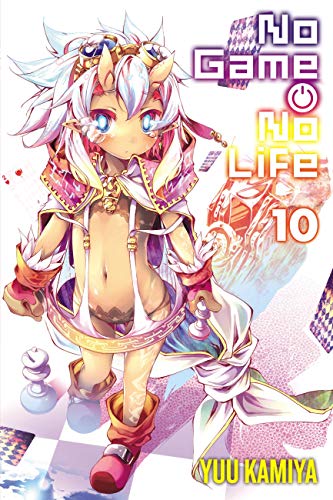
No Game No Life, Vol. 10

By Yuu Kamiya. Released in Japan by MF Bunko J. Released in North America by Yen On. Translated by Daniel Komen.

This volume begins with our heroes, [ ], having abdicated the throne (the country is now ruled by the business class, with Steph reduced to talking to potted plants – and Plum, who is about as helpful as one) and living life as sellers of medicine. In particular, their breast enhancer, although temporary, is quite popular. It also attracts the attention of the Dwarves, one of the few races we haven’t really dealt with yet, and they summon Sora and Shiro to their underground city to throw down. Fortunately, our heroes have a new dwarf ally, Tilvilg. Unfortunately, she lacks the natural genius ability that all dwarves have, and is somewhat beaten down that their answer to that seems to be “well, just keep trying anyway while we pity and belittle you”. Can Sora and Shiro show that her desire to see the sky is not merely a baseless fantasy? And, more importantly for the author, can they do it while throwing in so many references to boobs that the reader might throw up?

I will admit, when it comes to having your cake and eating it too, no one does it quite as well as Yuu Kamiya. This entire volume seems to be boob-obsessed, with both Chlammy (she and Fi are genuine allies in this book for once) and the dwarven leader Veig being particularly bad. And yet at the same time it goes out of its way to mock and belittle anyone who might have similar thoughts – Veig in particular dreams of the sort of pneumatic fantasy girl that only exists inside the head of virgins, something viciously pointed out by Sora. What’s more, his perverse behavior towards Tilvilg, which he brushes off as “I was drunk, it was a joke”, is noted to be “the top two excuses of male scum”. Kamiya fills his books with ludicrous and somewhat sickening fanservice… but also knows that’s all it is, and does not mistake it for anything else.

Steph does not have a large role in this book, but she is there, and her parts (as always) interested me the most. Once again, when asked to be a political thinker, she’s head and shoulders above the rest of the cast, and her confrontation with Emir-Einz, where she blackmails her into taking her to Sora and Shiro by threatening to disrupt the book’s fragile status quo, is brilliant. (It also shows that Steph is not as oblivious to her own feelings as it appears.) And, getting back to the book’s obsession with boobs once more, there’s a nice scene where Steph gets upset at the fact that Sora groped her when they first met, only for Jibril and Emir-Einz to call that “humblebragging”, pointing out to Steph that so far, of all the women in the entire series, Sora has only groped one by his own choice – her. The jealousy is searing.

In the end, of course, no one should be reading No Game No Life who is not already able to deal with its proclivities, and I’m not trying to say that they’re lessening – in fact, there was even more in this book. But the author is better at showing us the man behind the curtain, as we see that none of it really makes much of a difference in the end. This volume is about accepting your weaknesses, accepting that everyone is different, and going beyond the impossible. It’s also (not counting the unlicensed “Practical War Game” spinoff) the last book in the series to date, so we may have a while till we see Book 11.

Silver Spoon, Vol. 13

By Hiromu Arakawa. Released in Japan as “Gin no Saji” by Shogakukan, serialized in the magazine Weekly Shonen Sunday. Released in North America by Yen Press. Translated by Amanda Haley.

There’s always a careful balancing act that an author has to keep up when writing a character whose failures are hilarious. On the one hand, you can’t overegg the pudding – you need to contrast this hilarity with moments where they actually succeed. If done right, this can be extremely heartwarming. The first half of the manga deals with the equestrian competition, with Hachiken actually competing this time, and his “slow, steady and have fun” approach actually does pretty well, especially as it allows Mikage to dazzle. And of course the beauty of it is that it sets things up for the much larger stage where Hachiken again competes… and fails so badly that it turns into 20 pages of “lol”. You feel bad for him, but thinking as an author, the reason for this is obvious: Hachiken when he’s suffering is very, very funny. What’s more, there’s been less and less of that as he’s matured, so it’s nice to see he can still be a national laughingstock when appropriate.

Speaking of which, Hachiken, in his despair after doing so badly, wonders if Mikage won’t love him as he’s bad at horse racing. This is a callback to earlier in the book, when Mikage smiles as she recalls him saying he’ll ask her out after she passes her exams… then realizes that might mean if she fails, he won’t ask her out! Does he hate “stupid” girls? Now that the two of them have made it clear how they feel about each other, all that’s left is to actually get together. But it’s not as simple as that – they have goals to achieve first, Mikage’s father is watching Hachiken like a hawk, and his own father just seems to get in the way of any romantic resolution. What’s more, as the above jokes indicate, the two of them are still too insecure for a strong romantic relationship to happen. Mikage doesn’t need to pass her exams to date Hachiken – but it certainly would help her see herself as a success.

Elsewhere in the book, it’s pigs and pizza once again. I like the idea that the head of the school is willing to go the extra mile for these kids provided they can actually justify it as learning things and being educational. As a result – more pizza ovens! Which leads to a good competition where they try out various kinds of three-cheese pizza to see which one proves the most popular. Likewise, even in the midst of despair at his equestrian performance, he’s still able to do some pig research while in a different area of Japan (sadly, he finds that the pigs raised there would not do well in the northern climes of his school.) And, for once, there’s not even any long series of chapters devoted to butchering and slaughtering animals, so even the squeamish can enjoy this one.

We’re nearing the finish line for Silver Spoon, and I expect the next volume to mostly be about Mikage passing (or not) her exams. Will that also lead to romance? God, I hope so. I feel like Sakae – Just do it already!