Monthly Archives: February 2020

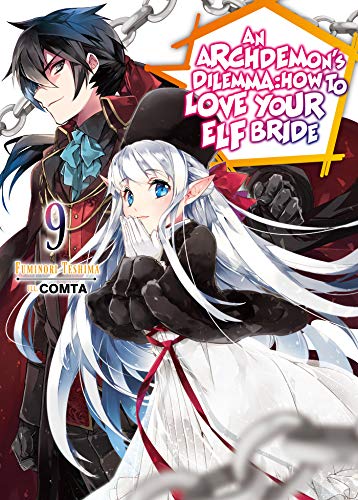
An Archdemon’s Dilemma: How to Love Your Elf Bride, Vol. 9

By Fuminori Teshima and COMTA. Released in Japan as “Maou no Ore ga Dorei Elf wo Yome ni Shitanda ga, Dou Medereba Ii?” by HJ Bunko. Released in North America digitally by J-Novel Club. Translated by Hikoki.

As this series has gone on and become a reasonable success, the author has sensibly decided to widen its brief. As such, the “will they actually do anything?” parts get smaller and less relevant as time goes on. This is not to say that they’re absent, however, and we do get possibly the funniest moment in this volume when Zagan thinks that he and Nephy are literally cursed to never get closer to each other rather than, as everyone else around them can see, just being two socially awkward dorks in love. Still, at least the two of them share a honeymoon suite. That’s progress? And they sleep in each other’s arms, and call each other (as they are under cover) as “honey” and “dear”. But yeah, that’s all you’re going to get. Honestly, even Chastille and Barbatos make more progress in this book than Zagan and Nephy, who are adorable but really should grow up the teensiest bit. That said, they’re ahead of Shax, Mr. “I had your underwear in my pocket for a reason”.
The main thrust of the plot sees everyone converging on the Holy City for various reasons. That’s where Azazel’s Staff is, which is highly important to every single faction in the series. So we get the Angelic Knights, who don’t know much about it but know it should not fall into the wrong hands; Bifrons and Shere Khan, who have sent two minions to destroy the holy treasure room to get it; and Zagan and Nephy, who are actually there to try to find Orias, who might be able to help her cure Kuroka’s blindness, but end up looking for the staff as well. As you might imagine, there’s a lot of fighting towards the end of the book, mostly involving everyone attacking Zagan and his mopping the floor with them. That said, in the final battle against one of the stronger Angelic Knights, he has to use martial arts, rather than sorcery, to win. He regards this as a loss. Everyone else thinks he’s simply ridiculously overpowered.

It is amusing to see how many of the characters are leading double lives. There’s a traitor among the Angelic Knights, and you might briefly be worried for Chastille, but everyone agrees her alliance with Zagan is far too open and honest; she’s not tricky enough to be the real traitor. Then there’s Michael, who is secretly an Archdemon, but is also not the actual traitor. We also continue to get more insight on Alshiera, who continues to stay true to the course of “blond underage vampire mistress” in modern Japanese works, i.e. she’s pretending to be an irredeemable bad guy but really fits the caring mentor role better. And props to Foll, who is growing powerful enough to take on Bifrons and deal him actual damage. Our little dragon girl is growing up.

We’ve now caught up with Japan, as the 10th volume came out there two weeks ago, so it might be a bit till we get it here. Till then, though, this is a good, solid entry in the series, provided you don’t care that Zagan and Nephy are the most awkward couple ever – still.
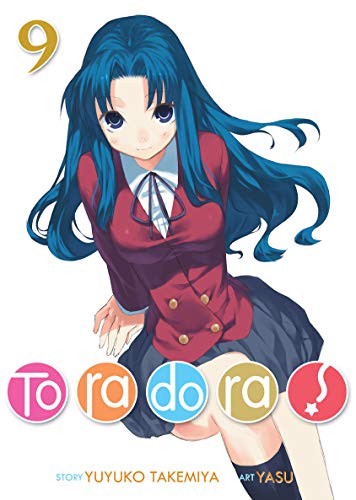
Toradora!, Vol. 9

By Yuyuko Takemiya and Yasu. Released in Japan by Dengeki Bunko. Released in North America by Seven Seas. Translated by Jan Cash & Vincent Castaneda. Adapted by Will Holcomb.

The character arc of Toradora! as a whole has generally been each of the characters trying to save each other from jumping off a cliff by jumping off the same cliff first, and that reaches a crescendo here, in a volume that might as well be called “Toradora!: Everyone Hates Themselves SO MUCH”. Ryuuji is the poster child here, of course, shouting into the void that no one will let him sacrifice his life and future. To be fair, he has very real concerns. His family are indeed poor, and his mother, despite being a comedy character for almost the entire series to date, is working herself sick so that he can have a better life. But his solution in the course of “realistic ideas” is stubborn, petulant and bad, and you want to strangle him. Things are not helped by Taiga being absent from the first part of the book, dealing with her own drama, which doesn’t become apparent till the climax. Hell, even Ami is super angsty here. Everyone wants to run away.

We’re back at school after the events of the last volume, but everything is not back to normal, no matter how much Ryuuji tries to make it happen. He’s having nightmares about Taiga dying at the ski slopes… while in class. The class is sympathetic, but this is a far cry from the Ryuuji of the start of the series. His main concern is the career survey he hasn’t turned in, though: he’s determined to get a job so that his mother can take it easy, and he might do college later. His mother is adamant that no, he will be doing college, even if she has to work a second job to earn more money. Taiga does eventually show up, having recovered from a head wound she got from her fall, but she too is reluctant to complete the career survey, and, when it’s eventually revealed that it was Ryuuji who saved her and heard her confession, shows she’s just as unable to deal with the fallout. The book ends with the two, confronted by their mothers, literally running away from everything.

As for the supporting cast, aside from one of Those Two Guys showing off he’s had a girlfriend all this time (which reads as somewhat out of nowhere), it’s all about Ami and Minori. Ami is almost as bad as our two leads in the “why am I so terrible?” sweepstakes, bemoaning that she let things like friendship stop her from transferring out like she planned to earlier in the year… and is now planning to do again, without confessing to Ryuuji or patching things up with Minori. As for Minori, she admits (in an extended rant while chasing Taiga) that she’s loved Ryuuji all this time, but that’s no excuse for Taiga to sacrifice everything for her. In fact, that’s the theme of the whole book: Self-sacrifice for the sake of others is painful and dumb.

The next book is the last in the main series (there are three side-story novels as well, but I wouldn’t hold my breath), and I’ve no doubt things will eventually work out. For now, though, enjoy everyone being very, very sad and flagellating themselves.

What’s Michael?: Fatcat Collection, Vol. 1

By Makoto Kobayashi. Released in Japan by Kodansha, serialized in the magazine Weekly Morning. Released in North America by Dark Horse, originally in six separate volumes. Translated by Dana Lewis, Toren Smith, Jeanne Sather, Alan Gleason, Hisashi Kotobuki, Lea Seidman, and Elin Winkler.

This is the first of two huge re-releases of Dark Horse’s What’s Michael? collections, this one containing the first six volumes. Despite that, it’s only 530 pages – they weren’t big volumes. They’re compiled as they were in the late 1990s, so don’t expect the book to read right-to-left or the missing chapters with violence and nudity to be put back in. That said, I’m not particularly concerned, as it allows this marvelous creation to come back into print after all this time. What’s Michael? is not only a joy to read if you love cats, but it’s also a wonderful experience for those who love its creator, Makoto Kobayashi. This is his most famous title, though Dark Horse did also try to publish his early 90s host club comedy Heba! Hello-chan (aka Club 9), which also desperately needs a re-release. Kobayashi’s cartoonish, rubbery humans are even more fun than his cartoonish, rubbery cats.

Michael is the titular cat, and is the sole recurring character in every chapter. The series has a sort of semi-continuity, in that there are a series of households, any one of which has Michael as their pet for the duration of the 6-page chapter. He doesn’t travel around from house to house – you’re just supposed to say “ah, this time it’s the young OL who owns him”, and then a new chapter happens and “ah, this time it’s the couple with the kid”, etc. Kobayashi picks the owners that best fit the mood of the chapter. Sometimes, although not nearly as often as its reputation suggests, we also see an “all-cat” chapter where Michael and other cats act like humans, as he’s interrogated by police, has a boxing match, etc. For the most part, however, Michael is a cat who acts like a cat here, albeit a cat who can be quite eccentric. Kobayashi has clearly enjoyed a lot of cat-watching creating this series, and owners will find much to identify with here.

There are a few running gags throughout the series, such as the tough guy yakuza who tries to hide how much he loves cats (his talk about the danger of the “Kodansha gang” reminded me of Pop Team Epic’s treatment of Takeshobo), and the burly guy who’s just trying to live a catless life but finds the neighborhood cats constantly wandering into his house to hang out with him. Reiko, the OL, is the most frequently seen owner, and with her Michael is one of about ten cats that she has, most of whom sleep on top of her and make it impossible for her to get a good night’s sleep. On the other hand, the married couple have Michael as a father with a wife and kid (an early chapter sees them buying a female kitten for Michael, and she grows up rapidly to fit the role). As I noted, the series is curated to be all-ages, with the possibly exception of one chapter where Michael ends up at what is clearly a cat brothel, but I think adults may find this funnier than kids for the most part.

I believe that Dark Horse released 11 volumes total, so the next collection should have the remaining five. They’re an absolute must get for cat lovers, and for those who want to experience the unique eccentricities of Makoto Kobayashi.