Monthly Archives: February 2020

Kokoro Connect: Step Time

By Sadanatsu Anda and Shiromizakana. Released in Japan by Famitsu Bunko. Released in North America by J-Novel Club. Translated by Molly Lee.

I get the feeling the author needed a break from the angst as much as the reader did. The last few regular volumes of Kokoro Connect have been rather excruciating, if well-written, and all signs point to the next two books coming up as being even worse. (There are some hints and foreshadinwg in this book as well, the only really serious moment in it.) As a result, even more than the last collection of Short Stories, Step Time allows us to relax and enjoy the cast being together without the threat of Heartseed hanging over them. It also allows the author to go back and take care of some business. Kokoro Connect began with the Cultural Research Club fully formed, our heroes all in it and friends with each other, and Iori and Inaba best friends. So here we get to see how that happened in the first place, in two stories which read like one part destiny to eight parts slice of life.

The book has four largish stories in it. The first, as I suggested, deals with how the CRC was first formed by their teacher (still a normal lazy teacher at this point) and Taichi and the rest talking and realizing they don’t share many interests and all want to be in different clubs anyway. That said, there’s clearly something about these five kids… it’s not the most subtle story in the world, but does a good job of showing why the CRC hang out with each other in the first place. It’s part of a mini-theme in this book of “don’t overanalyze things”, which brings us to the second story, where Inaba and Iori tell the CRC how they came to be friends. This is probably the strongest story in the book (the lack of Taichi POV helps), as Inaba’s natural grumpy cussedness hits up against Iori’s “I am already losing my ability to pretend” complexes and the two have to deal with a stalker of Iori’s.

The third story is also good, though you kind of want to take Kurihara and throw her into the nearest lake. She’s one of the group of girls in the class who aren’t Iori, Inaba or Yui, and she’s very frustrated at the fact that, although there are now three couples in their little group, none of them are having lovey lovey date time. As such, she and an enthusiastic Iori decide to have the three couples (Taichi x Inaba, Yui x Aoki, and that other girl x that other guy) do a triple date, supervised by Kurihara herself. The best part of this is Taichi and Inaba, who really are a terrific couple, as they find out. The last story focuses on Fujishima, who is once again brilliant at everything except ordinary social interaction, and her attempts to figure out why others in their school consider the CRC members “cool”. She’s joined by the two junior CRC menbers, Shino and Chihiro, both of whom are equally socially awkward. What follows is, again, “don’t overanalyze things”, with a healthy dose of Fujishima being oblivious to her own powers of attraction. (She also confirms she is bisexual, almost offhandedly.)

So again, if you love the cast but hate seeing them suffer, this is a terrific volume to pick up. And if you enjoy seeing them suffer… well, Volume 9 should be coming soon.

A Man & His Cat, Vol. 1

By Umi Sakurai. Released in Japan as “Ojisama to Neko” by Square Enix, serialization ongoing in the magazine Gangan Pixiv. Released in North America by Square Enix Manga. Translated by Taylor Engel.

There’s a new publisher in the North American market, and Square Enix Manga has chosen this series to be their debut. It’s a strong choice. The series hits on several popular manga genres, is heartwarming and touching without getting cloying, and is also one of those titles where pet owners will be nodding their heads in understanding and sympathy. Since it is a new publisher, I’ll briefly get into the technical details before starting the review. The book looks nice, with thicker cover stock than others, and good solid paper. There are color pages at the front and the back. The translation is fine, though be warned that one of the narrators is a cat, which means that there are lots of “inserting meow into every word” choices. This mirrors the Japanese, of course, but I know some people might find it aggravating. That said, the main reason anyone will be picking up and continuing to read this is the titular man and cat.

A cat, nearly one year old, sits unloved in a pet shop. He’s an exotic shorthair, and looks odd, so no one cares… plus he’s now too old. Into this shop comes Kaito, an old man who takes an immediate liking to this cat, who he buys and names Fukumaru. The man and the cat are both very lonely people through circumstance, and so bond almost immediately. The rest of the volume consists of glimpses into Kaito’s current and past life and amusing “this is what it is like to own a cat” stories. Fukumaru is very loving and hands-on for a cat, so the series ends up being full of heartwarming moments. Kaito’s friends and co-workers are also very nice, sweet people. There’s no real conflict beyond things like “will he be OK when I leave the house for the day”, but that’s fine, as this series gets by on pure heartwarming.

One thing I love about this title is its subtlety regarding Kaito’s life, which is still only somewhat sketched in. He’s an older gentleman, and we see a few flashbacks to him and his wife, where they discuss getting a cat. It’s never explicitly stated, but it’s very clear his wife has now passed away, which weighs heavily on him. A flashback suggests they knew each other from childhood, which makes it even more painful. Kaito seems to be a music teacher, and there are some lovely scenes of him playing the piano. But the kids he teaches note that he only played sad songs till recently (i.e. pre-cat), and he implies he has a love/hate relationship with his piano (and, inferred, his career in general.) Basically, while I definitely think people are buying this manga for the cat, the man gets just as much attention, and is fascinating.

This is definitely a title that “hits you in the feels”, and I think it’s a great choice for Square Enix to mark its debut. I highly look forward to the second volume.

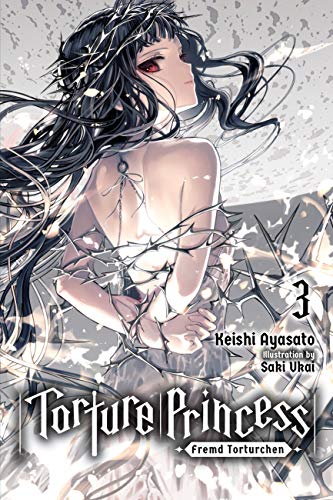
Torture Princess: Fremd Torturchen, Vol. 3

By Keishi Ayasato and Saki Ukai. Released in Japan as “Isekai Goumon Hime” by Media Factory. Released in North America Yen On. Translated by Nathaniel Hiroshi Thrasher.

Given how many of the villains were dispatched in the last book, it should come as no surprise to find that Elisabeth and Kaito finish off her task by the end of this book. The twelve villains she was ordered by the Church to destroy are, more or less, destroyed. Of course, that means that it’s her turn to be executed next. And therefore this is the final volume. Bye, everyone!… wait, no, of course it isn’t. There’s always an out, and the author is now describing the book as the end of the first arc. But what do you do when you’ve killed off the bad guys? Simple, have ma new bad guy for everyone to fear, twice as mean and terrifying, and set Elisabeth out to destroy him! Of course, there is one slight problem, which is who the villain actually is. (It should not be hard to figure this out.) It’s a very clever and also very foolish plot.

This book takes place in the capitol, and as such the cast expands greatly, though really there’s only one name we need to remember. The various knights and paladins of the church are doing their best, but in the end this is something that mercy and compassion are a bad fit for. Izabella in particular is so pure and shiny that she no doubt will be a powerful antagonist in future volumes (she’s the name to remember). In case you were worried that there would not be descriptions of horrific graphical body horror, torture and fates worse than death, fear not, they’re here in abundance – one featuring a children’s theater was particularly horrible. But then you get a fantastic line of dialogue, or an evocative description, or even just Elisabeth briefly turning into Teru from Dengeki Daisy and demanding Kaito go bald, there’s always a new element to remind you why you’re reading this series. (If you are reading this series just for the gore, good for you, and also you may want to visit some other blog.)

And then there’s Hina, who is only in one or two scenes in the book, but they’re so memorable they threaten to overshadow everything else. (That said, props to “The Butcher”, who remains ridiculous in the extreme.) Still in a coma for the majority of the book, she literally dive bombs into the final battle, declaring her love for Kaito as loud as a ball-jointed doll possibly can, and their reunion is actually really sweet. What follows is also the funniest point of the book, where Hina says she loves him even though they can’t have kids, and Elisabeth explains how they CAN have kids – even if the act she’s describing makes her blush. As I said in the other reviews, fans of Rem from Re: ZERO may as well start reading this, because you’re not getting more of her in the main series right now and this Rem actually gets the guy.

And so, at the end of the book, Elisabeth sets out to execute this new villain, Kaito and Hina are reunited and possibly making babies (though I doubt it, honestly), and Torture Princess remains a fantastic read, despite all the gore and torture. For those with strong stomachs, absolutely recommended.