Monthly Archives: May 2020

Baccano!: 2002 [Side B]: Blood Sabbath

By Ryohgo Narita and Katsumi Enami. Released in Japan by Dengeki Bunko. Released in North America by Yen On. Translated by Taylor Engel.

I’ve talked before about the Japanese tendency to write the blackest of black villains, so evil and horrible that it ends up being absolutely fine when our heroes kill them off in morally questionable ways. In general, I’m not a fan of these, and tend to prefer more nuanced or morally grey types. That said, I have to admit, Narita writes these sorts of people better than most light novel authors. We get two classic examples here, but one’s a spoiler, so I’ll talk about the other. Bride is the leader of SAMPLE, a thoroughly disturbing religious cult descended from the same cult that tortured Elmer when he was a kid. Bride is abusing children, mentally breaking and drugging a woman (investigating them undercover) into submission, killing large numbers of people, and being gleeful about it the entire time. But he’s sort of horrifyingly fun. Possibly as the book avoids the rape threats so many other authors would throw in (Bride makes a comedic play at his drugged wife, but this seems staged.) He also contrasts with the other villain of the book, who is… less fun.

The first half of this book takes place on Exit, the ship going from Japan to New York, and the sister ship to the one Firo and company are on. Elmer, Sylvie, Nile and Denkurou (who gets his first significant role here, though to be honest he doesn’t do much except moon over Sylvie) are invited, supposedly by Huey, to the ship, and they all go because if they don’t, Huey would arrange it so they do anyway. There they don’t find Huey, but they do find the Mask Makers, who are also on the other ship, who have a plan to get revenge for a killing that happened 300 years earlier by capturing Elmer. And the passengers also include SAMPLE, Bride’s religious cult, who are there for Sylvie. As for Isaac and Miria… well, they still aren’t here, they’re back in New York. Which is probably why everything starts to go wrong for everyone on both ships. Even Firo, who tries to look cool in front of his family, does not really succeed.

Speaking of spoilers, there is a question about how much constitutes one. This series, after all, is mostly read by fans who have already spoiled themselves on this book and future ones. And indeed we get a big spoiler for (one assumes) future books given to us as part of the plot early on here: the Mask makers are supposedly getting revenge on Huey for killing Monica 300 years prior, which might come as a surprise to those who read the 1705 book. That said, it’s possible that the reader will be more distracted by the end of the book, which reveals who the real Big Bad of the entire Baccano! series is… and it’s someone that we thought had already been dealt with. Interlocking and interconnecting plots and characters are how Narita writes, but this particular book works very well at making you want to go back and read some passages in older books while also making you anxious for the next ones.

So a much better book than the first part, as is typical with Narita two-parters. Bobby is still annoying, though. So, next do we go back to 1710 to see the tragic fates revealed in this book? Or do we continue in the 21st century to see how Czes and his family deal with this new and horrifying threat? Of course not, that would be too easy. No, next time it’s 1931, as we go back to the Flying Pussyfoot and the immediate aftermath, in a plot that might seem very familiar to those who saw Baccano’s 3 OAV episodes…
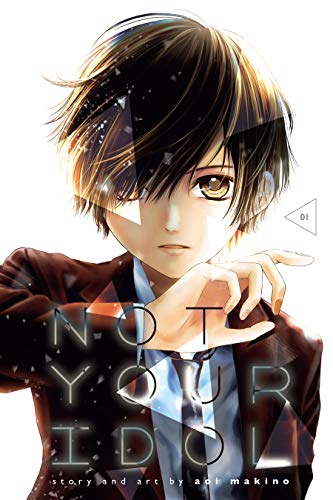
Not Your Idol, Vol. 1

By Aoi Makino. Released in Japan as “Sayonara Miniskirt” by Shueisha, serialization ongoing in the magazine Ribon. Released in North America by Viz Media. Translated by Tetsuichiro Miyaki. Adapted by Nancy Thistlethwaite.

This is one of Viz Media’s strongest debuts in some time, and it’s taken me a while to find a way to put down some words and review it. There’s a number of reasons for that. It’s a strong debut but it’s not a fun book – this book wants to deliberately make you uncomfortable and challenge traditional views on things. It looks at idol culture and the obsessiveness of their fans, about reaching out to accept help and how that can be both a good thing and also a bad thing; about fighting back against the everyday sexism in the lives of women and why some choose not to. There’s a lot going on here, including some things that (possibly) spoil the entire book that I am going to do my best to dance around. In the end, though, this is a book that grabs you by the collar and rips your face towards the pages. I’m not sure I enjoyed it, but I really liked it.

Nina Kamiyama is a brooding, quiet high school student who dresses in the male uniform, and is immediately contrasted with the rest of her classmates discussing things like how good their legs look in skirts. We also meet Hikaru, a young man in the judo club who seems to be the only guy in their class who’s not turned off by Nina. Things come to a head when the teacher announces that someone is assaulting girls around their school area, so everyone should go home in groups. Of course, Nina is a loner, and also does not want to show any weakness, so she goes home by herself, despite clearly dealing with some past trauma. She is then confronted by Hikaru, who knows her secret: she’s Karen Amamiya, former member of a top idol group who retired after being knifed by a stalker at an event. He admits that his younger sister was sexually assaulted by a teacher, and that she became a fan of Karen’s idol group because they said it was “OK to be a girl”. Slowly Nina and Hikaru grow closer… but is that what’s really going on?

I don’t usually post pictures of panels in my reviews, which is a shame, as there’s lots of terrific ones here. Nina leaping on a desk to grab some jerk’s school tie, saying “girls don’t dress to please guys like you”. Nina and Hikaru helping a shy classmate when she’s groped by a stalker on a train. The entire last few pages of this volume. It’s not shying away from problematic behavior, from both boys and girls, and contrasts Nina heavily with the cute, bubbly Miku, who is everything stereotypically feminine. Nina is also in touch with her former idol group, and we learn how they’re struggling to keep popularity now that Karen has retired… and we also hear from her friend Sara that Karen was too good at suppressing her emotions and being “inhuman”. All this culminates in the climax to the book, which again I won’t spoil, but shows us everything we’ve learned about a character to date and makes us question it.

After finishing the book, I was on the fence about whether I really wanted to read more. I’ve since come around. I want to find out what happens next. I hope you do as well.

Konosuba: God’s Blessing on This Wonderful World!: The Arch-Wizard’s Little Sister

By Natsume Akatsuki and Kurone Mishima. Released in Japan as “Kono Subarashii Sekai ni Shukufuku o!” by Kadokawa Sneaker Bunko. Released in North America by Yen On. Translated by Kevin Steinbach.

I recently reviewed the third volume of Combatants Will Be Dispatched!, by the same author, and noted the difference between that series and KonoSuba is that KonoSuba has heart. Which is true, as the latter half of this book shows. But to get there we have to get through the first half of this book. And it’s a good reminder that, while the cast of KonoSuba are nice and sweet compared to the sociopaths of Combatants Will Be Dispatched!, they are still quite horrible people overall. No one exemplifies this more than Kazuma, who after the last volume is spending his days lazing around the castle being waited on by servants and corrupting the princess (no, not like that, fortunately – she’s just talking casually now). After finally being thrown out, he then has to get back into his own mansion, as he’s been locked out by a thoroughly pissed-off Aqua. It’s only when Megumin’s sister Komekko shows up that the cast remember that they’re badass and also not terrible.

In a nod to the overall plot, Komekko is brought to Axel because Megumin’s village is under attack by the Demon Lord’s forces, which has led to their home being destroyed. so “those two girls” (in a nod to the trope, Megumin can’t remember their names, and to be honest neither can I) drop Komekko off to be looked after by Megumin while the Crimson Magic Clan strikes back and also cleans up. Komekko’s quite happy with this, as everyone and their brother is feeding her. She’s also happy because Megumin has been writing her letters about how AWESOME she and everyone else in Axel is, and she wants to find out about this first-hand. Given that, for once, Kazuma and company are reasonably well-liked by the town, the other adventurers are willing to go along with Megumin’s exaggerated letters. In fact, the guild decides to take advantage of this. A lot.

Everyone here gets their moments to shine and also their moments to be humiliated, in the best KonoSuba way. The exception is Komekko, who plays everyone like a fiddle and will likely be far more powerful than Megumin when she grows up. Darkness comes off worst, as she’s still hamstrung by having to be the sensible one, with her perverse moments kept to a minimum. As for Megumin, much to the surprise of Kazuma (and the reader), she is not going to let him forget her confession from the end of the 9th book – she repeats it, and then says she’d like to be “more than friends but less than lovers”. It’s a great scene, and Kazuma responds to it (for him) relatively seriously. Of course, it’s then undercut immediately, because no one does that better than KonoSuba – Komekko heard this confession and tells everybody, leading to a hilarious final scene.

As this point Kazuma/Megumin seems to be set in stone… though the cliffhanger may bring fresh chaos. Darkness has a kid? Is she a child from the future? (Probably not). In any case, this was an enjoyable book, once I got past the obligatory “sixty or so pages of Kazuma being a scumbag” parts.