Monthly Archives: May 2020

BL Metamorphosis, Vol. 1

By Kaori Tsurutani. Released in Japan as “Metamorphose no Engawa” by Kadokawa Shoten, serialization ongoing in the magazine Comic Newtype. Released in North America by Seven Seas. Translated by Jocelyne Allen. Adapted by Ysabet MacFarlane.

In troubled times, sometimes you just want to read something that puts a smile on your face and a song in your heart. Slice-of-life series can be all kinds of things, and this story of an old woman bonding with a teenager over BL manga fits perfectly. Ichinoi teaches calligraphy classes at her home, and is alone now that her husband has passed away. One day, the cafe she goes to closes down so she’s forced to go further into town, where she goes into a bookstore to cool off. Startled by how much of the store is now devoted to manga, she’s taken by a book with gorgeous artwork. She buys it, startling the bookstore clerk, Urara, because the book is BL – something Ichinoi is unaware of till she reads it later at home. That said, the love story within intrigues her, and she goes back to the bookstore for more – sparking a friendship with Urara.
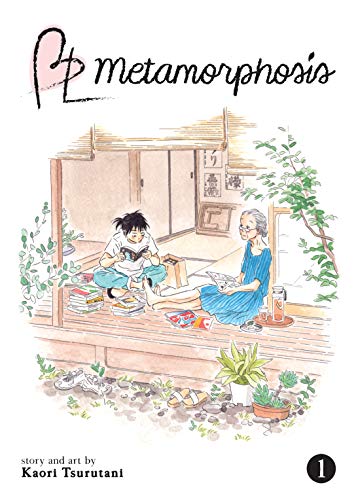
The balance between the new friendship slice-of-life and the BL manga that connects the two is perfectly done. Ichinoi does not have a life that is wanting by any means, but she’s feeling lonely, and enjoys talking about the books with Urara. Urara is the sort of teen I’d describe as ‘naturally sullen”, and has trouble connecting with kids her own age, all of whom seem more together than she is. Discussing the books that Ichinoi is buying helps to break the ice, and Ichinoi is also a natural-born friend-maker, which Urara is very much not. By the end, they’re even going to a writer signing event, though the size of the event proves to be a surprise. It’s a very natural, well-paced budding friendship between two women with 50 years between them.

There is also discussion of the BL manga itself. Ichinoi last read manga back in the Aim for the Ace! days (1970s), so was unprepared for the BL relationship in the book she bought, but she immediately gets into the series. We see occasional pages from the series, showing a not-quite couple, both of whom seem to be bad at communicating their true feelings – one bright and outgoing, one inward and moody. The series is only three volumes long, and it only comes out every 18 months, so for Ichinoi there’s a very real worry she won’t live to see the end of it. The manga ties in with the protagonists’ lives so that it seems natural, and doesn’t overwhelm the day-to-day stuff (such as Urara’s crush on her childhood friend, which isn’t going anywhere as he’s dating someone else.

In the end, this is simply a terrific story, and I really want to see these two hang out and talk about BL manga or anything else they choose to. I’d also like to see more of their pasts – we see Urara had another childhood friend who’s no longer in her orbit, and the final chapter shows Ichinoi approaching a building (for the author signing) her husband wanted to take her to the top of but they never did. Absolutely recommended, whether you like BL or not.
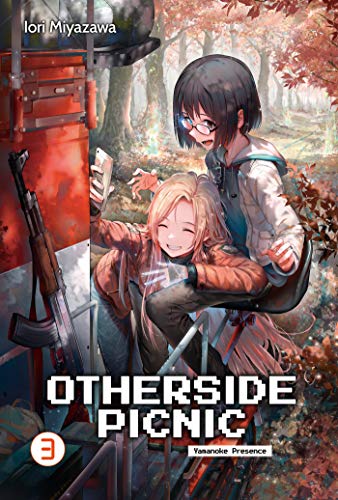
Otherside Picnic, Vol. 3

By Iori Miyazawa and shirakaba. Released in Japan as “Urasekai Picnic” by Hayakawa Bunko JA. Released in North America by J-Novel Club. Translated by Sean McCann.

I’ve talked before about how this book is well served by the fact that Sorawo is our narrative voice. This means, of course, that we see what she thinks of Toriko’s words and actions, but don’t get Toriko’s own POV in reverse. The fun part lies when the reader is able to infer what Sorawo isn’t. Certainly Sorawo is correct that Toriko is obsessed with finding Satsuki, but she seems to equate that with a romantic longing, and on our end we’re not so sure. More to the point, Sorawo can be very savvy in some ways and not in others – there’s a scene where Toriko mentions the fact that she was brought up by two mothers, and it’s very clear she’s dropped this information on Sorawo to see how she’s going to react… because of course Toriko is in love with Sorawo, something that has been clear for some time but is increasingly textual as the book goes on. It’s good characterization, and the narrative POV helps sell it.

There’s three main stories in this volume. In the first, Toriko and Sorawo go back to the other world and try going in a different direction, but their rooftop picnic (love the idea of an actual picnic in this book) is interrupted by some time-stretching shenanigans and the ominous presence of Satsuki, who is invisible to Toriko but very visible – and terrifying – to Sorawo. The second story sees the return of Sorawo’s kohai Akari, who Sorawo continues to be wary and uncomfortable with, and Akari’s childhood friend Natsumi, who has unfortunately not done as the creepy urban legend told her to, and is suffering as a result. Finally, Sorawo and Kozakura are kidnapped by a cult, whose leader has a voice much like Toriko’s hand and Sorawo’s eye, and said leader really, really wants to meet Satsuki. Unfortunately for all concerned, she does.

I will admit, the actual urban legends/ghost stories presented here did not ring a bell for me, nor are they really supposed to for Japanese readers, I think, despite all the documentation of 20-year-old 2chan threads in the book’s appendix. Indeed, Sorawo makes an important distinction here, as she hates “I know a guy who this happened to” stories, which are far more likely to be made up, and looks for real “this happened to me personally” legends. As with the second volume, the scarier stuff is at the back half here, though those with teeth phobias may wince at the second story. This includes Sorawo herself, who upon being kidnapped and locked up brings to the fore another part of herself only concerned with survival (though honestly, there’s not much difference between this and her normal self, IMO – I think a lot of it may simply be her psyching herself up.) The climax of the book leaves one dead, one maimed, and one big Satsuki problem that still isn’t going away, but at least our heroines are OK.

This is getting an anime soon, apparently, and it will be interesting to see how they convey some of the concepts here – a lot of the horror themes work best on the page. As for this volume, it’s another strong one in the series, and I look forward to the fourth one, if only to see how – or if – Sorawo responds to Toriko’s words at the end.

Infinite Dendrogram: The Glory Selecter

By Sakon Kaidou and Taiki. Released in Japan by HJ Bunko. Released in North America by J-Novel Club. Translated by Andrew Hodgson.

Since my last review, the Dendro anime has come and gone… and probably best not to speak of it again. Hopefully it’s not a franchise killer like Index III. The novels are still ongoing, though, and this one is a prequel taking place before Ray enters the game. The mysterious admins behind the game are all based around Alice in Wonderland names, and the one called Jabberwock wants to create stronger players with the Superior designation. As such, he unleashes a nightmarish nearly impossible to kill dragon with multiple heads and sets it on poor Altar (this is another volume that shows us why the Kingdom was on its last legs when Ray arrived). Some incredibly powerful and cool folks go up against it… and fail horribly. So it’s up to Figaro (who wants revenge for his friend), Tsukuyo (who just wants to have fun) and Shu (who is a little more pissed off than we normally see him, and takes off the animal suits for the big battle) to save the day. The result is a good book… if you like battles.

We do meet another strong and briefly interesting character at the start of the book. Foltesla, the King of Swords and leader of a powerful battle group, is a player who is very invested in the game, loves to duel with Figaro (who also gets some backstory here, explaining why he’s always a solo player), and has a lovely NPC wife. Every single thing about him screams tragedy, and sure enough, that’s what happens, to the point where honestly it almost swamped the rest of the book for me. I don’t doubt he’ll eventually come back… there’s too much time devoted to him not to… but it does remind me once more that there are a luge number of books that involve “the NPCs are more real than we’d thought”. Sword Art Online Progressive has it as almost its entire plot, and Dendrogram also hammers on it. Figuring out what’s different about this game is part of the fun of reading it.

The battles are usually also part of the fun, and there are some good moments here, particularly involving the “King of Crime”,but it has to be said that there’s a lot of “hope you love gaming stats” talk here. Dendro is better than some at blending this with the actual prose, but when so much of the book is devoted to one battle against one giant monster, it can be a bit boring for those who aren’t stat heads. It doesn’t help that the outcome of the battle is not really in doubt… we know given that there are three lines of defense (Figaro, Tsukuyo and Shu) that all three will eventually have to fight, and we know that anyone else who tries to fight is going to end up vaporized. Also, the book really wants the dragon to talk, but it can’t, so the author tries to give the dragon dialogue it would have said if it did talk, and… it’s as awkward as it sounds.

So it’s a middling book in the series, one that unfortunately made me remember the tragedy rather than the triumph. Can we get back to the main plot next time?