Monthly Archives: June 2020

Strike the Blood, Vol. 15

By Gakuto Mikumo and Manyako. Released in Japan by Dengeki Bunko. Released in North America by Yen On. Translated by Jeremiah Bourque.

I’ve often talked with this series about how it feels slightly fake, how it’s written by a computer, and how it was written not as a story in and of itself but a story to become an anime. All these are still true. But that doesn’t mean it’s bad, and sometimes, when the computer writing it has a particularly good bunch of data to work with, it ends up with a really, really good book. Such a book is the 15th volume, which might as well be called Strike The Blood: The Movie. It’s the longest book in the series to date by far, and that seems appropriate given the subject matter: the secret cabal that runs the world (yeah, I know, I know…) has decided that too many dangerous things are going on on Itogami Island and, more importantly, too many dangerous people are there, including Kojou. So they’ve sent in a fleet of magic battleships and airships to destroy the island and everyone on it.

The author calls this book the “end of Part One”, and you can see why. There’s a lot of big, plot moving things going on here. Nagisa finally discovers the truth about her brother, though her reaction to all of this will have to wait for next time, as she’s also nearly killed due to the other soul inside her. Kojou finally manages to control his beast vassals and also get all of them, meaning he’s now come into his own as the Fourth Primogenitor. He also publicly declares that Itogami Island is his “territory”, putting it in a class of nations that cannot simply be wiped off the map because they’re inconvenient. And oh yes, Asagi and Vattler join forces to declare war on the people declaring war on them, a pairing so unlikely that everyone and their brother boggles at it.

Why is Asagi doing this? Well, we find out in a great fight scene between her and Yukina, which I wish had been longer. Yukina is fighting to protect Kojou, the Fourth Primogenitor who is using his great power to save others and will one day be the most powerful force in the world. Asagi is fighting to protect Kojou, the high school kid and her friend/crush, who she wants to continue to have SOME semblance of a normal life. As you might expect, they both have valid points but Yukina’s are more valid. You can’t walk back what Kojou is now (though we do get an amusing epilogue where he’s forced to do makeup homework because he missed a month of class negotiating peace treaties). As for Vattler, it will come as no surprise to regular readers to find out he was behind all this, but I was surprised at the eventual outcome of his fight with Kojou. Which is about the 13th major fight Kojou gets into in this book, which is filled with old cast members returning once more.

The series just ended in Japan at 22 volumes, so Part Two, whatever it is, is not going to be as long as Part One was. And for those waiting to see who wins the “harem” wars, La Folia points out what is likely going to be the obvious solution, though that may simply be because it benefits her most. In the meantime, Strike the Blood remains shallow fun, and this book is particularly fun.

Owarimonogatari: End Tale, Part 02

By NISIOISIN and VOFAN. Released in Japan by Kodansha BOX. Released in North America by Vertical, Inc. Translated by Ko Ransom.

We saw Nisioisin in the last book begin to get ready to wrap the series up (which, spoiling you, he absolutely did not do) and tell the stories that he’d been skipping around and only hinting at: the first appearance of Ogi Oshino and the story of why Araragi got so broken before the start of the series, i.e. the story of Oikura Sodachi. He’s just about ready to finish up by telling us what happened after Gaen literally killed Araragi and sent him to hell at the end of Koyomimonogatari. However, there’s another story that got too big to tell – he says in the afterword it was supposed to be part of the other two “August” Araragi-narrated books, Kabukimonogatari and Onimonogatari, but there simply wasn’t room. And so we get Shinobu Mail, a story big enough to get a volume to itself. It’s ‘mail’ as in armor, and is Shinobu-focused, but also has a heaping helping of Kanbaru, who’s had very little to do since her own narrated book.

Gaen is on the cover along with Shinobu, and she’s also in this book a fair amount. Which may be surprising, given it’s also loaded with Kanbaru, but Gaen solves the problem by simply lying through her teeth about who she is, and Kanbaru, while not dumb, is straightforward enough not to question it. Gaen is here – along with Episode, who hasn’t really had much of a role in the series since Kizumonogatari – to deal with a part of Shinobu’s past that has shown up. Her first thrall, Seishiro, who we had been told (by her) had killed himself rather than be a vampire with here, has managed, after 400 years, to reconstitute himself – killing yourself when you’re Kissshot’s thrall is HARD – and wants to roam the world with Shinobu again. And if that means killing Araragi by fair means or foul, welp, those are the breaks.

This is a particularly well-written book in the series. Araragi and Kanbaru’s long, long, LONG dialogue at the start shows how much she was missed, and also how close the series gets to lowbrow humor. Things aren’t helped by Araragi, in what is meant to be the coolest line in the book, tell Gaen that he knows that both Senjogahara and Hanekawa would understand – he’ll happily leave them to save themselves to rescue a little girl. On the bright side, though she doesn’t actually appear in person, we get another terrific conversation between Araragi and Senjogahara, this one meant to parallel the thoughts that he’s been having about him and Shinobu. Senjogahara, despite admitting that if a man better than him came along she would absolutely dump him, knows exactly what he wants to hear, and it’s actually very romantic. As for the resolution, it’s very appropriate to Araragi.

The whole book is framed as a conversation Araragi has with Ogi right before he leaves for his exams – a trip we already know ends in his death. It feels like all the dots have now been connected. Is his death permanent? Well, we’ll find out next time with the last of the End Tales. Till then, this is a strong volume in the series, especially for Shinobu and Kanbaru fans.

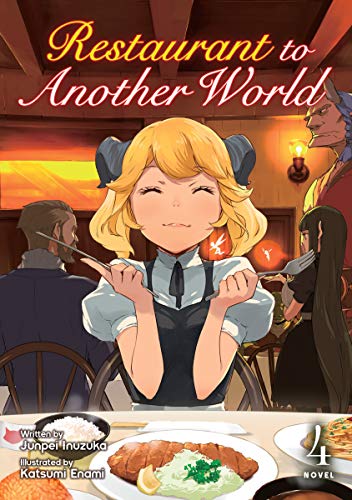
Restaurant to Another World, Vol. 4

By Junpei Inuzuka and Katsumi Enami. Released in Japan as “Isekai Shokudou” by Shufunotomosha. Released in North America by Seven Seas. Translated by Elliot Ryouga. Adapted by Nino Cipri.

This sat in my queue for a while, not because I don’t enjoy it, but because I know reviewing it will always be hard, as it’s 75% loving descriptions of food. We get rice burgers, French onion soup, Oyakodon, Peperoncino and potato chips, and trust me, they’re all described so that you immediately want to make the meal yourself. Sadly, there aren’t recipes included in these books the way you see with a lot of cooking manga (perhaps the manga version will add them?). In terms of the restaurant itself, the biggest development is that Aletta gets a raise, as she’s now been there for one year. That said, there’s a lot of development on the other side of the door in terms of worldbuilding. Indeed, we finally get the origin story for the doors, and it shows a tie between both worlds that is both surprising and obvious at the same time. Turns out it runs in the family.

This isn’t to say that we don’t get glimpses of the future as well. One of the book’;s more annoying but tolerable habits is to show a character won over by something the restaurant is serving and think about how to create it in their world, followed by a caption talking about how in a hundred years’ time, their names would be legendary in terms of achieving the objective. The fantasy world may lack preservatives, but it’s making do, and finding ways to at least come close to things that the restaurant can serve. There’s also more discussion of half-elf prejudice – we’ve seen this discussed before, but here we get it starkly laid out, as by chance one girl in a village born to two half-elfs is a “changeling” – essentially meaning she develops in elf terms. This leads to her being abandoned by the village for being “slow”, when in reality it’s more she’s still a baby. Fortunately, she gets rescued and apprenticed.

The book jumps around more than usual – there’s several chapters with the previous generation at the restaurant, and the prologue and final chapters deal with the generation before that. It turns out that Yomi, one of the saviors of the world from ancient times, was essentially blown up into our dimension, and ended up being found by the current manager’s grandfather. Them marrying is what led to the restaurant and the special relationship it has with her old world. Her husband has passed on, but she’s still around, and shows up at the final chapter to give her grandson the “master key” – in essence, showing she trusts that he can handle everything going forward. It’s not a “I’m about to die” sort of scene, but reads more as a passing of the torch – indeed, she reads like a tough old grandma, and even meets up with one of her old compatriots, now also an old man.

So another solid entry in the series, though as noted you’d better love descriptions of food. Fans should be quite hungry – I mean, happy.