Monthly Archives: June 2020

Kobold King, Vol. 2

By Syousa. and sime. Released in Japan by Legend Novels (Kodansha). Released in North America by J-Novel Club. Translated by Amy Osteraas.

First things first: aside from the very start of this book, it is entirely devoted to warfare, with a large group of adventurers, mercenaries and soldiers marching to wipe out the Kobolds and their allies, and our heroes essentially turning into a jungle-based terrorist group to stop them. If this doesn’t interest you, you are not going to get much out of this book, as the brief characterization we had in Book 1 is left behind for the most part in favor of battle scenes. The good news is that the battle scenes are quite well written, and there’s a definite sense of tension to the whole book. Having killed off one of the main characters in the first volume, the reader is under the assumption that no one is safe. Indeed, while I wasn’t expecting the bad guys to win, I did start to suspect it would be a pyrrhic victory where most of the main cast sacrifice themselves. It comes close. That said, this is marked the end of the first “arc”, so presumably more books are coming.

On one side we have the evil obsessed Wyatt and his suit of magical armor, determined to destroy absolutely everyone on the Kobold side, especially Gaius. He’s attracted most of his force by offer of a large reward, but some others (the ones who were there the first time) he has to blackmail. The force itself is quite well divided between men and women, actually, which surprised and pleased me. Of course, this means that both men and women get their skulls caved in, hearts torn out and heads chopped off, because the mercenary force runs into Gaius and Sashalia’s Kobold guerrilla fighters. They have a force far, far smaller than the army’s, but are fighting for both survival and to make the other side give up and say it’s not worth the trouble. To that end, the Kobolds put out endless dangerous traps, use dirty and underhanded fighting tactics, and also have Gaius, who can kill dozens on his own. All this coordinated by Sashalia, who can no longer fight but can still be a tactician.

While I enjoyed this book, there’s not really much to say about it because it’s almost all action. I was thankful that the whole “I want to be the one to take Gaius’ virginity!” plotline was given barely a passing mention, and indeed there’s no love triangle here as was hinted in the last book, mostly as everyone is too busy fighting. Most of the cast ends up coming pretty close to dying – indeed, I was fairly certain that when Darke was hurled against a tree at full speed that she was dead. I was also certain that Emon was dead when Wyatt basically started hacking him to bits. And I certainly expected Gaius and Wyatt to kill each other in the final battle. Instead, the day is saved by a spirit from the dead returning and giving Gaius one final weapon. It’s unrealistic, but hey, we’ve had realism the whole battle, so I was fine with it.

As with other series from this label, we’re not sure when there will be more of it – it’s only two volumes in Japan for now. Still, if you want to know what Vietnam would have been like with kobolds, elves, dwarves and giant lizard creatures, this is a strong read.
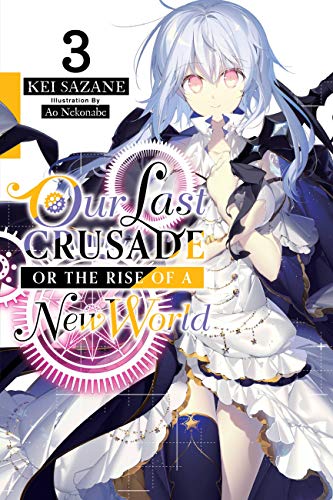
Our Last Crusade or the Rise of a New World, Vol. 3

By Kei Sazane and Ao Nekonabe. Released in Japan as “Kimi to Boku no Saigo no Senjou, Aruiwa Sekai ga Hajimaru Seisen” by Fujimi Fantasia Bunko. Released in North America by Yen On. Translated by Jan Cash.

Some authors are really good at plotting and worldbuilding. Some succeed at depth of characterization. Some write amazing dialogue. And then there’s Kei Sazane, who does none of those things, but that’s OK, as they have one thing that they do better than most anyone else: crafting cliffhangers that make a reader want to get the next book. I spent most of the second volume of this series thinking I would drop it after I finished, only for a last-minute plot twist that made me want to read more. Unfortunately, little is made of the plot twist here, mostly as the characters are two-dimensional. And once again I got to the end thinking, “yeah, OK, interesting did not happen, dropping this” only to get an epilogue which made me say, “Hrngh, now I want to know what happens next.” It’s a praiseworthy skill, and very well done. Of course, I wish that the skills had been used on a better light novel series.

Last volume ended with the revelation that Iska’s captain and designated dojikko Mismis now had an astral crest after basically falling in a pit of magic. So they have to figure out a way to keep it hidden so that she’s not imprisoned for life at best and executed at worst. I suspect skin-colored bandages, tried here, are not going to work well. It doesn’t help that, aside from one or two flashes of actually being a commander, Mismis is a fluffhead of the first order. (The author loves to write those types – more on this later.) Fortunately, they have a reason for her to be away from the Empire and using an Astral Crest – they have to infiltrate the enemy territory. Unfortunately, everything goes south when, for once, it’s Iska who gets to be the designated idiot, sipping a drugged drink provided by Alice’s maid and now taken prisoner in the hideous… honeymoon suite of a first-class hotel.

Last time Alice and Iska never met up, this time they’re together most of the book. It’s not really a great thing for Alice, as, like Mismis, the author loves to write her as a fluffhead, in this case a girl in love who doesn’t actually realize it. The ‘kidnapping’ wasn’t her idea, and she prefers to settle things on the battlefield in a one-on-one fight, of course. Unfortunately, the Empire is also trying to break out a top security prisoner (who is basically Gilgamesh from Fate/Stay Night only with magic instead of swords), and so everyone needs to rush off and stop everything ending in fire. Including Iska, who is, of course, also slowly falling for Alice in his own stoic lunkhead sort of way. Both Iska and Alice excel at combat scenes, where they’re both allowed to be ridiculously overpowered and cool, rather than enacting A Child’s Garden of Romeo and Juliet Scenes.

There’s no actual bad scenes or writing here – everything is very competent but empty, and reminds me a lot of Strike the Blood or Asterisk War in that it feels like it was written as a novelization of an anime. The main cast are all pretty likeable, and as I said, there’s a great cliffhanger that will probably make me read the 4th book in the series. I’ll be grumbling as I do, though.

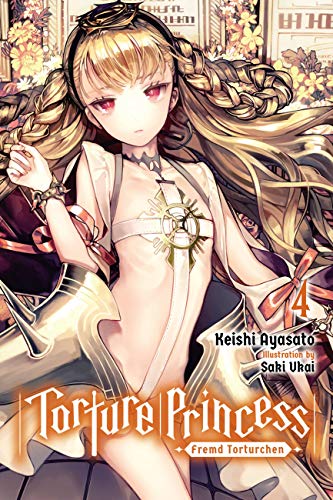
Torture Princess: Fremd Torturchen, Vol. 4

By Keishi Ayasato and Saki Ukai. Released in Japan as “Isekai Goumon Hime” by MF Bunko J. Released in North America Yen On. Translated by Nathaniel Hiroshi Thrasher.

I had mentioned that I was reading this new volume on Twitter, and someone replied to me “isn’t that just torture porn?”. It’s a reasonable question, given the title of the series and a good deal of the content. This fourth volume has slightly less grotesquery than previous ones, but that’s only by degree: there’s still many scenes here meant to disgust you. That said, I would argue it isn’t torture porn for the good reason that anyone reading this series ONLY for the gore is bound to be disappointed. The start of this book delves into mystery briefly, as Kaito and Hime try to discover what or who is slaughtering villages of beastmen. The end of the book, meanwhile, opens the Pandora’s Box of its lore and mythology, showing us that there’s far more disturbing creation myths than we really expected. The gore is there to drive the plot like all the other elements. And, once again, we have a book that is well-written if a bit off-putting because, well, intestines.

There’s also, surprise!, another Torture Princess, who we see on the cover here. Fate/Zero fans may have a head start on this one, though fortunately she doesn’t (so far) share her historical namesake’s fetishes. Jeanne de Rais was created much as Elisabeth Le Fanu was, only her sacrifices were 100% consensual. She’s thought to be the one behind the village massacres, but it turns out to be far more complex than that. She actually ends up being more of a guide/mentor figure, gathering everyone to a place the Church does not want to be seen and then showing them all what’s inside. She’s a fun new villain, though her method of speech takes some getting used to; half the time she sounds emotionless, the other half she talks like a foul-mouthed cowboy.

As for the others, well, fans of Subaru and Rem who want them to get it on will want to read this one, which may be as close as you’re going to get. (it does cut away before coitus ensues, so those reading for THAT will also be disappointed.) Kaito and Elisabeth continue to get very angry with each other for trying to sacrifice themselves so the other can live on, in a way that is half heartwarming and half hilarious. Izabella continues to be a trope that Japan loves, which is the one true believer in an increasingly corrupt Church. Sadly, she’s having a very bad last few weeks. And then there’s the Butcher, who has sort of been a comedy relief figure so far in the series, but here is shown to have a FAR larger role in everything that’s occurring, being a sort of combination of Judas and Mary Magdalene. I wonder what he’ll be doing going forward.

The book ends with a series of revelations about the world’s past religious history, and I suspect that the next book will involve the Church condemning absolutely everyone who found out about it to, well, torture. that said, with Elisabeth AND Jeanne on the same side, I doubt they’ll get far. Torture Princess can be grotesque, and is not for the faint of heart, but it’s far more than mere torture porn.