Monthly Archives: July 2020

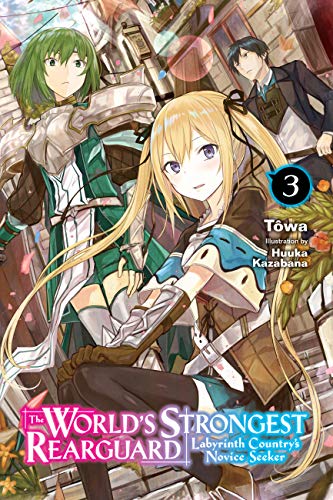
The World’s Strongest Rearguard: Labyrinth Country’s Novice Seeker, Vol. 3

By Tôwa and Huuka Kazabana. Released in Japan as “Sekai Saikyou no Kouei: Meikyuukoku no Shinjin Tansakusha” by Kadokawa Books. Released in North America by Yen On. Translated by Jordan Taylor.

Tempting as it might be to simply cut and paste my review of the second volume here, I will try to find new words to say about this series. For one thing, I think I’m going to have to come to terms with the fact that I enjoy it quite a bit, and not just because I’m hate-reading it. It’s still not a good series objectively, but subjectively it’s fine. It reminds me quite a bit of In Another World with My Smartphone, but so far has avoided all the traps that that work fell into, such as making its hero something of a relaxed sociopath. Arihito continues to attract women, and continues to be relatively oblivious to their overtures towards him. It’s a relatively huge light novel which takes place over a mere day and a half, and there’s still stats galore, including picking out new bonuses, etc. It should be dull as dirt and mildly offensive. Instead… it’s peaceful.
Arihito’s party (still unnamed, which is brought up but not dealt with here) arrive on Level 7, which has a lot more people on it but also a lot more people who have essentially stopped trying – it’s hard to go from 7 to 6. Well, hard unless you’re our heroes, who over the course of this book defeat two of the three named monsters you need to move up. They soon team up with a four-woman group called the Four Seasons (a name pun) who they saw being harassed/blackmailed by a group that are being set up to be antagonists but in this book are mostly just foreshadowing. The two parties team up and fight off giant moles and insects, then go to the next dungeon level and battle killer sheep. Once again, everyone does amazing things, and once again, everyone feels as if they need to “be the one protecting” everyone else. All this, plus a nice Chinese dinner and a bath/massage.

Reading this series is sort of like reading a game of Jenga, because it would take only one wrong move for the whole thing to come tumbling down. Arihito has to remain self-deprecating and mild-mannered because the alternative is a leering guy banging his (by the end of this book) eleven women who have fallen for him. Likewise, they’re all perfectly content to simply make the occasional overture (that he doesn’t get) and have a few bouts of self-hatred themselves. The battles are very well-written, to the point where I don’t even mind the inserted stats, which says a lot. I will admit that, in a book trying to remain so emotionally placid, sometimes it aims for a tearjerker and doesn’t quite get it – the scene with the demihuman and his late fiancee was not quite as sad as the author meant it to be. But for the most part, there aren’t really any sharp edges in this. It’s an isekai that a salaryman can happily read on the train home.

As noted, this volume does introduce a few plot points that are then left dangling – I expect the next book will take care of that. At least they didn’t move to Level 6 already. Still, this remains a book that’s easy to read.

The Invincible Shovel, Vol. 2

By Yasohachi Tsuchise and Hagure Yuuki. Released in Japan as “Scoop Musou: “Scoop Hadouhou!” (`・ω・´)♂〓〓〓〓★(゜Д゜ ;;) .:∴DOGOoo” by MF Bunko J. Released in North America by Seven Seas. Translated by Elliot Ryoga.

It should not come as too much of a surprise to find that this second volume is not quite as funny as the first. The Invincible Shovel has a few choice gags that it hammers on with the subtlety of a truck hitting an isekai protagonist, And so the element of surprise is gone here. That said, this ended up being funnier than I expected, particularly as it went along. We meet a couple more heroines who add themselves to the uninterested Alan’s not-quite-harem, including a ditzy sage and a sheltered princess, everyone misunderstands things in a sexual way due to the use of ‘shovel’ to mean absolutely everything, and we get somewhat incrementally closer to finishing the quest, as there’s a mid-range boss to defeat and we get a glimpse of the big bad. And then there’s Lithisia, who definitely levels up in this book… in both good and bad ways. Alan may be the OP hero, but in the end Lithisia is the most terrifying.

I’d mentioned in my review of the first volume that the word ‘shovel’ was used 703 times, and in this second book it’s 880. Note that we don’t really get variations – at one point an illustration shows Lithisia is clearly holding a trowel, but it’s referred to as a shovel, and we don’t see spade or other types either. This is deliberate, both for the comedy – the overuse of the word, especially from Lithisia inventing new words including it, is ridiculous – but it’s also meant to be exhausting, to leave the reader so drowning in shovels that they just learn to let it roll over them. We feel much like Catria, the sole voice of reason in this title, who wants things to make sense but is constantly cursed by Alan using his shovel to make instant tunnels through gigantic mountains, remove a memory block to help someone recall their past, and force the villain to confess his evil deeds by literally digging his own grave.

As for Lithisia, I will admit that I did get very tired of her constant horniness, which ends up carrying over to the other characters. The idea of ‘shovel’ meaning sex… or, frequently in this book, masturbation, as Alan says that they can learn to shovel better by themselves, is the sort of thing that’s mostly interesting to 15-year-old boys. Fortunately, there’s more to her than that… in a somewhat scary way. Lithisia devoting herself to the Way of the Shovel is funny, but Lithisia being able to brainwash others to the same vision is alarming. The shovel is gaining more and more followers, though as a worried Alan notes, they don’t actually have the shovel superpowers that she assumes come with the job. This actually has a serious core at its deluded center: she’s afraid that when the quest is over, Alan will leave her, and so vows to TAKE OVER THE WORLD! to ensure she remains by his side. It’s… sweet? In a way?

As I said earlier, your enjoyment of this title may end up being how tolerant you are of the word ‘shovel’ and the female cast being horny on main most of the time. But it’s still gloriously silly enough that I’ll be shoveling the next book. Um, reading. I meant reading. Shovel.

A Wild Last Boss Appeared!, Vol. 1

By Firehead and YahaKo. Released in Japan by Earth Star Novels. Released in North America by J-Novel Club. Translated by Kevin Chen.

Sometimes you get books where the concept is drab and you’ve seen it before, but the execution is excellent, and sometimes you get novels with a great concept that can’t quite pull it off. This comes closer to the second type, which may surprise readers given that it’s another “Japanese gamer is pulled into his game world” sort of book. But there are intriguing things going on here. It’s sort of reminiscent of Overlord, in that we have a gamer who arrives in his game world as the villain he created, complete with minions (most of whom have to be tracked down, admittedly) and whose self of self is being somewhat overlaid with the character. That said, this book does not seem to be nearly as dark as Overlord gets. It’s just Lufas getting used to being back in the world (which is 200 years later), getting used to being a woman (the gamer who created her was male), and getting used to being far, far more powerful than everyone else. Does it work? Somewhat.

As noted, our hero is a gamer who played a fun MMORPG (she’s the blonde on the cover, not the blue-haired girl), taking on a character who ended up playing the role of the villain. She was taken down by seven heroes in a massive battle (which the gamer was totally in on, this was a controlled event) and killed off. Suddenly the gamer finds himself in what appears to be that world, two hundred years later, summoned as part of a botched spell to summon a hero. Lufus has no interest in dealing with the folks who summoned her (the character is a woman, something that actually has a lot less relevance than you’d expect) and so goes back to her old Dark Tower, which she finds is rather decrepit but still standing. It also has her minion and expodump girl Dina, who Lufas created as an NPC and then forgot about, but who can helpfully explain what’s happened since Lufas’ death. She decides to round up her twelve monster companions, which first involves talking one of them down from his roaring rampage of revenge.

There are interesting things going on here. The gamer’s memories and Lufas’ have sort of melded together, and as the book goes on the relevance of “this is a game I played in Japan” lessens, which is interesting. To my surprise, the book also has virtually no fanservice at all, and in fact Lufas notes that she doesn’t really feel any desires for women anymore – or men, for that matter. This does, admittedly, make you wonder why the gender bender was conceived of to begin with, except that Lufas looks really beautiful. There’s also some foreshadowing that one of the characters is not what they seem, and it’s handled very deftly. I am rather relieved that the book slowly starts to drop the gamer stuff as it goes along, as the gamer sometimes uses vocab and ideas that make me suspect he was one of those basic sexist Japanese guys. More to the point, while I appreciate that it has a long game in mind, the book meanders. It’s not meant to be a slow life title, but sure feels like one at times, especially when Lufas is doing things like making Golem Winnebagos.

So I’d say that the series has not quite gelled yet. That said, it’s interesting enough that I’ll read more, and folks who (have I said this a lot in my reviews lately?) don’t mind overpowered heroes will find something to enjoy here.