Monthly Archives: July 2021

A Certain Scientific Railgun, Vol. 16

By Kazuma Kamachi and Motoi Fuyukawa. Released in Japan as “Toaru Kagaku no Railgun” by ASCII Media Works, serialization ongoing in the magazine Dengeki Daioh. Released in North America by Seven Seas. Translated by Nan Rymer.

The beloved and sadly very out of print Even a Monkey Can Draw Manga had one of its chapters dedicated to the subject of “power creep” in shonen manga, which Railgun definitely falls under, despite its magazine technically falling under the seinen umbrella. (Dengeki Daioh’s readership is basically “otaku, of any genre”.) If you have a bad guy that you defeat, then the next villain has to be slightly more powerful, and so on and so forth till you’re eventually fighting against the biggest threat in the entire universe, and it all gets a bit silly. Railgun has that issue, but not for its villains – instead, it’s the heroines who struggle with it. We’ve already seen Misaka nearly go out of control when they tried to force her to evolve to Level 6. Now here we see Uiharu, who is supposedly a Level 1 “thermos”, force-evolving her hacking powers to literally rewrite reality in order to save the day, which… I suspect we won’t be seeing down the road.
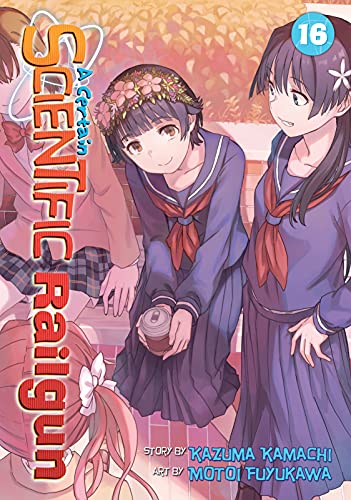
Of course, that is not the only thing that Uiharu does in this volume. This is her arc, after all, and after spending most of the last volume on ice, she’s back in command here, showing us the same strength that allowed her to stare down Kakine and suffer only a broken collarbone. We even see her – gasp! – use her ability, rather than her hacking, in order to escape from her guards, and it’s a very clever usage as well. That said, the bad guys also know what her weak spot is. Railgun’s yuri poster child may be Kuroko, but I suspect the number of fans who think Misaka and Kuroko will end up together is zero. But Uiharu and Saten have just as much if not more subtext, and this volume really hammers it home. Uiharu is so dedicated to Saten that she’ll suffer great pains to get to her. And when told Saten has been fatally poisoned, Uiharu almost turns evil, to the point where she is literally just a cloud of blackness… until Saten, who is dying but not dead, snaps her out of it, saying that’s not the path she should follow. The Fullmetal Alchemist fan in me was recalling a similar scene, let me tell you.

On the down side, it’s not that I dislike any of the young kids who are being forced by Academy City’s evil science department to become supervillains, it’s just… we’ve seen this backstory about eight different times in Railgun alone, and it’s hard not to have the first thing I think be “here we go again”. Honestly, it’s something of a wonder that Mikoto ended up as well-adjusted as she is, and she’s the one with a super fiery temper. The other problem is that the arc doesn’t end in this book – there’s one epilogue chapter to go… which means we’ll have to wait till (presumably) 2022 to see if Saten survived (signs point to yes) and if Uiharu remains the most powerful being in the world (signs point to no). That said, this volume is quite strong and fans of the series should love it.
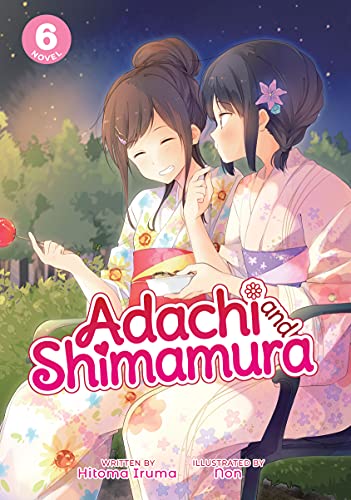
Adachi and Shimamura, Vol. 6

By Hitoma Iruma and Non. Released in Japan by Dengeki Bunko. Released in North America by Seven Seas. Translated by Molly Lee.

(I try not to spoil much, but honestly, if you read this you’ll guess what happens in it. Be warned.)

I’ve spent five volumes talking about Shimamura and her tendency to try not to feel too hard about things, which contrasts nicely with Adachi’s feeling very, very hard about everything… well, everything to do with Shimamura, that is. And if there’s any change that’s going to be happening, it’s going to have to be from Shimamura herself. Honestly, Adachi is expending all her energy not simply exploding in a giant cloud of gay. That said, good news: this is a big breakthrough volume for Shimamura, and probably the one that deals with her and her emotional reserve best. I don’t know that it works as well as it should – the author really relies on the reader connecting a lot of dots, and sometimes I don’t think they connect – but by the end of the book Shimamura is far more willing to reach out and deal with everything, including Adachi. Especially Adachi. Shimamura may not have worked out how she feels about Adachi just yet, but she’s definitely stopped ignoring the fact that Adachi is madly in love with her.

Sadly for Adachi, the first half of the book has Shimamura going to her grandparent’s place out in the country, so she’s going to have to suffer for a while on her own. Going back there, a place she’s spent many summers, fills Shimamura with memories, especially since the puppy which she played with when she was a little girl is now old and having trouble moving around like they used to. This causes Shimamura to think hard about her life, in particular the way that she’s chosen to close herself off from caring too much recently. When she returns (the return is the highlight of the book, for reasons I won’t spoil), she’s quick to phone Adachi, and they then agree to go out to another festival (I mean, it’s summer in Japan, there is always a festival somewhere). Oh yes, and before that they bathed together, which was… weird, but also led to Adachi confessing when she overheated. Will Shimamura finally face this fact and give Adachi a response? And will the response be something other than “well, OK, whatever”?

First off, I am spoiling one thing that does NOT happen in the book – the entire front of the book is setting the reader up for the dog to die. Hell, every time Shimamura sees the dog she herself is thinking that it’s going to be dead. But Adachi and Shimamura did not win the Newbery Medal, and therefore the dog does not die. I was relieved. As for Adachi and Shimamura, well, this is a turning point, certainly. I’m not sure it’s necessarily a good move all around – Adachi is worse than ever this volume, and I think if they ever animate it she’s going to have to simply be vibrating in place by the end. Shimamura has made great strides, and I was actually impressed with her through most of the book, but her response to Adachi still is more “sure, we’ll try that” rather than a big emotional investment. Which makes sense – honestly, even getting a small emotional investment is a victory.

So how will things progress from here? Will it be cute and teen romancey, or will it get realistic and have everything fly apart because these two are far too emotionally scattered to really connect right now? Still, Shimamura trying is infinitely better than the Shimamura we’ve had until now, so I’m in favor overall.

So I’m a Spider, So What?, Vol. 12

By Okina Baba and Tsukasa Kiryu. Released in Japan as “Kumo Desu ga, Nani ka?” by Kadokawa Books. Released in North America by Yen On. Translated by Jenny McKeon.

With this volume we have almost, but not quite, caught up with Shun’s “present” that we left off in the 6th volume. This book is the huge human/demon war that led to Shun becoming the Hero, with huge casualties on both sides. The book is essentially a war diary from various points of view, showing off the various battles going on around the world. We see the demons use revenge monkeys to completely destroy one fort; another demon army wiped out by Ronandt’s long-range magic; the cute childhood friend couple from Japan being a cute childhood friend adventurer couple here; Sophia saying “well, well, well, if it isn’t the consequences of my own actions”; Wrath basically winning easily; and the big final battle with Julius versus several demons, including Bloe and Agner, and White trying to cut the thread (so to speak) by bringing in a Queen Taratect to ruin everything. Which it does, but not quite in the way that she’d planned…

I talked about this last time as well, but I think the author has been trying their best to make sure that the reader cares about the human side and the demon side equally, and from what I’ve seen, that’s just not happening. In fact, honestly, the readers don’t want to see the demon side EITHER. The readers want spider. Lots of spider. Sorry to say, White is still a minor character in this book. She gets cute little sidebars explaining each battlefield in her usual hyperactive way, and we see her interactions with the demon lord, Bloe, and Sophia and the 10th unit. None of them really see White as we know her, though I think the demon lord is starting to figure it out. She’s also getting far more talkative and better at actually explaining her actions. Basically, White is maturing. This will be handy when they inevitably run into the giant pile of reincarnations we left off with ages ago, but can be frustrating right now.

The battles are well handled. As you might guess, this is mostly tragedy… with one exception. The story of Sophia’s adventures at school, complete with her version of the handsome jerk and the class president, are absolutely hilarious, especially given they all end up in the same military unit anyway. I hope we see more of them being absolute bitches at each other. And as I hinted above, everything about Kunihiko and Asaka’s relationship is adorable and heartwarming, and I don’t THINK they’re dead yet… (crosses fingers). But there’s lots of depressing stuff we knew was coming here, as all but one of the hero party gets wiped out, and it also takes out several major parts of the demon party as well. What’s more the demon lord and White didn’t even achieve their main objective – the one-kill anything sword is still around, and can now be used by the new hero against the demon lord. Annoying, that.

This is an excellent book, but the overall impression I get at the end is “can we PLEASE get back to the main storyline we started in Volume 1?”. Recommended for those who like war memoirs and cute lovesick girls getting crushed to death by giant spiders.